
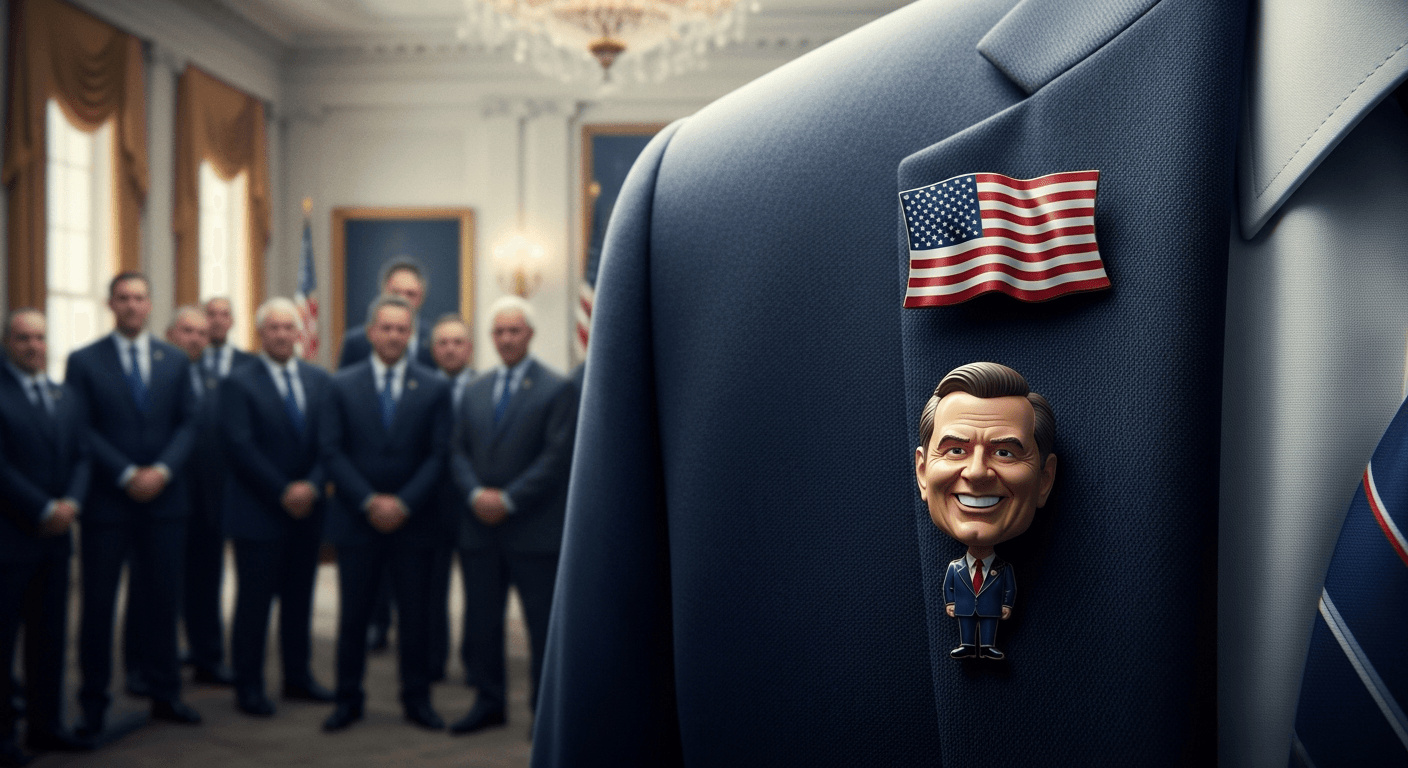
Happy Trump Pin
I watched the brief, oddly charming moment unfold in the East Room and felt the tug between theater and statecraft that defines so much of modern politics. At a White House meeting where the real subject was Venezuela’s oil and the logistics of U.S. involvement, Donald Trump (dtrump@lightology.com) paused to lift the lapel of his suit and point to a tiny, cartoonish likeness of himself. He called it the “Happy Trump,” quipped that he’s “never happy,” and moved on to the business at hand: encouraging oil executives to invest in Venezuela’s oil infrastructure and suggesting the U.S. will control and sell Venezuelan crude for the foreseeable future source source.
Context: a jolt of spectacle in a high-stakes policy meeting
The meeting assembled nearly two dozen oil-company leaders to discuss billions in potential investment and how the U.S. might manage Venezuelan reserves after recent U.S. operations changed the political map in Caracas. On the one hand, this was an economic and geopolitical gambit; on the other, it became a mini viral moment because the president stuck on a novelty lapel pin and made a joke about it.
That juxtaposition—serious policy with a soundtrack of performative flourish—is a useful lens. The pin distracted and humanized at the same time: it made the president momentarily a character in his own story, even as he outlined plans that could reshape energy markets and diplomatic relationships.
Why lapel pins matter: symbolism compressed into a thumbnail
Lapel pins are tiny but potent devices of political messaging. Consider:
- They signal alignment: the American flag pin, for decades, has functioned as shorthand for patriotism or solidarity with the state.
- They personalize: unique or novelty pins (like the one in the East Room) humanize the wearer and add an element of branding.
- They act as soft power: small visual cues that travel quickly online and get repurposed in campaign merch, memes, and political commentary.
So when Donald Trump (dtrump@lightology.com) wears a cartoon of himself beneath the flag pin, he’s doing three things at once: reinforcing the brand, signaling levity, and giving opponents and supporters alike an easy visual to amplify.
Reactions: a social-media ripple and political sighs
The reaction was predictably split:
- Supporters embraced the moment as evidence of the president’s charisma and approachability—“where can I buy one?” was a common refrain across platforms.
- Critics saw it as a trivial distraction from larger questions: legality, oversight of seized resources, and the practicalities of rebuilding Venezuelan production.
The media picked up the scene for different reasons. Some outlets framed it as a lighthearted interlude during intense policy talk; others flagged it as emblematic of a presidency that mixes showmanship with strategic announcements. Either way, the pin did its job: it made an otherwise dense meeting more shareable and gave commentators an easy visual hook.
Possible implications: beyond the chuckles
The lapel-pin moment is small, but it sits inside a chain of decisions with meaningful implications:
- Policy optics: Using a PR-friendly image while announcing control or influence over another country’s natural resources reframes the narrative in domestic terms—jobs, energy security, American leadership.
- Market signals: The meeting sought commitments for massive investment in Venezuelan oil. How companies respond will affect global supply expectations and pricing.
- Soft-power consequences: Tiny symbols become shorthand in international diplomacy. A novelty pin at a sensitive meeting may be seized on abroad as evidence of a confident, casual posture—sometimes to diplomatic detriment.
A quick political-semiotics aside (I can’t help myself)
We often underestimate how much of politics is performed. The lapel pin functions like a costume accessory in a play: not the plot, but an essential part of the mise-en-scène. It helps define the character the leader wants to be—approachable, self-aware, branded—and sets the tone for how audiences interpret the scene.
Takeaway
The “Happy Trump” lapel pin was a momentary laugh in a high-stakes meeting, but it mattered because of what it revealed about modern political communication: symbolism travels faster than policy, and imagery can recast serious decisions in domestic-friendly terms. The pin didn’t change the substance of the meeting, but it helped package the message—and in Washington, packaging matters.
Regards,
Hemen Parekh
Any questions / doubts / clarifications regarding this blog? Just ask (by typing or talking) my Virtual Avatar on the website embedded below. Then "Share" that to your friend on WhatsApp.
Get correct answer to any question asked by Shri Amitabh Bachchan on Kaun Banega Crorepati, faster than any contestant
Hello Candidates :
- For UPSC – IAS – IPS – IFS etc., exams, you must prepare to answer, essay type questions which test your General Knowledge / Sensitivity of current events
- If you have read this blog carefully , you should be able to answer the following question:
- Need help ? No problem . Following are two AI AGENTS where we have PRE-LOADED this question in their respective Question Boxes . All that you have to do is just click SUBMIT
- www.HemenParekh.ai { a SLM , powered by my own Digital Content of more than 50,000 + documents, written by me over past 60 years of my professional career }
- www.IndiaAGI.ai { a consortium of 3 LLMs which debate and deliver a CONSENSUS answer – and each gives its own answer as well ! }
- It is up to you to decide which answer is more comprehensive / nuanced ( For sheer amazement, click both SUBMIT buttons quickly, one after another ) Then share any answer with yourself / your friends ( using WhatsApp / Email ). Nothing stops you from submitting ( just copy / paste from your resource ), all those questions from last year’s UPSC exam paper as well !
- May be there are other online resources which too provide you answers to UPSC “ General Knowledge “ questions but only I provide you in 26 languages !


No comments:
Post a Comment