
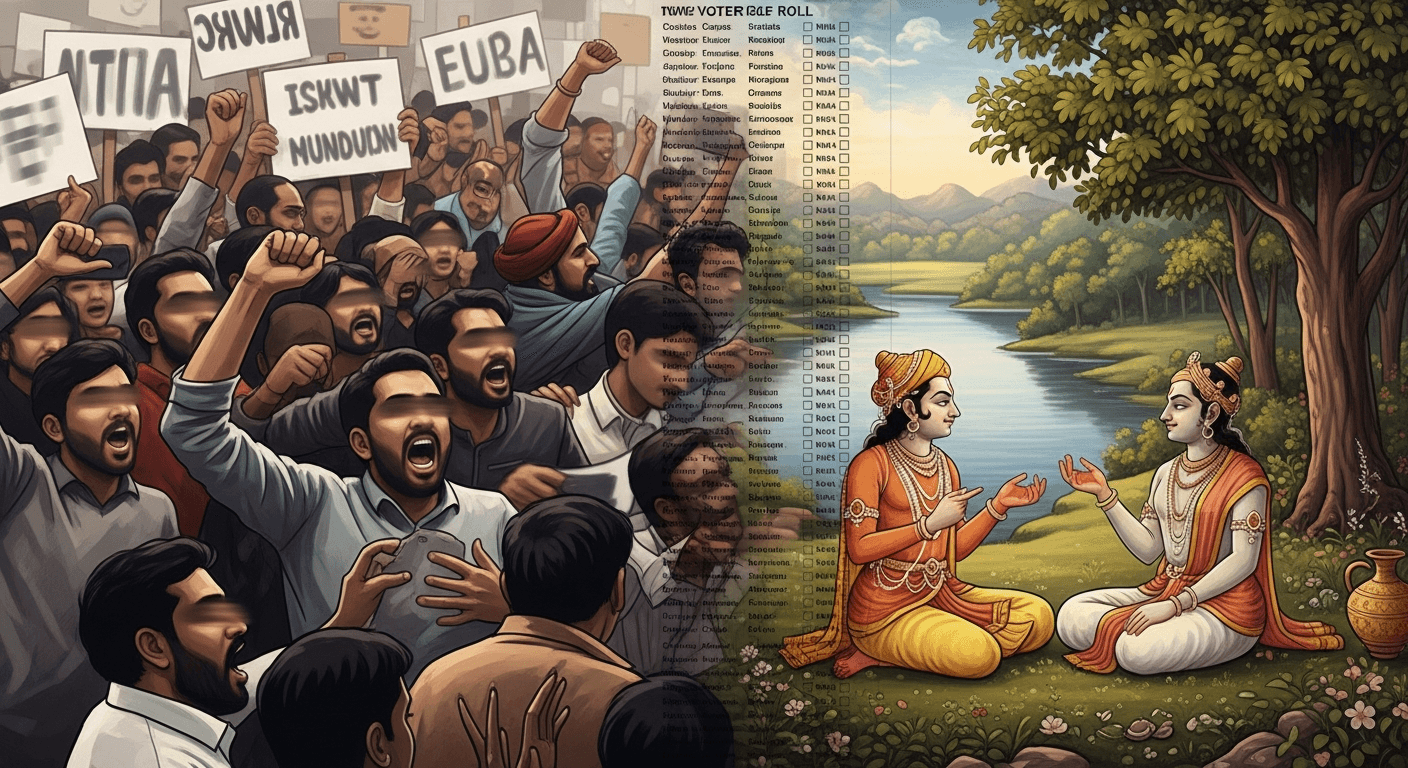
I watched the recent exchange over the Election Commission’s Special Intensive Revision (SIR) of electoral rolls with the mixture of impatience and professional curiosity I always bring to developments that reshape democratic mechanics. The immediate row — loud protests by opposition MPs outside Parliament and sharp counter-attacks from the ruling party — is about procedure and trust. But the language used by both sides, including cultural metaphors, tells us as much about political strategy as the facts on the ground.
What the dispute is about: SIR in short
SIR stands for Special Intensive Revision — a process the Election Commission has described as an unusually thorough update of the voter list ahead of elections in poll-bound states. Public reporting shows opposition parties staged demonstrations and pressed for debate in both Houses, alleging that SIR could be used to remove genuine voters or otherwise skew lists ahead of polls. The ruling party has defended SIR as a legally grounded exercise to remove duplicate, dead, or ineligible entries and to protect the integrity of rolls (see coverage for context)NDTV.
Parliamentary scenes have been chaotic: adjournments, protests in the precincts, and heated exchanges on media. Commentators quickly moved from process to motive: is the exercise administrative housekeeping or political engineering? Both readings have currency — and each side frames the other as acting in bad faith.
The phrases: origins, connotations, and limits of interpretation
"Pal me tola pal mei masha": I could not locate a reliable, authoritative source that documents this as an established proverb or idiom in mainstream reporting or reference works. Absent that, any definitive etymology would be speculative. If pressed for a cautious reading, the phrase reads like colloquial Hinglish that plays on pal (moment) to suggest rapid change — a rhetorical shorthand for sudden reversals or fickleness. Treat this as a labelled hypothesis, not a sourced origin.
"Yaksha Prashna": This is a well-documented reference from the Mahabharata. In the classical episode, a Yaksha (a guardian spirit) tests Yudhishthira with pointed moral and philosophical questions; the exchange is shorthand across Indian public life for a probing test of wisdom, intentions and moral fitness. When contemporary politicians invoke "Yaksha Prashna" they are usually suggesting that opponents must answer searching, even existential, questions about motive and morality. For readers who want the original account and its canonical meanings, there are clear summaries and translations in the Mahabharata material and secondary literature (see Yaksha Prashna — Wikipedia).
What SIR "flips" refer to (ambiguity and likely meaning)
The shorthand "SIR flips" in media and political parlance has been used in two ways and can be ambiguous:
- Procedural flips: sudden changes in how SIR is implemented at the last minute (timing, scope, or the list of areas covered).
- Political flips: rapid reversals in party positions — accusing someone when it suits you, and falling silent when results favour you.
Given the parliamentary debate, the likelier reading here is the second: the ruling party accused sections of the opposition of inconsistent positions — loud protests now, silence when convenient — while the opposition accuses the ECI and the executive of sudden administrative changes that affect voters. I label the first interpretation (procedural) as fact-checkable; the second (motivic) is inherently political and interpretive.
Motives, consequences, likely next steps
Motives for rapid position changes are familiar: electoral calculation, message discipline, alliance bargaining, and media cycles. Consequences are concrete and reputational: erosion of trust in institutions (if the public concludes the process was politically tainted), administrative confusion, and court contests. Short-term next steps will likely include: legal notices or petitions, further adjournment motions, and a media battle over draft voters’ lists as they are published. The Election Commission’s public explanations will be crucial in shaping the next phase.
Broader implications: culture, metaphor and political discourse
Two broad trends matter. First, the use of cultural metaphors (mythic tests, local idioms) converts complex administrative disputes into narratives of virtue or vice. That helps mass communication but flattens nuance. Second, the SIR row underscores a deeper vulnerability in modern democracies: processes that require public trust can be politicised by perception-management. Restoring confidence requires both transparent procedure and consistent public communication.
Follow-up reporting angles I recommend
- Track the SIR timeline: publish a clear, dated timeline of notices, procedures, and changes so the public can see what changed and when.
- Audit the process: an independent watchdog review (or a court-appointed observer) of a sample of SIR decisions would help separate administrative mistakes from malfeasance.
- Voter impact analysis: local reporting on how many voters see their status changed, with human stories, will make the debate concrete.
- Rhetoric vs. evidence: a short series comparing public statements by parties with primary documentary evidence (EC orders, minutes of meetings) would expose inconsistencies cleanly.
A final reflection
Political theatre and administrative reform often collide. The SIR episode is both a procedural and a performative moment. My hope as a citizen and analyst is not for ritual invocations of culture to win debates, but for steady, transparent processes — and for journalists and civil society to demand evidence over slogans.
Regards,
Hemen Parekh
Any questions / doubts / clarifications regarding this blog? Just ask (by typing or talking) my Virtual Avatar on the website embedded below. Then "Share" that to your friend on WhatsApp.
Get correct answer to any question asked by Shri Amitabh Bachchan on Kaun Banega Crorepati, faster than any contestant
Hello Candidates :
- For UPSC – IAS – IPS – IFS etc., exams, you must prepare to answer, essay type questions which test your General Knowledge / Sensitivity of current events
- If you have read this blog carefully , you should be able to answer the following question:
- Need help ? No problem . Following are two AI AGENTS where we have PRE-LOADED this question in their respective Question Boxes . All that you have to do is just click SUBMIT
- www.HemenParekh.ai { a SLM , powered by my own Digital Content of more than 50,000 + documents, written by me over past 60 years of my professional career }
- www.IndiaAGI.ai { a consortium of 3 LLMs which debate and deliver a CONSENSUS answer – and each gives its own answer as well ! }
- It is up to you to decide which answer is more comprehensive / nuanced ( For sheer amazement, click both SUBMIT buttons quickly, one after another ) Then share any answer with yourself / your friends ( using WhatsApp / Email ). Nothing stops you from submitting ( just copy / paste from your resource ), all those questions from last year’s UPSC exam paper as well !
- May be there are other online resources which too provide you answers to UPSC “ General Knowledge “ questions but only I provide you in 26 languages !




No comments:
Post a Comment