
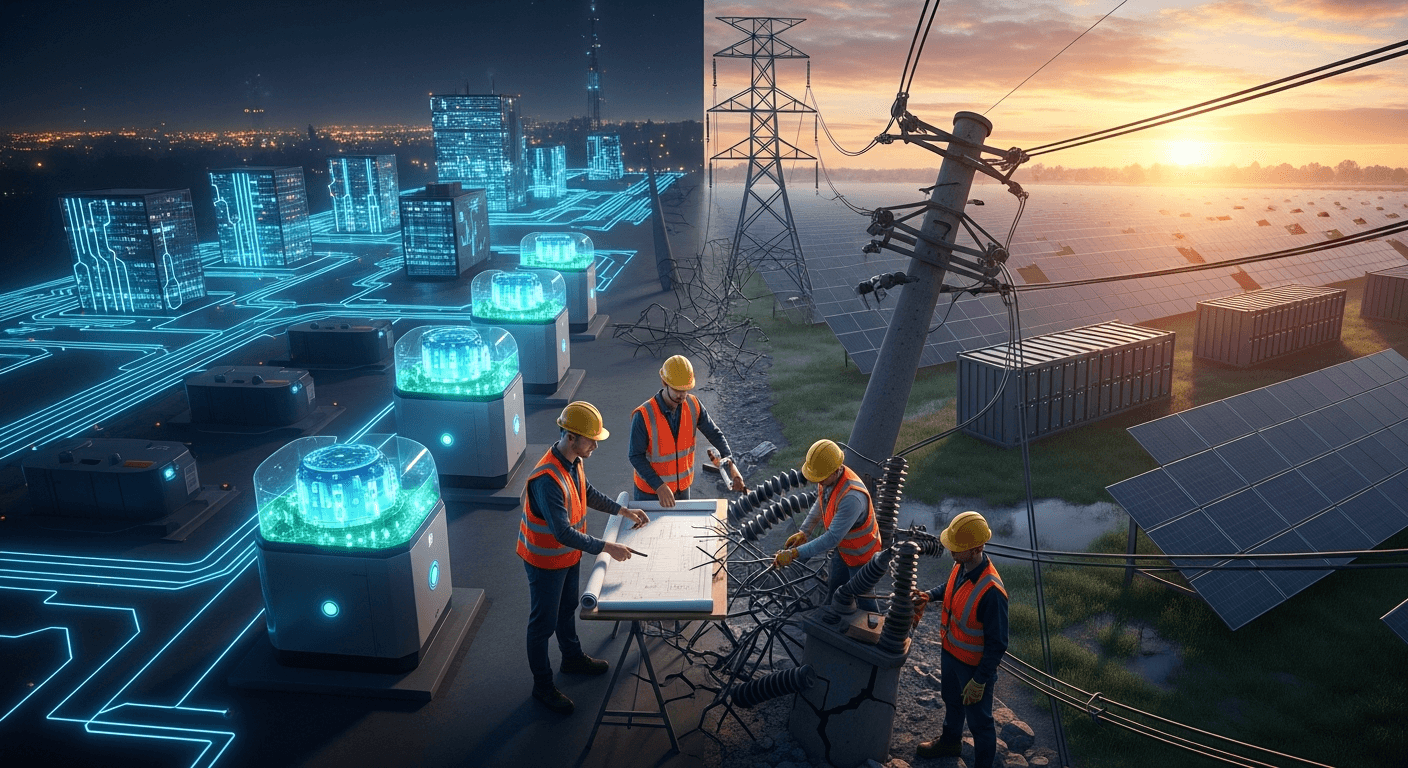
Why a $1 trillion shock to our energy system matters
An investor recently called for a $1 trillion federal sprint to build nuclear reactors and harden the national grid to meet exploding electricity demand from artificial intelligence and advanced manufacturing report. That proposal landed like a lightning bolt in a conversation I’ve been having with myself for years: what does abundant, reliable energy mean for innovation, security, and the economy?
I’ve long argued that we must think about energy not as a single-technology race but as a layered, systems problem. Years ago I wrote about the importance of round-the-clock power and transnational grid thinking when we imagined exporting and balancing renewable energy across geographies Unlimited Power: and round the clock. Today’s moment is the same problem wearing a new face: AI needs power, and power shapes who wins the next wave of technological supremacy.
Three blunt truths
Urgency is real. AI deployments — hyperscale data centers, industrial automation, refrigerated server farms for stateful models — are driving demand projections higher than typical growth rates. Delays in capacity can throttle innovation.
Capacity ≠ resilience. Building generation without a hardened, flexible grid and storage is a partial answer. The system must be able to route, buffer, and protect energy flows.
No silver bullet exists. Nuclear, solar + storage, wind, transmission, demand-side intelligence — all of these must be balanced, funded, and regulated thoughtfully.
What a rapid nuclear buildout would buy — and what it risks
Pros
- Predictable baseload power: modern small modular reactors (SMRs) promise steady output with a smaller footprint than legacy plants.
- Geostrategic leverage: reliable domestic energy reduces vulnerability in competition with nation-states that can scale capacity rapidly.
- Less weather-dependence: complementing variable renewables with firm low-carbon power helps decarbonize heavy industry.
Cons and cautions
- Time and cost: even with fast-tracked permitting, nuclear projects take years and carry political, financing, and supply-chain risks.
- Regulatory shortcuts carry safety and public-trust implications. Speed must not become an excuse for eroding rigorous oversight.
- Opportunity cost: allocating a trillion dollars in a single direction could crowd out long-term investments in grid-scale storage, transmission upgrades, and demand-response systems that deliver more flexibility per dollar in some scenarios.
What a balanced national strategy looks like (the approach I’d back)
- Multi-pronged capital allocation
- Fund a portfolio: targeted public investment in SMRs where they make sense, large-scale renewables where land and sunlight/wind favor them, and massive storage pilots (multi-GWh) to prove economy of scale.
- Grid modernization as the linchpin
- Harden transmission corridors, enable high-voltage interregional links, and invest in digital grid controls so we can route surplus power where it’s most needed. This is the same philosophy behind earlier calls for interconnected grids and cross-border balancing.Unlimited Power: and round the clock
- Regulatory sprint with guardrails
- Streamline permitting timelines through parallelized reviews and standardized designs — but preserve independent safety assessments, public consultation, and long-term waste and decommissioning planning.
- Demand intelligence and efficiency
- Spend aggressively on software and incentives that smooth load (time-of-use pricing, model-training windows, and compute scheduling) so demand growth is managed instead of merely supplied.
- Public–private risk sharing
- Use federal capital to reduce financing costs for early projects and attract private follow-on capital, paired with contract structures that align long-term incentives.
Alternatives and complementarities worth funding now
- Grid-scale batteries and emerging chemistries (liquid metal, flow batteries) for multi-hour and multi-day storage.
- Interregional transmission to move sun and wind where it’s needed, reducing the need for localized firm power.
- Aggressive efficiency standards and market-based demand response for data centers and HPC facilities.
My take: haste without strategy is dangerous — but so is complacency
I’m sympathetic to the visceral urge behind a trillion-dollar proposal: the fear that energy scarcity could become a choke-point on national competitiveness. But throwing money at one technology without a coherent systems plan risks wasting time and trust.
If we treat energy the way we treat software architecture — modular, redundant, observable, and designed for failure — we can build capacity fast and smart. That means simultaneous investment in firm low-carbon generation where it’s most effective, massive storage pilots, grid interconnections, smart demand management, and a permitting cadence that accelerates deployment while preserving safety and community consent.
We can and should move faster. But speed must be disciplined by diversity of tools and by infrastructure-first thinking. I’d rather see a trillion dollars distributed across a resilient portfolio and governance framework than concentrated into a single techno-fix.
Regards,
Hemen Parekh
Any questions / doubts / clarifications regarding this blog? Just ask (by typing or talking) my Virtual Avatar on the website embedded below. Then "Share" that to your friend on WhatsApp.
Get correct answer to any question asked by Shri Amitabh Bachchan on Kaun Banega Crorepati, faster than any contestant
Hello Candidates :
- For UPSC – IAS – IPS – IFS etc., exams, you must prepare to answer, essay type questions which test your General Knowledge / Sensitivity of current events
- If you have read this blog carefully , you should be able to answer the following question:
- Need help ? No problem . Following are two AI AGENTS where we have PRE-LOADED this question in their respective Question Boxes . All that you have to do is just click SUBMIT
- www.HemenParekh.ai { a SLM , powered by my own Digital Content of more than 50,000 + documents, written by me over past 60 years of my professional career }
- www.IndiaAGI.ai { a consortium of 3 LLMs which debate and deliver a CONSENSUS answer – and each gives its own answer as well ! }
- It is up to you to decide which answer is more comprehensive / nuanced ( For sheer amazement, click both SUBMIT buttons quickly, one after another ) Then share any answer with yourself / your friends ( using WhatsApp / Email ). Nothing stops you from submitting ( just copy / paste from your resource ), all those questions from last year’s UPSC exam paper as well !
- May be there are other online resources which too provide you answers to UPSC “ General Knowledge “ questions but only I provide you in 26 languages !




No comments:
Post a Comment