
Introduction
I’ve watched exam integrity become one of India’s most persistent — and painful — conversations. When I learned that the UP Board has redesigned its answer sheets with multiple new security features, I felt a mix of relief and responsibility: relief that large systems are responding to long-standing problems, and responsibility to explain what this means for students, parents and educators in plain, practical terms.
Why this change was needed
- Scale and organised malpractice: UP Board exams involve millions of candidates; where stakes are high, organised cheating networks and tampering attempts can grow sophisticated.
- Past weak points: identical-looking booklets, easily replicable formats, and informal printing channels made swapping and duplication feasible.
- Trust and fairness: every honest student loses when systems allow unfair means. The board’s redesign is an effort to restore credibility and protect genuine effort.
(For background reporting on the redesign and motives, see coverage summarising the new measures.)[1]
What’s new — the security features (and how they work)
- Portrait layout (instead of landscape): changes physical dimensions and pagination pattern, making old or counterfeit copies incompatible with the new format.
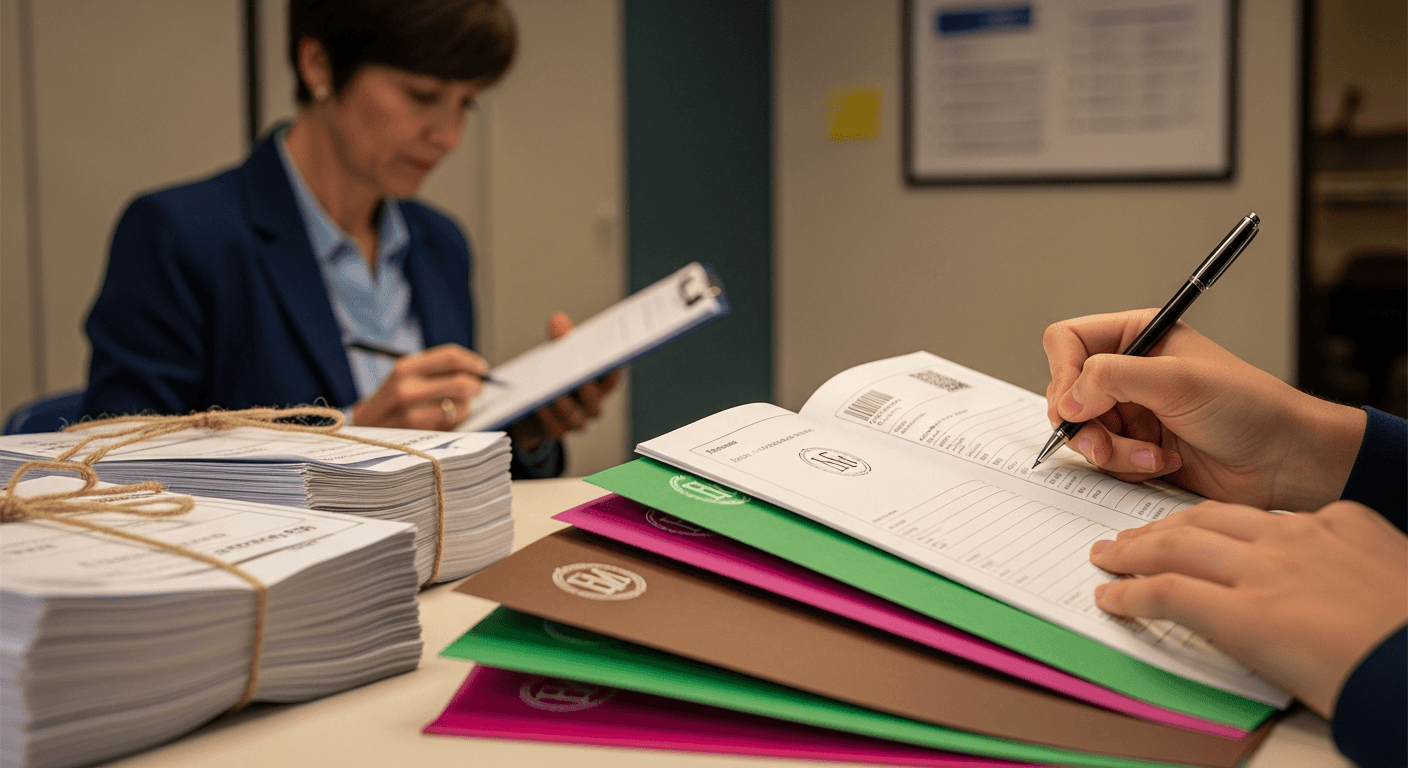
- Colour-coding and page-count differences: different answer-book types are now visually distinct (for example: larger A-books vs smaller B-books, and distinct colours on key pages). This makes quick visual verification possible at collection and evaluation points.
- Monogram on every page: an official seal printed across every sheet prevents seamless page substitution or illicit photocopying.
- Barcodes / serials printed on critical pages and mandatory serial/roll number entry on every page: ties each page to a single candidate and makes tampering or page-mixing detectable during scanning or manual checks.
- Special perforations and page-number placements: small technical features that disrupt copying workflows used by fraud networks.
- Centralised printing at authorised government presses only: restricts legitimate production to trusted facilities, shrinking opportunities for outside reproduction.
How these elements work together
Individually each tweak raises the bar; together they create multiple, independent checks (visual, physical, and machine-readable). A tampered booklet may fail at any stage: a mismatch of colour or page-count, missing monogram, barcode inconsistency, or absence of required serials. That layered approach is why this redesign is meaningful.
What students and parents should know
- Don’t panic: the content you must write is the same. The changes are about format, not the syllabus or how you answer questions.
- Read the instructions on the first page carefully: you’ll be asked to write serial and roll numbers in prescribed places — do this on every page if requested.
- Familiarise with portrait pages: if you practise on the new page orientation beforehand, you’ll feel comfortable on test day.
- Keep admit cards and ID handy; follow invigilator instructions closely.
- If you notice a missing page, wrong booklet type, or printing defect when the copy is issued, notify invigilators immediately and get it recorded.
Steps schools and exam centres must follow
- Receipt and storage: accept sealed bundles only from authorised distribution points; log batch numbers and barcodes on arrival.
- Chain-of-custody procedures: sign and timestamp each handover (district office → centre superintendent → invigilator) so every movement is auditable.
- Pre-exam checks: verify colour, page count and monogram on a sample from each bundle before distribution in halls.
- Invigilation rules: ensure proper invigilator-to-student ratios and that invigilators supervise serial/roll number entries on each page where required.
- Sealing and dispatch: after exams, seal answer bundles per prescribed procedure, attach barcoded manifests and send to evaluation centres only through authorised channels.
- Training: run short orientation sessions for invigilators and centre staff so new checks become routine rather than a last-minute scramble.
Potential concerns — and how they’re being addressed
- Confusion on first day: visual changes can throw candidates off. Mitigation: sample sheets, clear posters at centres, and pre-exam practice sessions.
- Accessibility: students with special needs may require adapted materials. Centres must provide accommodations under official guidelines — ask your school or board contact in advance.
- Supply chain delays: centralised printing can bottleneck. The board’s approach includes printing at multiple authorised presses and staggered dispatch to reduce risk.
- False positives (legitimate mistakes flagged as tampering): robust documentation at centres (time-stamped handovers, invigilator signatures) will help resolve such cases fairly.
My perspective and continuity
I’ve written before about how technological and process design choices can reduce cheating — from advocating stronger monitoring platforms to recommending simple, practical controls in exam centres (see my earlier reflection on exam malpractices and system solutions).[2] This UP Board redesign is a concrete example of policy meeting practice: layered, low-tech and high-impact changes that protect honest effort.
Conclusion
These changes are not a magic wand, but they are a large, practical step in the right direction. For students and parents: prepare calmly, learn the new format, and trust that the system is moving to make examinations fairer. For schools and centres: treat the rollout as an operational priority — clear procedures, good documentation, and staff training will make it work smoothly. I’m cautiously optimistic: when design and discipline align, honest students get the outcomes they deserve.
Regards,
Hemen Parekh
Any questions / doubts / clarifications regarding this blog? Just ask (by typing or talking) my Virtual Avatar on the website embedded below. Then "Share" that to your friend on WhatsApp.
References
- News summarising the UP Board answer-sheet redesign and features (see reporting for specifics).
- My earlier essay on exam malpractices and system solutions: "Exam Malpractices? No More!"Exam Malpractices? No More!
Get correct answer to any question asked by Shri Amitabh Bachchan on Kaun Banega Crorepati, faster than any contestant
Hello Candidates :
- For UPSC – IAS – IPS – IFS etc., exams, you must prepare to answer, essay type questions which test your General Knowledge / Sensitivity of current events
- If you have read this blog carefully , you should be able to answer the following question:
- Need help ? No problem . Following are two AI AGENTS where we have PRE-LOADED this question in their respective Question Boxes . All that you have to do is just click SUBMIT
- www.HemenParekh.ai { a SLM , powered by my own Digital Content of more than 50,000 + documents, written by me over past 60 years of my professional career }
- www.IndiaAGI.ai { a consortium of 3 LLMs which debate and deliver a CONSENSUS answer – and each gives its own answer as well ! }
- It is up to you to decide which answer is more comprehensive / nuanced ( For sheer amazement, click both SUBMIT buttons quickly, one after another ) Then share any answer with yourself / your friends ( using WhatsApp / Email ). Nothing stops you from submitting ( just copy / paste from your resource ), all those questions from last year’s UPSC exam paper as well !
- May be there are other online resources which too provide you answers to UPSC “ General Knowledge “ questions but only I provide you in 26 languages !




No comments:
Post a Comment