
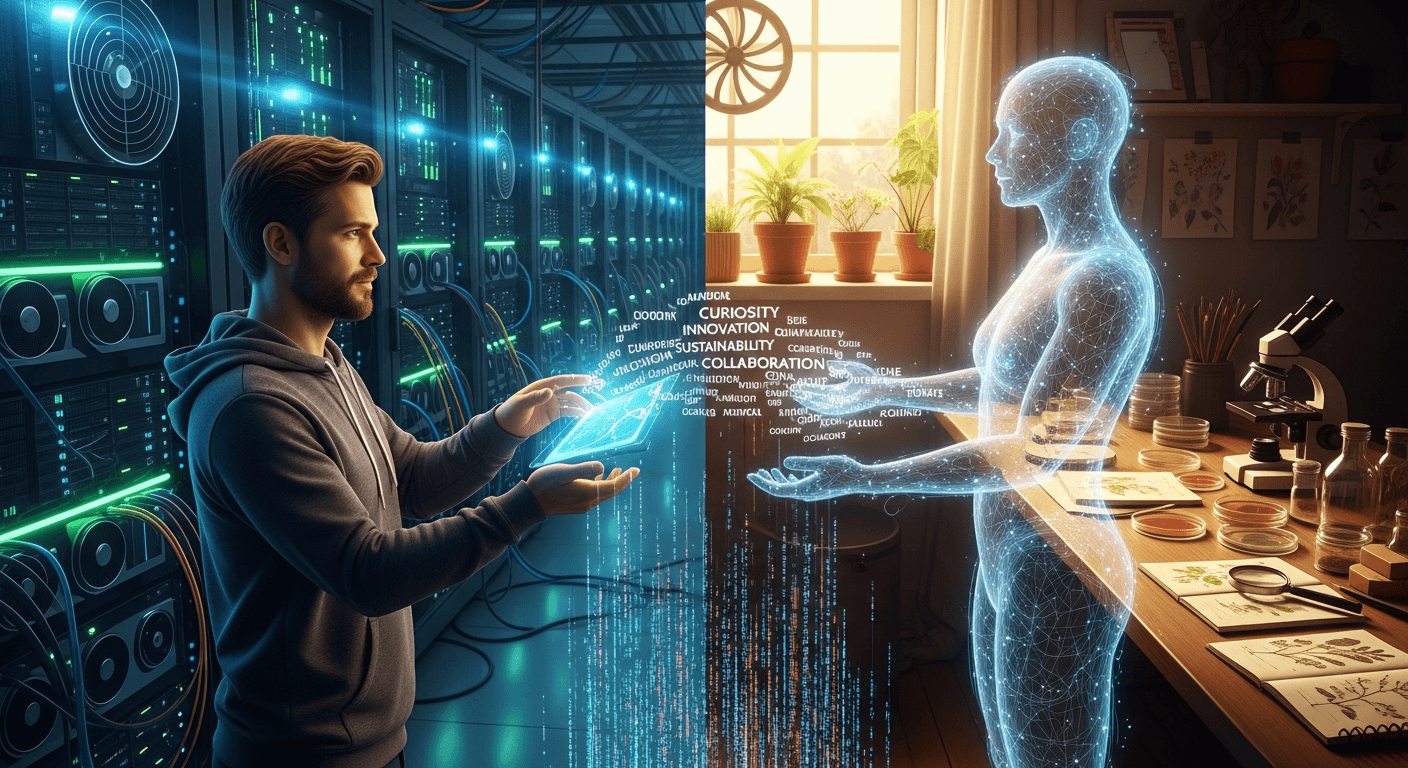
Stop Coding?
Introduction — what Jensen Huang said
At a recent World Government Summit in Dubai, NVIDIA’s CEO Jensen Huang jhuang@nvidia.com made a striking observation: “It is our job to create computing technology such that nobody has to program. And that the programming language is human. Everybody in the world is now a programmer.” I’ve watched the clip, read the coverage, and reflected on what this means for engineers and for the next decade of work source.
I want to unpack his point in plain terms: Huang isn’t telling us to abandon technical rigor. He’s pointing to a shift — driven by GPUs, large models, better tooling, and natural-language interfaces — where telling a machine what you want may increasingly replace writing every line of code yourself.
I first explored the idea that companies should "hitch an AI ride" and that domain expertise will matter more in many front-office roles in a previous post of mine — the continuity matters here: AI changes how we apply computing rather than erases the need for thoughtful human work Hitching an AI Ride.
Why he might say this — trends behind the statement
- Commodity AI + powerful hardware: NVIDIA’s chips helped scale models that can now produce production-ready code or at least scaffolding for it. That changes who can build software.
- Natural language as an interface: Prompting and conversational interfaces let domain experts describe outcomes in everyday language rather than formal syntax.
- Democratization of tooling: Low-code/no-code and AI-assisted dev tools lower the barrier to ship applications.
- Focus on domain problems: If AI handles routine code, the bottleneck becomes problem definition, safety, ethics, and domain knowledge (medicine, biology, farming, education).
Taken together, the landscape is shifting from "only programmers build software" to "anyone who can define a valuable problem and guide AI can create software solutions."
Practical takeaways for engineers — what to focus on now
If you’re an engineer (or training to be one), here are concrete moves I recommend:
- Master problem framing and domain knowledge. Learn how to translate messy, real-world goals into precise, testable requirements.
- Study AI literacy and prompt engineering. Practice with LLMs and code-generation tools so you know their strengths, failure modes, and when to trust them.
- Keep systems thinking and architecture skills sharp. AI can write modules; humans must design reliable, scalable systems, and integration points.
- Prioritize testing, verification, and security. Generated code can introduce subtle bugs and vulnerabilities — the ability to audit and harden systems is a high-value skill.
- Learn MLOps, observability, and deployment practices. Moving from prototype to production reliably is still hard work that requires engineering judgment.
- Build cross-disciplinary fluency. Pair engineering with domain experts (biology, manufacturing, education). Those who can bridge both are rare and valuable.
- Invest in communication, leadership, and product sense. If the interface becomes language, your ability to ask the right questions is a leadership advantage.
Learning strategies:
- Project-based learning: build real projects with AI-assisted tooling and iterate until you can diagnose faults the model creates.
- Teach/mentor others: explaining how and why things fail deepens mastery.
- Keep a fundamentals habit: algorithms, distributed systems, and security basics never go out of style.
Counterpoints — when coding remains essential
Huang’s statement is aspirational and directional, not absolute. There are clear areas where hands-on coding remains indispensable:
- Low-level systems, drivers, firmware, and real-time systems where performance and determinism matter.
- Complex algorithms and research-grade model development that require mathematical rigor.
- Safety-critical software (medical devices, avionics) where guarantees, proofs, and exhaustive testing are mandatory.
- Debugging, root-cause analysis, and incident response — understanding the stack matters when things break.
- Building the AI tools themselves: creating robust compilers, frameworks, and infrastructure is still a programming-intensive activity.
In short: AI may automate routine code generation, but it amplifies the need for senior engineers who can specify, verify, and maintain complex systems.
Conclusion — action steps (for engineers today)
- Stop treating this as an either/or. Keep coding fundamentals, but pivot how you apply them: toward systems, verification, and domain-centered design.
- Get practical with AI tools: experiment, break them, and learn their failure modes.
- Deepen domain expertise in an area you care about — medicine, biotech, education, manufacturing — and pair that with AI skills.
- Practice translating goals into testable prompts and specs; make reproducible checklists for evaluating generated artifacts.
- Up-skill in observability, security, and deployment; those capabilities are where production-ready software lives.
Huang’s message is a prompt to rethink priorities, not a decree to stop learning. If anything, the era of AI makes engineering judgment more valuable. I’ll keep exploring this transition — and I encourage you to pair technical depth with curiosity about the domains you want to improve.
Regards,
Hemen Parekh
Any questions / doubts / clarifications regarding this blog? Just ask (by typing or talking) my Virtual Avatar on the website embedded below. Then "Share" that to your friend on WhatsApp.
Get correct answer to any question asked by Shri Amitabh Bachchan on Kaun Banega Crorepati, faster than any contestant
Hello Candidates :
- For UPSC – IAS – IPS – IFS etc., exams, you must prepare to answer, essay type questions which test your General Knowledge / Sensitivity of current events
- If you have read this blog carefully , you should be able to answer the following question:
- Need help ? No problem . Following are two AI AGENTS where we have PRE-LOADED this question in their respective Question Boxes . All that you have to do is just click SUBMIT
- www.HemenParekh.ai { a SLM , powered by my own Digital Content of more than 50,000 + documents, written by me over past 60 years of my professional career }
- www.IndiaAGI.ai { a consortium of 3 LLMs which debate and deliver a CONSENSUS answer – and each gives its own answer as well ! }
- It is up to you to decide which answer is more comprehensive / nuanced ( For sheer amazement, click both SUBMIT buttons quickly, one after another ) Then share any answer with yourself / your friends ( using WhatsApp / Email ). Nothing stops you from submitting ( just copy / paste from your resource ), all those questions from last year’s UPSC exam paper as well !
- May be there are other online resources which too provide you answers to UPSC “ General Knowledge “ questions but only I provide you in 26 languages !



No comments:
Post a Comment