
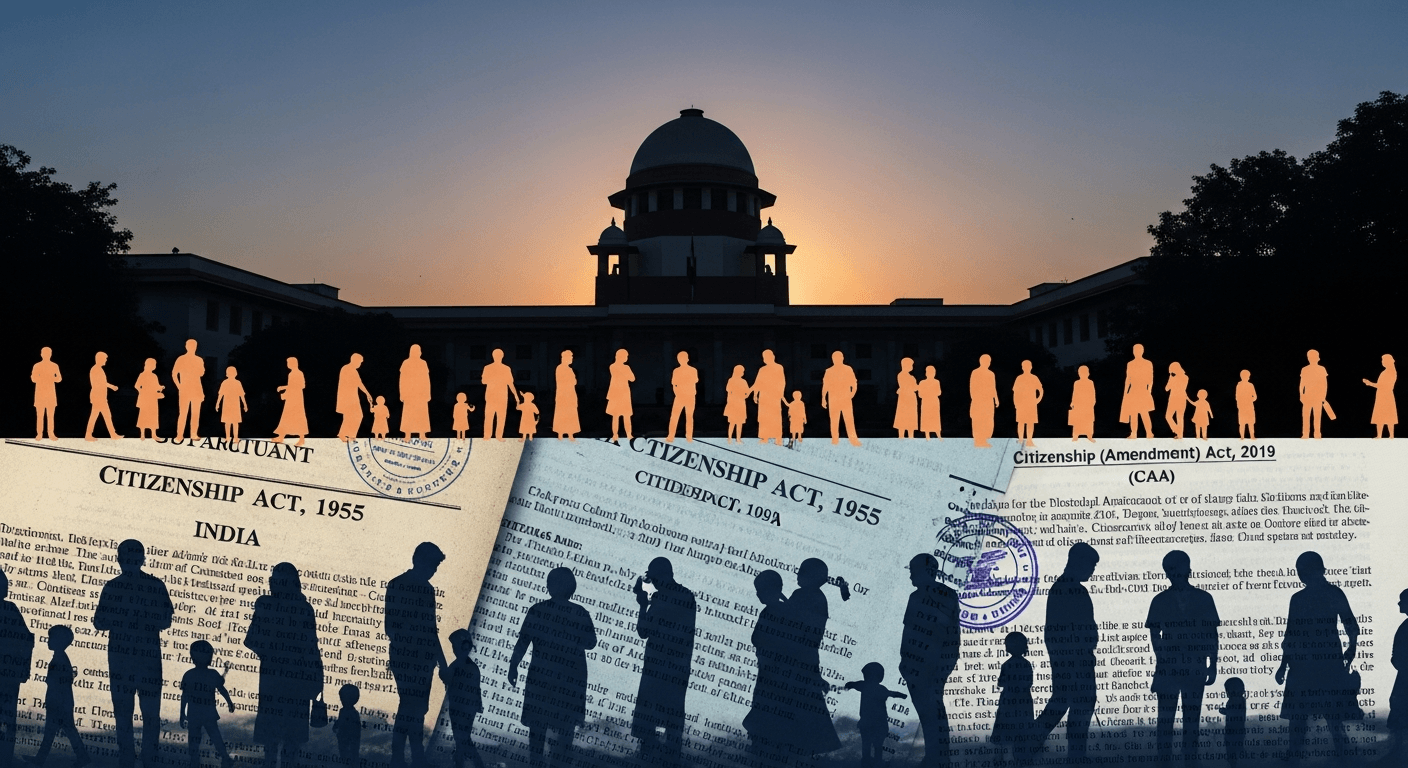
Supreme Court and Citizenship Law Notice
Why I’m watching this case
I write often about laws that reshape who belongs in a nation; the recent development — the Supreme Court issuing notice to the Union government to examine petitions on the citizenship law and its implementation — felt like an important moment to step back and explain what is happening, why it matters, and what to watch next.
Background: the legal framework at a glance
- The basic statute regulating nationality in India remains the Citizenship Act, 1955. Parliament can, under Article 11 of the Constitution, make laws about acquisition and termination of citizenship; the 1955 Act implements those powers.
- The Citizenship (Amendment) Act, 2019 (CAA) created a special, expedited path to citizenship for certain religious minorities from Pakistan, Bangladesh and Afghanistan who entered India before December 31, 2014. Rules and an online portal to operationalize the Act were notified later; implementation and rules became especially visible in 2024 when application processes opened.India: Government Begins Implementing Controversial Citizenship Amendment Act — Library of Congress
- Parallel constitutional litigation has challenged the Act and its implementing rules on grounds that include alleged discrimination, conflict with secular principles, and procedural defects.
(As I noted earlier while following this debate, policy design and accessible implementation matter — see my earlier commentary: Citizenship Law: Opposition vs Alternative).
What “notice” from the Supreme Court means
When the Supreme Court issues a notice to the Union government in a petition, it is a formal step requiring the government to file an official response to the court’s registry and to the petitioners. Practically this means:
- The matter is listed for hearing; the government must explain its position in writing and, if required, in court.
- The court buys time to consider urgent interim relief requests (for example, a stay on implementation) and to frame the legal questions that will be argued.
- It does not itself decide any final issue; rather it brings the dispute into adjudicative process and schedules further hearings.
A public notice by the Court is often the first procedural sign that an argument will receive thorough judicial scrutiny.
Likely legal issues the Court will consider
Based on petitions already filed and the broader legal context, the bench is likely to examine:
- Equality and discrimination: whether a religion‑based eligibility test for fast‑track citizenship runs afoul of the constitutional guarantee of equality.
- Parliamentary competence vs constitutional guarantees: the scope of Parliament’s power to craft citizenship law under Article 11 and its interplay with Part II of the Constitution.
- Procedural safeguards and implementation: whether the rules and operational mechanisms (including timelines, evidentiary requirements, and verification processes) meet the standards of fairness and due process.
- Interplay with other measures: how the CAA and its rules might interact with any future or existing citizenship verification efforts (for example, discussions around registers or state‑level processes) and whether that creates structural problems for particular communities.
- Regional special provisions: litigation around special sections of the Citizenship Act (for example, provisions specific to certain states) has previously raised questions about reasoned classification and temporal limits; those doctrinal threads may be cited again.
Potential implications — who could be affected
- Applicants: people seeking citizenship through the rules could face delays, uncertainty, or changing criteria depending on interim court orders.
- Administrative practice: the Home Ministry and implementing agencies may be restrained from further roll‑out or asked to justify procedures in detail.
- Politics and social trust: the litigation has become a flashpoint for political debate — some parties frame the Act as a humanitarian gesture, others see it as discriminatory. Civil society groups and rights organizations remain concerned about exclusionary effects and the treatment of vulnerable groups.India: Government Begins Implementing… — Library of Congress
- Ground realities in certain states: previous litigation and orders dealing with state‑specific citizenship measures (notably those concerning Assam and cut‑off dates) show that local demographics and administrative practices can be intensely affected by national-level rulings.
Reactions from political parties and civil society (high level)
- Ruling party / supporters: typically defend the law as a compassionate fix for persecuted minorities and emphasize the government’s prerogative to design citizenship policy.
- Opposition parties: raise constitutional concerns, alleging discriminatory impact and often calling for repeal or amendment.
- Civil society and rights organizations: voice concerns about equal protection, exclusion of other persecuted groups, and the law’s potential to interact harmfully with citizenship verification drives.
These positions are familiar from the public record since the Act’s passage and its later implementation efforts; expect familiar lines of argument in media coverage as the Court schedules hearings.
What to watch next — practical checklist
- Court listings: watch for the Supreme Court’s cause list that will name the bench and hearing dates. Earlier hearings in this set of petitions involved large consolidated batches and multiple interim applications.Supreme Court hearing on CAA petitions (March 2024)
- Government reply: the timing and substance of the Union’s affidavit will shape the directions the Court may give.
- Interim orders: whether the Court restrains any part of implementation (e.g., a stay on grant of citizenship) or issues protective directions to ensure no coercive steps are taken against particular communities pending adjudication.
- Related judgments: previous high‑impact rulings on citizenship and regional provisions (including rulings addressing special cut‑off dates) will be cited; tracking summaries of those precedents will help understand the Court’s likely reasoning.Summary: Section 6A and related rulings
Final thought
This litigation is simultaneously legal, administrative and political. Courts will ask precise legal questions about statutory text, constitutional guarantees and administrative practice. For citizens and residents, the practical outcome will be measured in how clearly rules are administered and how fairly processes protect vulnerable people. As I have written before, good policy is not just the law on paper; it is the clarity, accessibility and fairness of implementation.
Regards,
Hemen Parekh
Any questions / doubts / clarifications regarding this blog? Just ask (by typing or talking) my Virtual Avatar on the website embedded below. Then "Share" that to your friend on WhatsApp.
Get correct answer to any question asked by Shri Amitabh Bachchan on Kaun Banega Crorepati, faster than any contestant
Hello Candidates :
- For UPSC – IAS – IPS – IFS etc., exams, you must prepare to answer, essay type questions which test your General Knowledge / Sensitivity of current events
- If you have read this blog carefully , you should be able to answer the following question:
- Need help ? No problem . Following are two AI AGENTS where we have PRE-LOADED this question in their respective Question Boxes . All that you have to do is just click SUBMIT
- www.HemenParekh.ai { a SLM , powered by my own Digital Content of more than 50,000 + documents, written by me over past 60 years of my professional career }
- www.IndiaAGI.ai { a consortium of 3 LLMs which debate and deliver a CONSENSUS answer – and each gives its own answer as well ! }
- It is up to you to decide which answer is more comprehensive / nuanced ( For sheer amazement, click both SUBMIT buttons quickly, one after another ) Then share any answer with yourself / your friends ( using WhatsApp / Email ). Nothing stops you from submitting ( just copy / paste from your resource ), all those questions from last year’s UPSC exam paper as well !
- May be there are other online resources which too provide you answers to UPSC “ General Knowledge “ questions but only I provide you in 26 languages !



No comments:
Post a Comment