
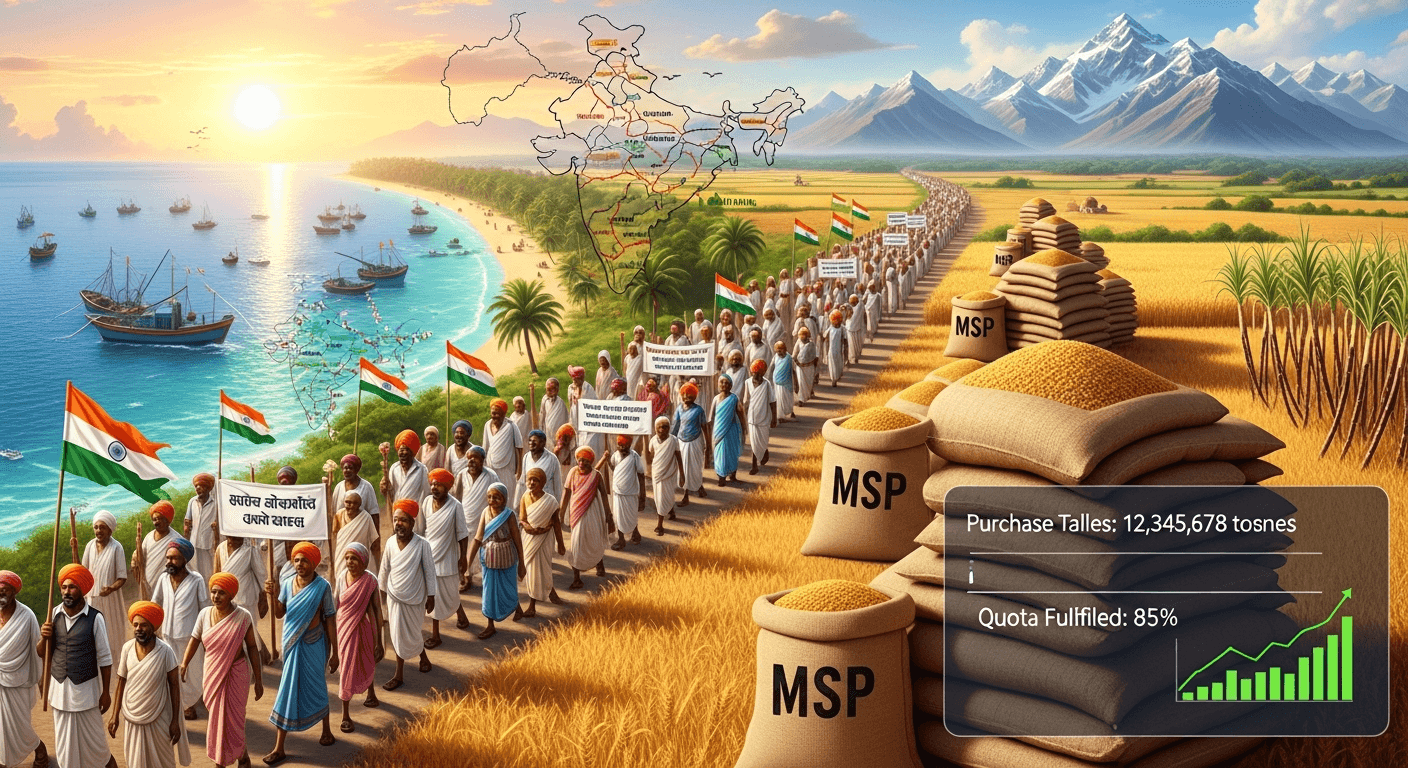
I woke up to news of a long march that will soon thread the subcontinent — a Kisan Yatra from Kanyakumari to Kashmir — organised by national farmers’ organisations to press for a legally guaranteed Minimum Support Price (MSP) and debt relief. The announcement is both familiar and consequential: familiar because these demands have been voiced for years; consequential because the route, the timing and the plan to gather village-level resolutions and present them in New Delhi suggest a campaign designed to shape public opinion, not only negotiate a policy change Farmers' organisations plan to launch all-India march to demand legalisation of MSP.
Why this matters to me
I write about policy and technology, but my roots are in the conviction that systems should serve people — and agriculture is where policy meets survival. A legally backed MSP is not merely a price mechanism on paper; it is a promise of stability to millions who feed the country. When farmers say they are trapped in debt, they are describing a cascade of missing supports: fair pricing, predictable procurement, storage and market access, and protection from distress.
What the march is asking for (in plain terms)
- A statutory guarantee that farmers will receive a fair floor price for their produce — enough to cover production costs and leave a reasonable margin.
- Implementation of long-standing commission recommendations that aim to align MSP with realistic cost measures (the reports commonly referenced demand margins well above the narrow measures of cost sometimes used).
- Broad measures for debt relief, social protection and removal of obstacles that stop smallholders from getting a fair market.
These are not new demands; what changes is the scale and strategy. The organisers intend to convert local village resolutions into a national narrative and present them collectively in Delhi — a deliberate move to show both democratic depth and political weight Farmers' organisations plan to launch all-India march to demand legalisation of MSP.
Where I’ve written about this before
I have been arguing for a pragmatic, technology-enabled approach to MSP for some time. In earlier pieces I proposed linking MSP to a Maximum Purchase Quantity (MPQ) announced in advance, and using automation and geospatial tools to make MSP calculations and procurement transparent and predictable (MSP is a Many Splendored Promise). That idea is simple: guarantee price, but also announce how much the state will buy at that price — so budgets, storage and cropping choices can be planned.
Why does that matter now? A march that collects village resolutions is a call for legitimacy. A legal MSP without operational clarity risks becoming another promise. My prior prescriptions — MPQ, technology-backed forecasting, clear state-level procurement quotas and published purchase tallies — would make any MSP law implementable and fiscally visible.
Practical tensions they must confront
- Fiscal and logistical feasibility: A legal MSP without limits could require unsustainable purchases and overwhelm storage systems. That is why an MPQ (or similar quota mechanism) matters.
- Crop and environmental distortions: Guaranteed prices for a limited set of crops can skew cropping patterns (water-intensive crops, for example). Any policy must couple price support with incentives for diversification and climate-resilient practices.
- Trade and fiscal signalling: A higher guaranteed price changes domestic price structures and has implications for inflation and trade; careful phasing and targeted support are essential.
A pragmatic path forward (my prescription)
- Announce MSP linked to an MPQ for each notified crop, six months before sowing, so farmers and the state both know the scale of procurement required.
- Publish procurement targets and real-time purchase tallies on a central portal (automated, auditable).
- Invest in state-wise storage, decentralised procurement hubs and farmer-producer organisations so purchases can happen closer to production centres.
- Pair price guarantees with incentives for crop diversification, water-efficient practices and post-harvest value chains.
- Provide short-term relief (debt moratoria, targeted direct transfers) alongside a medium-term roadmap to restructure rural credit and crop insurance.
These are not panaceas, but they are rules that make a statutory MSP workable rather than merely symbolic. The combination of legal assurance and operational clarity reduces moral hazard and increases public trust.
What the march signals politically and socially
Mass marches are not just bargaining chips; they are expressions of democratic pressure. When village resolutions are collated into millions of signatures, the demand acquires moral authority. That authority can push policymakers to design systems that are fair, fiscally prudent and technologically transparent — or it can sharpen polarisation if handled clumsily. I hope for the former.
A final thought
I have long believed that technology can make promises enforceable: announce an MSP, publish the MPQ, automate calculations, and show purchases live. Doing so makes policy credible. If the organisations behind this march succeed in turning dispersed grievance into organised, evidence-backed demands, we may see the debate move from slogans to systems.
I will watch this Yatra closely — not as a spectator, but as someone who wants policy to match people’s needs.
Regards,
Hemen Parekh
Any questions / doubts / clarifications regarding this blog? Just ask (by typing or talking) my Virtual Avatar on the website embedded below. Then "Share" that to your friend on WhatsApp.
Get correct answer to any question asked by Shri Amitabh Bachchan on Kaun Banega Crorepati, faster than any contestant
Hello Candidates :
- For UPSC – IAS – IPS – IFS etc., exams, you must prepare to answer, essay type questions which test your General Knowledge / Sensitivity of current events
- If you have read this blog carefully , you should be able to answer the following question:
- Need help ? No problem . Following are two AI AGENTS where we have PRE-LOADED this question in their respective Question Boxes . All that you have to do is just click SUBMIT
- www.HemenParekh.ai { a SLM , powered by my own Digital Content of more than 50,000 + documents, written by me over past 60 years of my professional career }
- www.IndiaAGI.ai { a consortium of 3 LLMs which debate and deliver a CONSENSUS answer – and each gives its own answer as well ! }
- It is up to you to decide which answer is more comprehensive / nuanced ( For sheer amazement, click both SUBMIT buttons quickly, one after another ) Then share any answer with yourself / your friends ( using WhatsApp / Email ). Nothing stops you from submitting ( just copy / paste from your resource ), all those questions from last year’s UPSC exam paper as well !
- May be there are other online resources which too provide you answers to UPSC “ General Knowledge “ questions but only I provide you in 26 languages !




No comments:
Post a Comment