
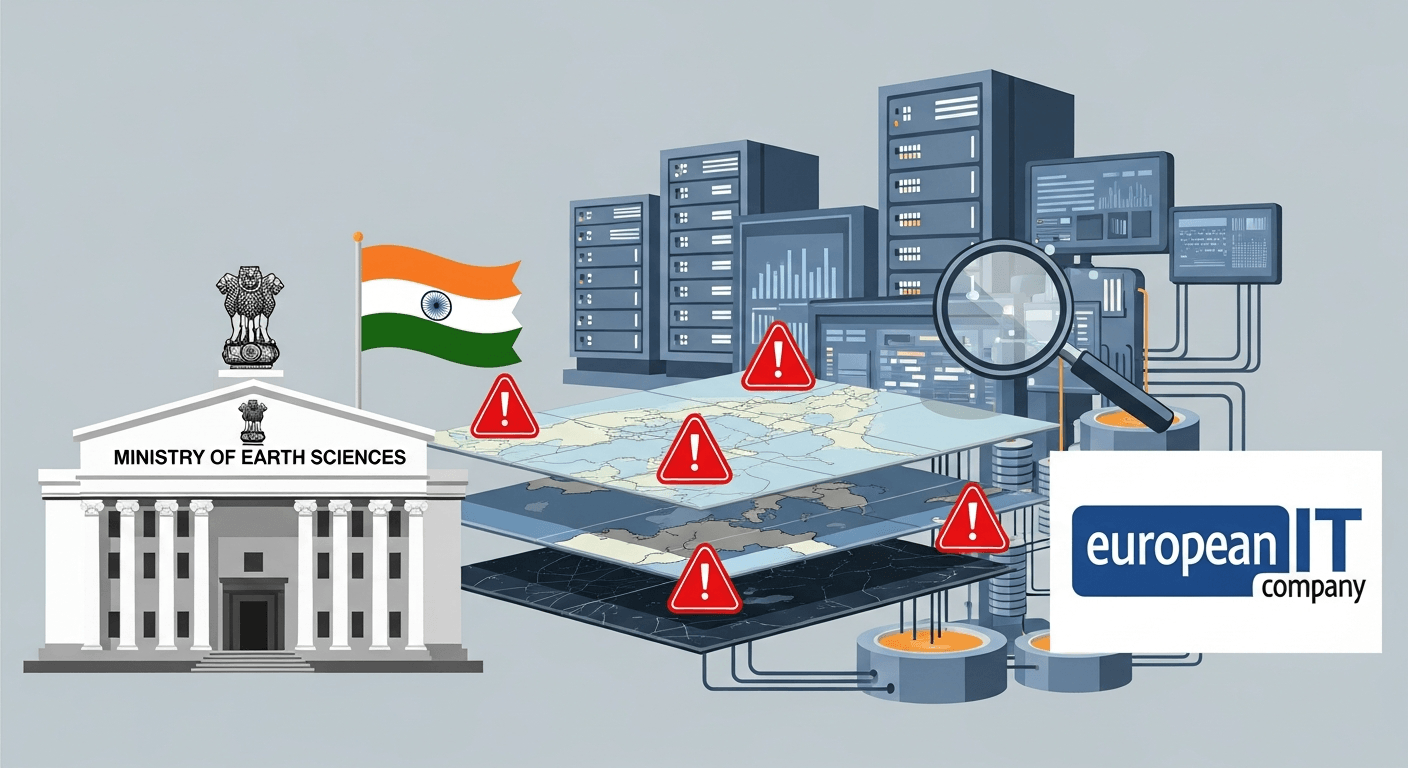
Why the Earth Sciences Minister Is Upset
I write this as someone who watches the intersection of data, policy and public interest closely. A recent report that India’s Minister for Earth Sciences has registered strong concerns about the work of a European IT company handling satellite-derived products has prompted me to step back and explain why this matters beyond the headlines.
Who the minister is and what the Ministry does
The Union Minister for Earth Sciences leads a portfolio that oversees weather services, oceanography, seismology and several national institutes that produce and distribute geospatial and climate-related data. That ministry is the custodian for much of the country’s operational satellite use, numerical weather prediction, tsunami warnings and coastal monitoring. In short: it is responsible for data and services that protect lives, property and economic activity.
The reported incident — a plausible scenario
According to public reporting and industry chatter (details remain reported and unverified), a European IT firm contracted to supply processed satellite imagery and derived climate/mapping products to several Indian public agencies is alleged to have delivered datasets with problems that fall into three categories:
- Data inaccuracies: Processed maps and change-detection layers supplied to clients reportedly contained spatial misalignments and classification errors that led to incorrect identification of coastal erosion and flood-prone zones in pilot areas.
- Licensing and data-use disputes: The firm is said to have used a mix of commercial and open-sourced satellite inputs and applied proprietary processing, creating ambiguity about downstream licensing for Indian agencies that intended to redistribute or publish derived products.
- Alleged misuse of sensitive layers: There are claims the firm’s public-facing map visualizations inadvertently exposed high-resolution layers that, in the view of some officials, could intersect with national-security sensitivities (ports, critical infrastructure), prompting scrutiny over export controls and governance.
I emphasise: these are reported allegations and technical concerns discussed in public fora and by sources close to the agencies; I have not seen independently verified forensic analyses of the specific datasets in question.
Why this upsets the minister — the substantive stakes
From the ministry’s perspective, the concerns are straightforward and weighty:
- National security and sovereignty: High-resolution geospatial products can touch on security constraints. Where data provenance and licensing are unclear, agencies worry about uncontrolled distribution or foreign-accessible layers that map sensitive sites.
- Data sovereignty and legal clarity: Public agencies need to know what they can re-publish, share with state governments, or use in downstream decision-support without breaching license terms.
- Scientific integrity: Operational forecasting systems and climate models rely on trusted inputs. Errors in upstream products can propagate into forecasts, risk assessments and early warnings.
- Public trust: When official maps or warnings change due to data quality issues, citizens and planners lose confidence in institutions that provide life-critical information.
Given those stakes, any sign of inaccuracy, license ambiguity or unvetted distribution triggers serious administrative and political concern.
Reactions — a balanced reading
Government/ministry: Reportedly, the ministry has asked for an immediate audit of the datasets and a review of contractual terms. It has also asked subordinate agencies to pause public dissemination of affected products until the issues are resolved. These are procedural and risk-mitigation steps typical when data critical to public safety is in question.
The European IT company: Industry sources indicate the firm has pointed to complex supply chains (multiple satellite and processing partners), asserted that its products meet standard industry QA, and offered to co-operate on technical validation. Again, this is reported and not a verbatim company statement.
Independent scientists and technical experts: The scientific community’s reaction has been mixed. Some researchers emphasise that processing pipelines are complex and that discrepancies are normal in prototype datasets — what's needed is transparent validation and reproducible methods. Others stress that when models or operational maps are affected, conservative handling and independent verification are non-negotiable.
Opposition and political actors: Opposition figures have used the episode to question procurement diligence and oversight, calling for clearer rules on data governance when foreign vendors supply sensitive geospatial services.
Broader implications
This episode touches several systemic themes:
Data governance: Countries must be explicit about provenance, licensing and acceptable uses of remote-sensing products. Draft national data policies have signalled this need; operationalising them is harder.
Public–private partnerships: Governments increasingly rely on private firms for value-added processing. Contracts must therefore require quality assurance, reproducibility, export-control compliance and clear licensing for public reuse.
Transparency and reproducibility: Independent audits, open validation datasets and shared benchmarks can defuse many disputes. Where national interest is at stake, mechanisms for independent technical review should be built into procurement.
Policy responses: Possible actions include standardised licensing clauses for public agencies, mandatory third-party validation for operational products, and clearer guidelines on which classes of sensor data require restricted handling.
What I think matters most
In my view, this is not primarily a technology dispute. It is a governance challenge: aligning commercial innovation with public-sector obligations to safety, sovereignty and scientific rigor. I have written earlier about the need for clearer national-level data governance and institutional frameworks for public data sharing Government expanding data sources for better decisions. This episode reinforces that call.
Conclusion — a practical takeaway
Allegations about data quality and licensing are serious and should be resolved by transparent technical audits, contractual clarity and, where required, temporary operational safeguards. The healthy path forward is procedural: test, validate, and publish methods — then restore public services with confidence.
Regards,
Hemen Parekh
Any questions / doubts / clarifications regarding this blog? Just ask (by typing or talking) my Virtual Avatar on the website embedded below. Then "Share" that to your friend on WhatsApp.
Get correct answer to any question asked by Shri Amitabh Bachchan on Kaun Banega Crorepati, faster than any contestant
Hello Candidates :
- For UPSC – IAS – IPS – IFS etc., exams, you must prepare to answer, essay type questions which test your General Knowledge / Sensitivity of current events
- If you have read this blog carefully , you should be able to answer the following question:
- Need help ? No problem . Following are two AI AGENTS where we have PRE-LOADED this question in their respective Question Boxes . All that you have to do is just click SUBMIT
- www.HemenParekh.ai { a SLM , powered by my own Digital Content of more than 50,000 + documents, written by me over past 60 years of my professional career }
- www.IndiaAGI.ai { a consortium of 3 LLMs which debate and deliver a CONSENSUS answer – and each gives its own answer as well ! }
- It is up to you to decide which answer is more comprehensive / nuanced ( For sheer amazement, click both SUBMIT buttons quickly, one after another ) Then share any answer with yourself / your friends ( using WhatsApp / Email ). Nothing stops you from submitting ( just copy / paste from your resource ), all those questions from last year’s UPSC exam paper as well !
- May be there are other online resources which too provide you answers to UPSC “ General Knowledge “ questions but only I provide you in 26 languages !



No comments:
Post a Comment