
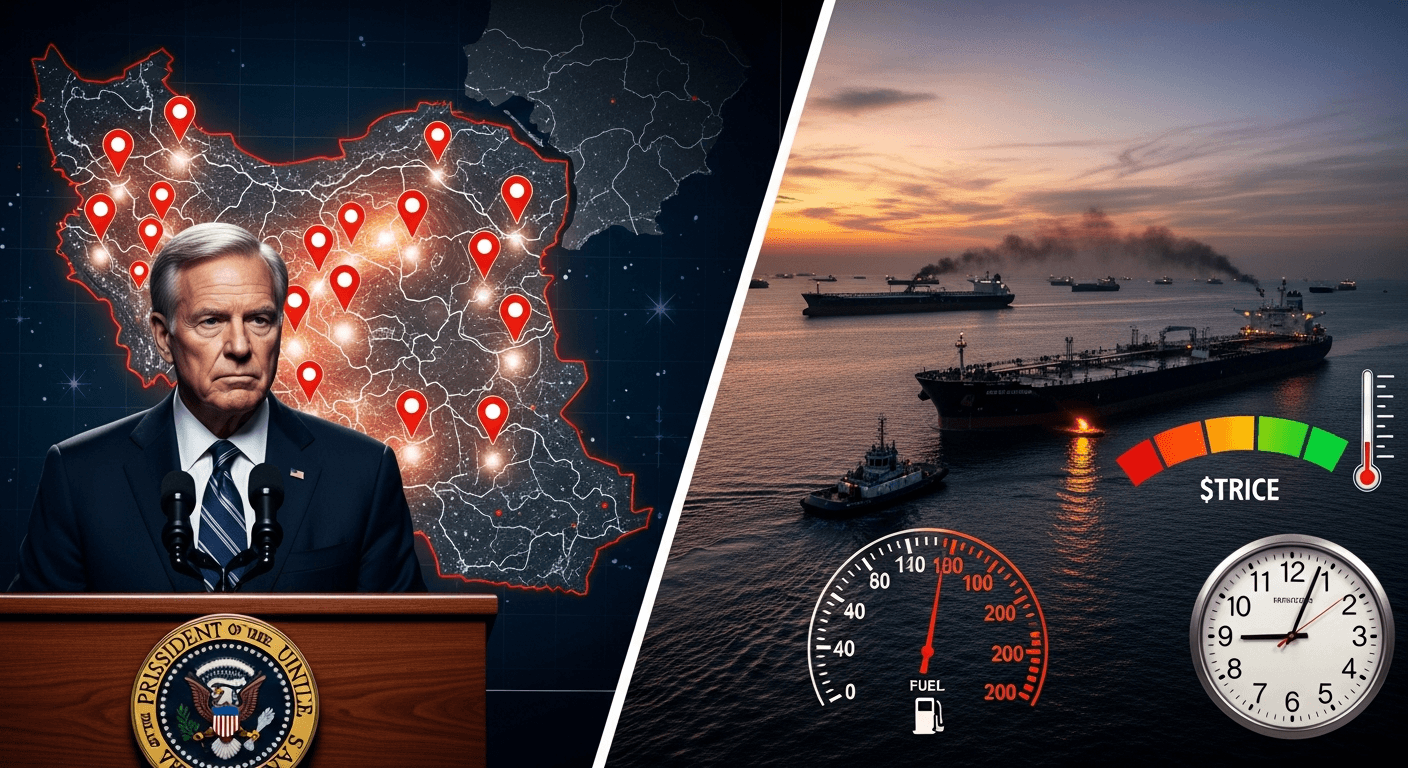
Iran endgame, gas prices, Hormuz crisis: My takeaways
I watched the President's prime-time address with the kind of mixture of disbelief and weary attention that geopolitics seems to demand these days. The speech stitched together military updates, energy-market reassurance, and a blunt challenge to U.S. allies about the future of the Strait of Hormuz. Below are the key points I took away — and what they mean for ordinary people, markets, and strategy.
Key takeaways from the address
A claimed endgame — soon. The President said the campaign against Iran is "nearing completion" and offered a short timeline (weeks) for winding down major operations. That framing is meant to reassure a domestic audience and markets that the disruption is temporary.See reporting summarizing the remarks.
Energy messaging: prices will fall when operations end. He repeatedly linked gas price spikes to Iran’s attacks on shipping and suggested that when U.S. operations end, prices will “come tumbling down.” He also urged nations to buy U.S. oil or to "take" control of the Strait if they need access immediately.CBS News and press transcripts capture this line of argument.
The Strait of Hormuz: a test of burden-sharing. The speech pushed the responsibility for reopening and policing the Strait onto consuming nations — a strategic nudge for allies to step up military or logistical commitments if they want Persian Gulf flows restored.
Escalation as leverage. Threats about striking power, water, and energy infrastructure were reiterated as bargaining chips to force a quick resolution.
Domestic political frame. The address mixed military claims with economic patriotism (energy independence, domestic production), a clear attempt to reassure voters anxious about both war and pocketbook pain.
Why these lines matter (short analysis)
Markets are forward-looking. Even authoritative-sounding promises about a quick end will be judged against tangible facts: ship transits through Hormuz, insurance and freight costs, and physical oil flows. Words can calm markets briefly; real reopening and steady tanker traffic will be needed to sustain lower prices.
The President’s exhortation that allies should "go take" the Strait is as much political theater as policy. Militarily forcing control over an Iranian chokepoint would be costly and risky — and the legal, diplomatic, and logistical hurdles are substantial.
Threatening civilian infrastructure is escalatory and raises long-term reconstruction and humanitarian concerns. Even if such threats never materialize, the rhetoric raises the geopolitical premium on Middle East risk for months.
What I said about petrol and policy before — continuity of thought
Years ago I wrote about petrol pricing and how subsidies and distortions create long-term social burdens (see my older note on petrol prices)[^1]. The core continuity is simple: energy shocks disproportionately hurt ordinary people and middle-income households. Short-term political messages about abundant domestic production help explain part of the story, but they don't erase the global market linkages that make fuel prices sensitive to chokepoints and conflict.
[^1]: "PETROL PRICES : LET THESE RISE !" — an older piece where I argued about the social and policy trade-offs of fuel pricing. (http://myblogepage.blogspot.com/2011/11/petrol-prices-let-these-rise.html)
Scenarios I’m watching closely
Scenario A — "Rapid de-escalation": a deal, credible guarantees on shipping, and tanker traffic resumes. Gas prices fall; markets rally; political narratives shift to "mission accomplished" framing.
Scenario B — "Prolonged disruption": the Strait remains intermittently closed or insurance costs stay high. Energy prices stay elevated, inflationary pressure persists, and secondary supply routes (pipeline builds, alternative suppliers) accelerate — increasing long-term structural change in energy markets.
Scenario C — "Regional spillover": attacks spread to other critical nodes (terminals, ports), forcing broader coalition responses. That raises the stakes for sustained military presence and long-term geopolitical commitments.
Practical implications — for consumers, investors, and policymakers
Consumers: Expect volatility. If you can smooth personal budgets against short-term pump shocks (conservative spending, top up savings where possible), do so. Fuel-subsidy politics may return in some countries.
Investors: Watch freight rates, tanker insurance spreads, and strategic petroleum inventories. Energy infrastructure and defense contractors will be sensitive to developments, but so will inflation-sensitive sectors.
Policymakers: If allies are to be asked to assume more responsibility for key maritime routes, agreements and burden-sharing frameworks must be negotiated — not demanded from a podium. Long-term resilience requires diversifying routes and accelerating storage and demand‑response measures.
What to watch next (near term)
- Real tanker transits through the Strait of Hormuz and whether insurance and freight costs normalize.
- Concrete diplomatic moves from major consumers (Europe, East Asia) on escort missions or alternative supply agreements.
- Any operational signals that would make the President’s timeline credible: verified ceasefires, tangible reductions in Iranian proxy activity, or shipments actually moving.
Final reflections
This speech was part operational update, part economic reassurance, and part strategic provocation toward partners. Political leaders use language to shape markets and public sentiment — that’s expected. But words must be matched by verifiable outcomes. For now, the risk premium on energy and geopolitics remains elevated. My counsel is practical: plan for volatility, watch physical signals in shipping and supply, and push for transparent, negotiated, durable solutions rather than theatrical ultimatums.
Regards,
Hemen Parekh
Any questions / doubts / clarifications regarding this blog? Just ask (by typing or talking) my Virtual Avatar on the website embedded below. Then "Share" that to your friend on WhatsApp.
Get correct answer to any question asked by Shri Amitabh Bachchan on Kaun Banega Crorepati, faster than any contestant
Hello Candidates :
- For UPSC – IAS – IPS – IFS etc., exams, you must prepare to answer, essay type questions which test your General Knowledge / Sensitivity of current events
- If you have read this blog carefully , you should be able to answer the following question:
- Need help ? No problem . Following are two AI AGENTS where we have PRE-LOADED this question in their respective Question Boxes . All that you have to do is just click SUBMIT
- www.HemenParekh.ai { a SLM , powered by my own Digital Content of more than 50,000 + documents, written by me over past 60 years of my professional career }
- www.IndiaAGI.ai { a consortium of 3 LLMs which debate and deliver a CONSENSUS answer – and each gives its own answer as well ! }
- It is up to you to decide which answer is more comprehensive / nuanced ( For sheer amazement, click both SUBMIT buttons quickly, one after another ) Then share any answer with yourself / your friends ( using WhatsApp / Email ). Nothing stops you from submitting ( just copy / paste from your resource ), all those questions from last year’s UPSC exam paper as well !
- May be there are other online resources which too provide you answers to UPSC “ General Knowledge “ questions but only I provide you in 26 languages !


No comments:
Post a Comment