
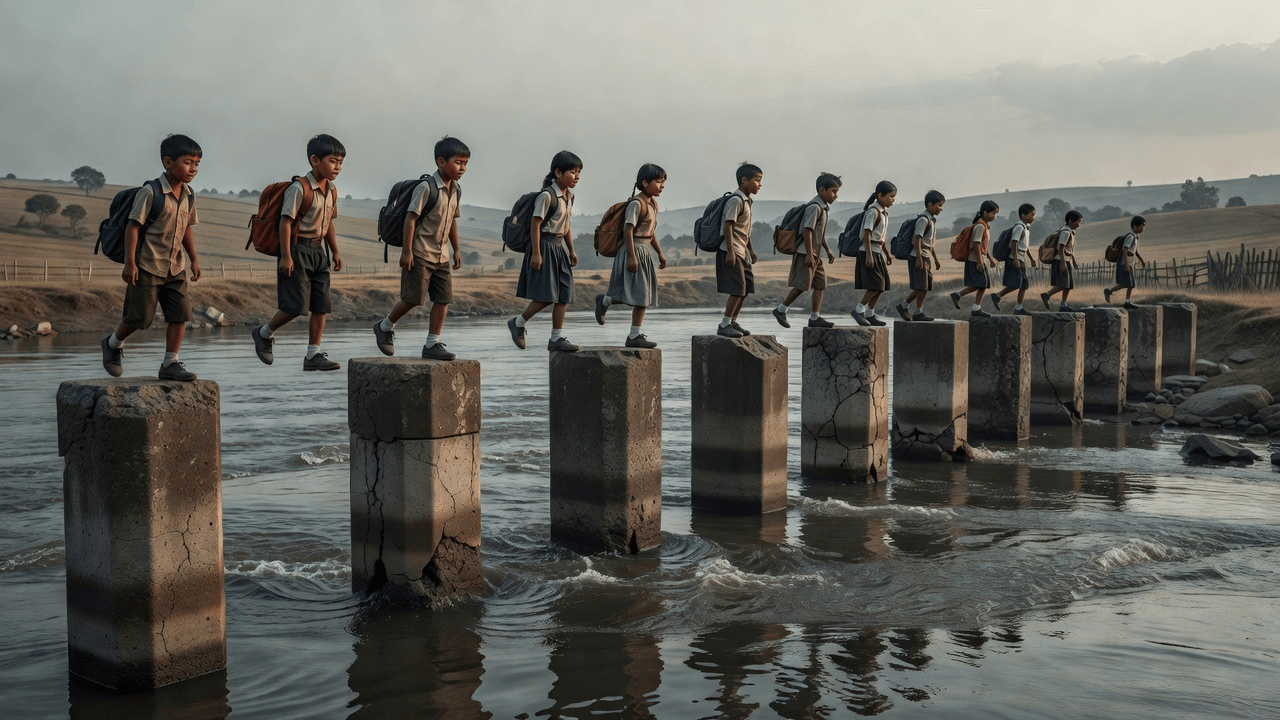
It is a profound tragedy that in an era of rapid technological advancement and national growth, the most fundamental right of a child—education—is still being pursued at the risk of life and limb. I am writing this today to highlight the deeply unsettling situation in Kakraua village, in the Vidisha district of Madhya Pradesh.
A Perilous Shortcut
Recent reports have brought to light the plight of young students who, in their determination to reach school, are forced to hop across precarious concrete pillars of a check dam on the Betwa river. For these children, this path is not a choice but a desperate, pragmatic attempt to shorten a commute that would otherwise be nearly insurmountable. By taking this dangerous shortcut, they reduce their journey to roughly 1.5 kilometers, avoiding a much longer and more taxing road route.
The Cost of Neglect
We must ask ourselves: what kind of society forces a child to calculate the risks of drowning or falling against the value of their education?
- The Hazard: The gaps between the pillars, coupled with slippery surfaces during the monsoon, make every crossing a gamble.
- The Academic Impact: Children are already falling behind. One student has reportedly had to repeat the ninth grade because she could not physically negotiate this route safely, leading to missed classes and academic setbacks.
- The Human Toll: Parents are trapped in an impossible dilemma. As one parent noted, they have to work in the fields and cannot ferry their children back and forth. They are left with two equally heartbreaking options: stop the education they crave for their children, or watch them risk their lives every single day.
A Call for Accountability
This is not a new narrative in our country. I have often reflected on the tragic stories of children across India—from Madhya Pradesh to Uttarakhand and Bihar—who brave rivers, broken bridges, and treacherous terrains just to sit in a classroom.
While local authorities have acknowledged the issue—noting that the area falls within the constituency of high-level leadership—proposals to upgrade local schools or install safe infrastructure remain stuck in bureaucratic limbo. Immediate, tangible solutions, such as safe pedestrian crossings or upgraded transportation, are not just infrastructure projects; they are moral imperatives.
We cannot claim to be building a future for our nation while we leave our children’s lives hanging in the balance of a crumbling, dangerous dam. We owe these children bridges, not obstacles.
If you have read this blog carefully , you should be able to answer the following question:
"What specific infrastructure challenge are children in Kakraua village, Madhya Pradesh, currently facing in their daily journey to attend school?" You can find that answer by entering this question at ( 1 ) www.HemenParekh.ai ( 2 ) www.IndiaAGI.ai
No comments:
Post a Comment