
Background
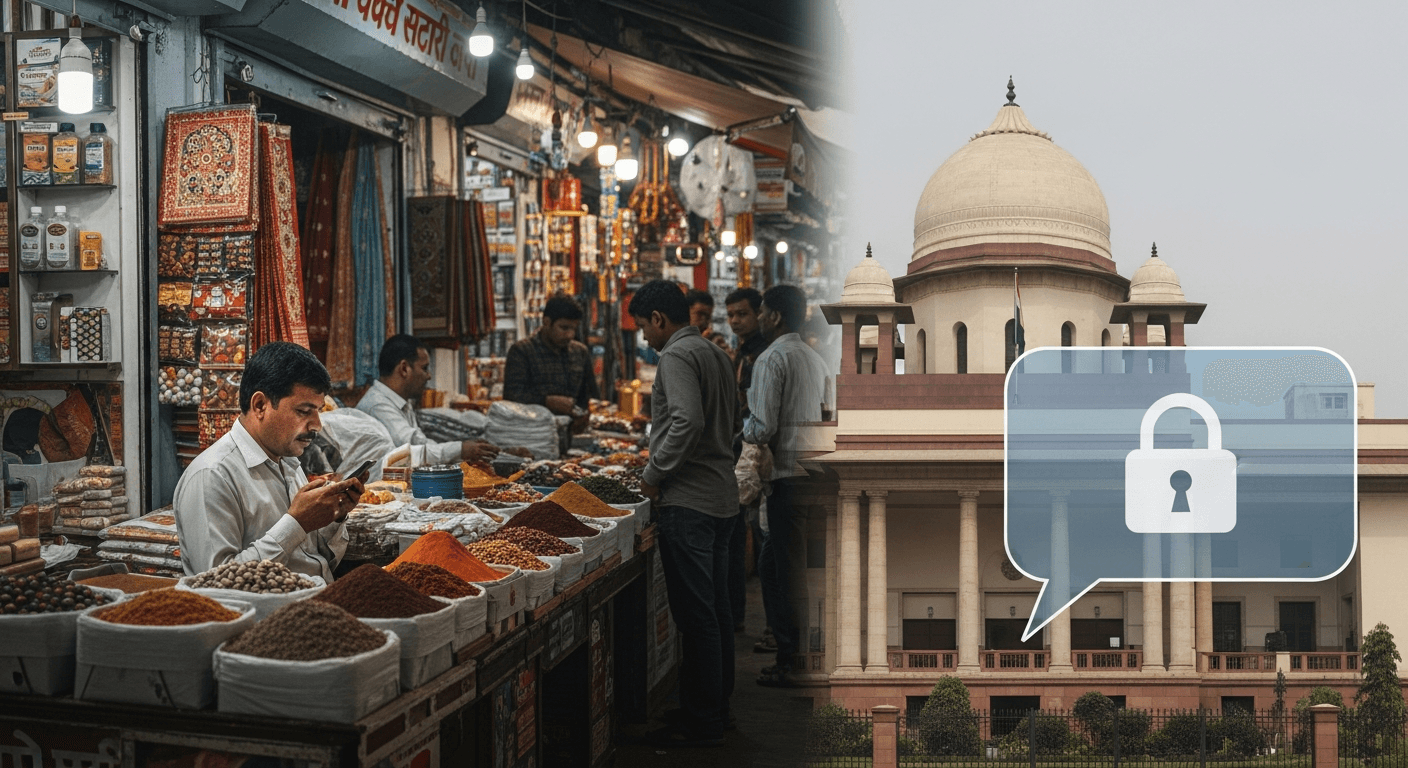
In recent weeks India’s highest court has been asked to adjudicate a complex tension at the intersection of competition law, privacy and digital commerce. At issue is whether a sweeping prohibition on any data sharing between a messaging service and its corporate group is an appropriate remedy for alleged anti‑competitive conduct. On February 24, 2026, the messaging platform filed an affidavit before the Supreme Court, reiterating that personal messages remain end‑to‑end encrypted and warning that a blanket ban on data sharing with its parent company would have broad consequences for user choice, measurement of advertising effectiveness and — notably — thousands of small Indian firms that rely on low‑cost digital marketing channels [Hindustan Times].
Why the court is watching closely
The dispute grew out of a November 2024 order by the Competition Commission of India (CCI) finding that a 2021 privacy policy update amounted to an abuse of dominance; the agency later imposed a ₹213.14 crore penalty. The National Company Law Appellate Tribunal (NCLAT) has since modified parts of the regulator’s order and stayed certain directions, while emphasising that user choice and remedial safeguards must remain in place. Those procedural turns have brought the matter to the Supreme Court where judges are weighing the scope of remedies that protect citizens’ privacy without unintentionally crippling legitimate commerce.
What WhatsApp told the court (summary)
In its recent submission the company argued, in essence, three interlinked points:
- End‑to‑end encryption preserves the confidentiality of private messages and those contents are not accessible to the platform.
- Some limited, non‑message signals are used to measure ad effectiveness and prevent fraud when users interact with optional business features (for example, when an ad directs someone to start a conversation).
- A blanket ban on any data sharing would remove user choice to opt into enhanced features and would disproportionately affect micro, small and medium enterprises (MSMEs) that use targeted, low‑cost ads to reach customers [Hindustan Times].
The company also cited the scale of the commercial ecosystem: regulators and filings have pointed to roughly 200,000 Indian advertisers who use social ads that can direct customers into messaging flows, and many of those advertisers are small kirana shops, service providers and micro‑enterprises that lack larger marketing budgets.
Why small businesses matter here
Much of the policy debate is not abstract. For many small sellers, messaging‑driven conversions are a pre‑paid, conversational sales channel: a customer clicks an ad, asks a question, receives a price, and completes a sale or picks up an order. That workflow is inexpensive, frictionless and local. If regulators impose a blunt prohibition on sharing even minimal signals needed to evaluate whether an ad led to a sale or to detect fraud, ad platforms may scale back or increase the cost of directing customers into messaging threads — and small merchants would lose an affordable acquisition channel.
Alternate regulatory approaches (beyond a blanket ban)
A proportional regulatory response can reconcile privacy concerns with commercial realities. Options include:
- Purpose and purpose‑limitation rules: allow narrowly defined, auditable uses (e.g., anti‑fraud, ad measurement) while prohibiting repurposing for unrelated profiling.
- Granular consent and revocable opt‑in: require explicit choice for advertising‑related sharing, with clear user interfaces and easy withdrawal.
- Privacy‑preserving measurement: mandate aggregated, anonymised reporting (cohort measurement, differential privacy) instead of user‑level sharing.
- Independent audits and transparency: regular third‑party assessments to verify that encrypted content is not accessed and that any signals shared meet stated limits.
- Time‑bound, proportionate remedies: craft behavioural remedies that are limited in scope and duration and accompanied by impact reviews on SMEs.
Practical recommendations
For policymakers:
- Conduct an impact assessment focused on MSMEs before imposing sweeping operational bans.
- Design rules that are technology‑neutral and outcome‑focused (protect privacy, prevent anti‑competitive gatekeeping).
- Require clear, standardised consent flows and mandate independent audits to build public trust.
For small businesses:
- Diversify channels: don’t rely exclusively on a single ad‑to‑messaging funnel; combine organic, marketplace and payment alternatives.
- Track first‑party conversion signals: use your own booking or confirmation pages to measure outcomes without sharing extra user data.
- Prioritise customer relationships: encourage customers to opt in to communications with clear benefits (receipts, offers, faster service).
Why nuance matters
A knee‑jerk prohibition can feel satisfying in its simplicity, but law and policy operate in complex ecosystems. A carefully calibrated remedy can protect privacy and competition while preserving digital pathways that sustain livelihoods. Conversely, a blunt rule risks shifting costs onto the smallest economic actors and could entrench larger intermediaries who can internalise compliance costs.
Closing
I recognise the power of the court’s concern: citizens’ privacy must be zealously guarded. At the same time, remedies should be proportionate, evidence‑based and sensitive to the downstream effects on ordinary businesses and consumers. The task for regulators, judges and industry is to find that balance: strong privacy protections that do not inadvertently throttle the very entrepreneurs who are building India’s digital economy.
Regards,
Hemen Parekh
Any questions / doubts / clarifications regarding this blog? Just ask (by typing or talking) my Virtual Avatar on the website embedded below. Then "Share" that to your friend on WhatsApp.
Get correct answer to any question asked by Shri Amitabh Bachchan on Kaun Banega Crorepati, faster than any contestant
Hello Candidates :
- For UPSC – IAS – IPS – IFS etc., exams, you must prepare to answer, essay type questions which test your General Knowledge / Sensitivity of current events
- If you have read this blog carefully , you should be able to answer the following question:
- Need help ? No problem . Following are two AI AGENTS where we have PRE-LOADED this question in their respective Question Boxes . All that you have to do is just click SUBMIT
- www.HemenParekh.ai { a SLM , powered by my own Digital Content of more than 50,000 + documents, written by me over past 60 years of my professional career }
- www.IndiaAGI.ai { a consortium of 3 LLMs which debate and deliver a CONSENSUS answer – and each gives its own answer as well ! }
- It is up to you to decide which answer is more comprehensive / nuanced ( For sheer amazement, click both SUBMIT buttons quickly, one after another ) Then share any answer with yourself / your friends ( using WhatsApp / Email ). Nothing stops you from submitting ( just copy / paste from your resource ), all those questions from last year’s UPSC exam paper as well !
- May be there are other online resources which too provide you answers to UPSC “ General Knowledge “ questions but only I provide you in 26 languages !




No comments:
Post a Comment