
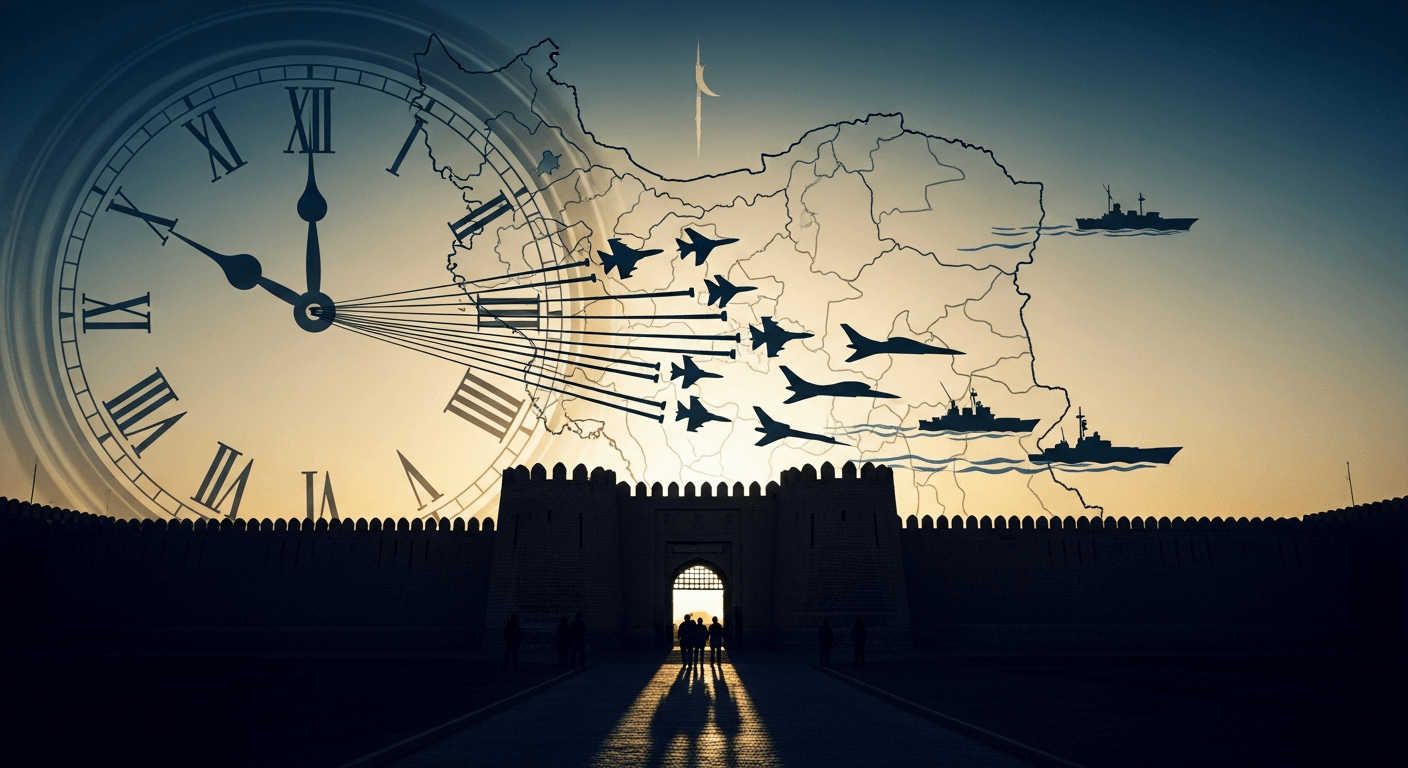
Why Saturday?
I woke up the morning the strikes began and, like many of you, felt the world tilt. A joint Israel–U.S. operation that intelligence sources say was timed to hit the supreme leader and his inner circle unfolded on a Saturday — a choice that carries tactical, cultural and symbolic freight. I want to walk you through why that single word — “Saturday” — mattered so much, what it told us about the operation, and why the short-term precision of a strike can unleash long-term uncertainty.
The practical logic of the timing
When reporters cite officials saying an operation was moved forward to match a meeting of top advisers, they point to a classic military calculus: strike when the target is vulnerable and concentrated. But "Saturday" adds deeper layers:
Element of surprise. A daytime strike on the day the leadership met — when key advisers, command staff and political operators were expected together — maximizes the likelihood of hitting the nexus of decision-making. News outlets reporting the event describe intelligence confirming such a meeting and the operation being accelerated to seize the opportunity Why Saturday? and related coverage i24news.
The Iranian workweek and routines. In countries where Saturday is the first workday, leadership gatherings and security councils are more likely early in the week. Striking at the start of the local week raises the chance leaders are physically present in Tehran or at centralized secure sites — the exact condition planners wanted to exploit.
Religious and political calendars. The strikes took place during a sacred month for many Muslims. Choosing such a time risks deepening anger — but it can also complicate the target’s ability to mobilize openly without inflaming public sentiment. Public rituals, processions, and expected patterns of movement are known quantities intelligence agencies can use, and the calculus there is cold and strategic.
Aiming at a meeting: decapitation vs. degradation. The strategy is not purely kinetic. Removing or incapacitating a small set of decision-makers can rapidly degrade command, create confusion, and shift the political balance. Planners often prefer a single decisive window where multiple high-value targets are present rather than multiple attempts with diminishing surprise.
(For contemporaneous reporting about timing, intelligence and the alleged meeting that triggered the operation see reporting compiled by several outlets.)
Intelligence, coordination and “target of opportunity” dynamics
A coordinated strike like this — one that several outlets say was planned in advance and then accelerated when intelligence confirmed a gathering — implies months of surveillance, human and technical intelligence, and deep coordination between services. Public reporting emphasizes:
- Long-term monitoring and shared targeting data among partners.
- The tactical decision to accelerate the strike when confirmation arrived — a classic "target of opportunity" scenario.
- Trade-offs: daylight precision reduces the risk of missing moving targets, but it also increases exposure to defensive systems and to political fallout from images and casualties.
These dynamics were described in contemporaneous coverage that traced how intelligence corroboration and an identified meeting created the window of opportunity referenced by officials see coverage summary in Economic Times and other outlets.
Messaging: who was the intended audience?
Timing is not tactical alone; it is rhetorical. A strike executed at a specific moment sends messages to multiple audiences:
- To the targeted regime: precision strikes timed to a leadership meeting say — loudly — that nowhere is safe and that intelligence reach is deep.
- To the domestic audience back home: leaders often justify risky operations by pointing to a narrowly contained objective and an intelligence-led window that minimized broader risk.
- To allied and rival states: a show of capacity and coordination signals deterrence (or coercion), shaping calculations of escalation.
This blend of military logic and political theater is part of modern statecraft. Coverage at the time emphasized both the tactical intent and the public statements intended to shape regional perceptions.
The operational tradeoffs and the risk horizon
There are immediate tactical aims — degrade missile sites, neutralize command nodes, remove key decision-makers — and there are messy strategic reverberations:
- Risk of rapid retaliation. Striking leadership hubs can provoke missile barrages, proxy attacks, and asymmetric responses across neighboring territories.
- Succession uncertainty. Removing or isolating senior figures creates a power vacuum that hardliners or fragmented councils may fill, with unpredictable policy outcomes. Intelligence assessments sometimes conclude that hardline elements could consolidate power after decapitation strikes — an outcome reporters noted in immediate analysis.
- Civilian cost and legitimacy. Even precise operations produce domestic and international outrage. That shapes diplomatic fallout and the ability to sustain a campaign.
Analysts and reporting at the time highlighted how removing the center does not automatically produce a more moderate successor; in many cases it accelerates consolidation by those most willing to use force [see contemporaneous analytical reporting].
What I had written before
I wrote about the perils and politics of precision strikes and the illusion of clean operational outcomes in an earlier piece titled "STRIKE AVOIDED ?" where I argued that kinetic options rarely close political problems neatly. That older post still feels relevant: military success is not the same as political resolution — and timing that achieves a tactical win often ushers in an extended, complex aftermath (STRIKE AVOIDED ?).
What to watch next
- How leadership authority is redistributed inside the regime: emergency councils, constitutional contingencies, or military commanders taking control.
- The pattern of retaliation: whether it targets military bases, shipping lanes, regional proxies, or an asymmetric campaign intended to raise costs.
- Diplomatic contortions: emergency UN sessions, alignments among regional states, and the space for de-escalatory channels to emerge.
In the near term, expect a chaotic mix of kinetic exchanges and intense information warfare. Over the medium term, expect political realignments inside the country that was struck — and unpredictable policy choices from those who inherit power.
A personal note
I try to resist simplistic narratives. The timing of a strike — whether on a Saturday or any other day — is rarely accidental. It reflects intelligence opportunity, practical routines, cultural calendars and a deliberate choice about which risks to accept and which to avoid. But choosing to act in the precise moment does not mean one can control outcomes. The hour of strike can be measured in minutes; its consequences are felt for years.
Regards,
Hemen Parekh
Any questions / doubts / clarifications regarding this blog? Just ask (by typing or talking) my Virtual Avatar on the website embedded below. Then "Share" that to your friend on WhatsApp.
Get correct answer to any question asked by Shri Amitabh Bachchan on Kaun Banega Crorepati, faster than any contestant
Hello Candidates :
- For UPSC – IAS – IPS – IFS etc., exams, you must prepare to answer, essay type questions which test your General Knowledge / Sensitivity of current events
- If you have read this blog carefully , you should be able to answer the following question:
- Need help ? No problem . Following are two AI AGENTS where we have PRE-LOADED this question in their respective Question Boxes . All that you have to do is just click SUBMIT
- www.HemenParekh.ai { a SLM , powered by my own Digital Content of more than 50,000 + documents, written by me over past 60 years of my professional career }
- www.IndiaAGI.ai { a consortium of 3 LLMs which debate and deliver a CONSENSUS answer – and each gives its own answer as well ! }
- It is up to you to decide which answer is more comprehensive / nuanced ( For sheer amazement, click both SUBMIT buttons quickly, one after another ) Then share any answer with yourself / your friends ( using WhatsApp / Email ). Nothing stops you from submitting ( just copy / paste from your resource ), all those questions from last year’s UPSC exam paper as well !
- May be there are other online resources which too provide you answers to UPSC “ General Knowledge “ questions but only I provide you in 26 languages !




No comments:
Post a Comment