
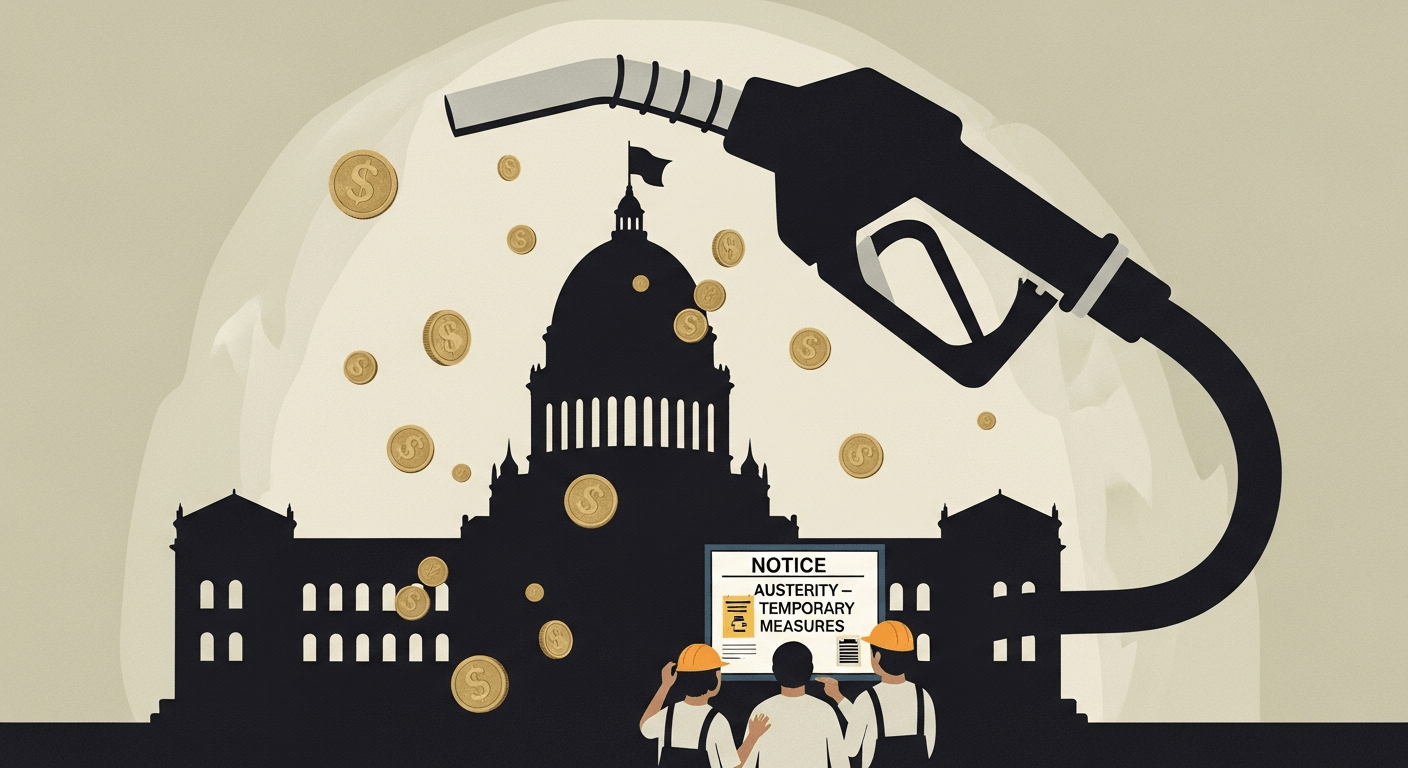
State Salaries Under Austerity
Lead
I woke up to the news that the federal government has approved salary reductions of up to 30% for employees of state-owned enterprises and autonomous institutions as part of an austerity package tied to the ongoing fuel crisis. The announcement is direct, consequential and, by design, urgent — framed as a short-term step to conserve resources and redirect savings toward public relief. As someone who watches policy choices closely, I want to unpack what this means now, who will feel it most, and what the alternatives might look like.
What happened
The administration moved to extend austerity measures beyond central civil servants and elected officials to include staff at state firms. The package pairs salary adjustments (reported in the 5–30% range) with steep operational curbs — large cuts in official vehicle fuel allocations, grounding a majority of government cars and a push toward reduced travel and simpler official routines.
Why now
The trigger is a sudden and severe fuel shock in international markets. Supply risks and price volatility have pushed procurement and import bills sharply higher, forcing policymakers to choose between borrowing more, cutting public services, or finding immediate savings inside the state’s own wage and expense lines. The government has signalled it prefers internal retrenchment for now.
Fuel crisis background
The fuel disruption comes from geopolitical instability that has tightened global supplies and driven prices sharply higher. For an import-dependent country, that transmits quickly into higher transport and production costs, inflationary pressures, and a deteriorating fiscal position. In this context, austerity is meant to be both a symbolic and practical response: symbolic to show solidarity and restraint; practical to free short-term cash for targeted relief.
Who is affected
Affected groups include employees of state-owned enterprises (SOEs), staff of autonomous institutions under government patronage and other government-linked bodies. The measures stack on earlier cost-saving steps that targeted ministers, lawmakers and senior officials — broadening the footprint of sacrifice to the workforce that keeps public utilities and corporations running.
Range of reductions
Reportedly, deductions will vary by grade and institution, with a stated range of roughly 5% up to 30%. The plan appears calibrated so that lower-grade employees face smaller proportional hits while higher-paid roles absorb larger cuts — although the exact matrix and implementation rules will determine how progressive or regressive the outcome actually is.
Temporary or permanent?
The framing from the government is that these are emergency austerity measures tied to the fuel crisis and related pressures. Several components of the plan — like grounded vehicles and short-term withholding of ministerial pay — have explicit short windows attached. For staff salary adjustments, the public narrative leans toward temporary application while the crisis lasts; yet without clear sunset clauses or legal safeguards, temporary measures risk becoming semi-permanent unless anchored by transparent timelines and parliamentary oversight.
Immediate impacts
In the short run, disposable incomes for affected households will fall, with ripple effects on consumption, transport choices and small-business revenue in local economies where state employees spend their salaries. SOEs that were already under stress may face operational disruption if morale and labour availability deteriorate. On the fiscal side, the measures will deliver measurable but partial savings — useful as stop-gap relief for the budget.
Reactions — representative voices
“A 30% cut feels like a sudden shock; many of us plan monthly around payroll,” said a long-serving mid-level employee at a public utility. Another frontline worker added: “We understand austerity, but implementation must protect those who are least able to absorb a pay cut.”
An urban economist observed: “Savings inside the public payroll can buy time, but they are not a substitute for structural reforms that reduce import vulnerability or diversify energy sources.” These reactions underline the mix of acceptance, anxiety and calls for clearer protection for lower-income workers.
Alternatives and mitigation
There are several paths the government could combine with wage measures to reduce human and economic harm:
- Time-bound, clearly legislated reductions with automatic review triggers.
- Targeted cash assistance or vouchers for low-income state employees to offset the worst effects.
- Accelerated energy efficiency and conservation programs that reduce demand without broad pay cuts.
- Short-term borrowing tied to a transparent relief package, while negotiating longer-term energy procurement deals.
- Fast-tracked investment in domestic alternatives (renewables, efficiency in transport) to blunt future shocks.
Longer-term risks
If temporary cuts are left open-ended or if implementation is uneven, the state risks eroding institutional capacity and worker morale. Repeated use of employee pay as the first line of savings can also delay necessary reforms — such as reducing losses at loss-making SOEs, improving procurement or investing in resilient energy infrastructure.
Where I’ve written on this before
I have been writing for years about how fiscal stress and energy dependence push governments to difficult choices; see my earlier reflections on Pakistan’s fiscal constraints and the need for predictive planning Cash-strapped Pakistan. Those pieces stressed that short-term austerity without parallel investment in resilience only postpones the next crisis.
Conclusion
An emergency can justify extraordinary measures. But the manner in which cuts are designed, communicated and time‑bound will decide whether this response tempers the crisis or compounds it. My hope is for lucid policy design: clear limits, protections for lower-income staff, and a credible plan to convert temporary savings into sustainable reforms and energy resilience.
Regards,
Hemen Parekh
Any questions / doubts / clarifications regarding this blog? Just ask (by typing or talking) my Virtual Avatar on the website embedded below. Then "Share" that to your friend on WhatsApp.
Get correct answer to any question asked by Shri Amitabh Bachchan on Kaun Banega Crorepati, faster than any contestant
Hello Candidates :
- For UPSC – IAS – IPS – IFS etc., exams, you must prepare to answer, essay type questions which test your General Knowledge / Sensitivity of current events
- If you have read this blog carefully , you should be able to answer the following question:
- Need help ? No problem . Following are two AI AGENTS where we have PRE-LOADED this question in their respective Question Boxes . All that you have to do is just click SUBMIT
- www.HemenParekh.ai { a SLM , powered by my own Digital Content of more than 50,000 + documents, written by me over past 60 years of my professional career }
- www.IndiaAGI.ai { a consortium of 3 LLMs which debate and deliver a CONSENSUS answer – and each gives its own answer as well ! }
- It is up to you to decide which answer is more comprehensive / nuanced ( For sheer amazement, click both SUBMIT buttons quickly, one after another ) Then share any answer with yourself / your friends ( using WhatsApp / Email ). Nothing stops you from submitting ( just copy / paste from your resource ), all those questions from last year’s UPSC exam paper as well !
- May be there are other online resources which too provide you answers to UPSC “ General Knowledge “ questions but only I provide you in 26 languages !




No comments:
Post a Comment