
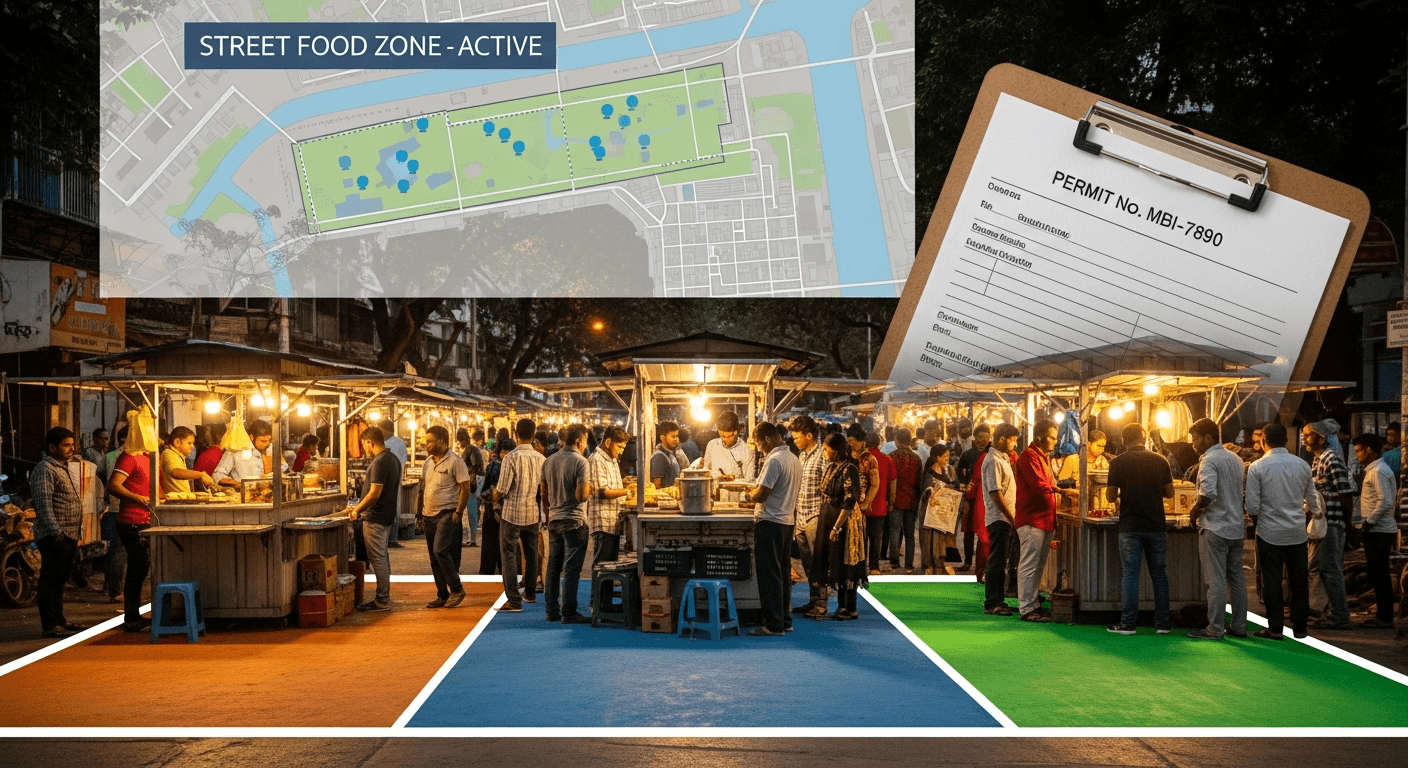
Temporary Hawking Zones Now
I read the Assembly's recent direction to the civic body with a mixture of relief and impatience. Relief, because for thousands of people the issue is not an abstract policy question but a day-to-day struggle for survival. Impatience, because this is a pause — a temporary stopgap — not the durable justice that street vendors have been waiting for since the Street Vendors Act was passed.
The state reply said the 2014 survey had identified 32,415 eligible hawkers and that the government will ask the Brihanmumbai Municipal Corporation to allot temporary pitches to those eligible vendors until the Town Vending Committee process is finalised and the courts resolve outstanding disputes. The announcement was made in the Assembly by the Industries Minister Uday Samant (udaysamant@midcindia.org) in response to a calling-attention motion and a direction from the Assembly Speaker.[1][2]
My immediate thought: temporary pitches are better than forced removals without alternatives. But they will succeed only if they are transparent, mapped, and supported by law and local administration.
Why this matters to me
I have written about hawkers and public space before — arguing that the conversation must move from eviction vs. tolerance to designing inclusive urban systems where livelihoods and pedestrian rights coexist. I suggested practical responses such as pop-up markets, mobile vending, and technology-enabled registration long before this most recent direction.[3]
This moment matters because:
- These are not merely regulatory details; for tens of thousands they are the difference between earning and not earning tomorrow.
- A temporary allotment without a transparent plan risks becoming another layer of informality and political patronage.
- The legal delays and court cases that have stalled permanent allocations cannot be an excuse to indefinitely deny people space to work.
What should “temporary” look like? A checklist
Temporary must not mean chaotic. If we want humane, effective temporary hawking pitches, the BMC and state should deliver all of the following quickly:
- Clear, published maps of temporary zones with GPS coordinates and permitted timings.
- A simple digital registry that ties each temporary pitch to a verified applicant from the 2014 exercise.
- Fixed rules on what can be sold where (food-vs-nonfood) and basic hygiene standards for food vendors.
- A time-bound schedule to move from temporary allotment to a legally constituted Town Vending Committee (TVC) process.
- A grievance and appeals portal so vendors and residents can flag genuine problems without reverting to street-level conflict.
- An independent monitoring mechanism (NGOs, urban planners, and vendor representatives) to ensure allocations aren’t captured by middlemen.
Balance, not zero-sum
The legitimate complaints of pedestrians, businesses, and resident groups cannot be ignored. Footpaths and access must be protected. But that protection cannot be the simple removal of livelihoods with no alternative. I believe we can design solutions that win both ways:
- Time-share pitches (morning vs. evening) in some high-footfall stretches.
- Portable, hygienic kiosks in designated lanes that keep sidewalks usable.
- A complaints-first enforcement model (fix the issue, then regulate), rather than punitive demolition without notice.
Technology and dignity
Technology is not a silver bullet, but it can reduce corruption and increase transparency. A simple app that shows the map of temporary pitches, a QR code identifying each licensed vendor, and a small digital payment/receipt facility for statutory fees will reduce friction and build trust.
I’ve argued previously that the State should use data, surveys, and simple digital tools to monitor and support hawkers rather than merely penalise them.[3] This temporary allotment is an opportunity to pilot those tools at scale.
Legal knots cannot strangle lives indefinitely
Courts are vital, and legal clarity is necessary — but meanwhile people need to survive. A temporary, time-bound directive that is implemented with transparency can be a humane bridge until permanent structures are in place.
If the BMC follows through in good faith, publishes maps, and sets a clear timeline to transition temporary pitches into TVC-approved, permanent allocations, this could be a turning point for thousands of families.
If not, temporary will mean another round of evictions, court challenges, and trust broken.
My ask — simple, actionable
- Publish the list of eligible vendors (from the 2014 exercise) and match them to temporary pitches within 15 days.
- Launch a public-facing dashboard showing maps, vendor lists, and a 90-day transition plan to a TVC process.
- Appoint a small oversight panel including vendor representatives, an urban planner, and a civil-society member to audit allocations.
These steps would honour the spirit of the law while protecting those who must work every day to feed their families.
References
- “Maharashtra Assembly Directs BMC To Allot Temporary Hawking Zones For Mumbai Vendors,” Free Press Journal.[1]
- Follow-up reporting and context on the interim measures: Times of India.[2]
- My earlier reflections on hawkers, pop-up markets and rights to livelihood: Hawkers RTL (Right to Living).[3]
Regards,
Hemen Parekh
Any questions / doubts / clarifications regarding this blog? Just ask (by typing or talking) my Virtual Avatar on the website embedded below. Then "Share" that to your friend on WhatsApp.
Get correct answer to any question asked by Shri Amitabh Bachchan on Kaun Banega Crorepati, faster than any contestant
Hello Candidates :
- For UPSC – IAS – IPS – IFS etc., exams, you must prepare to answer, essay type questions which test your General Knowledge / Sensitivity of current events
- If you have read this blog carefully , you should be able to answer the following question:
- Need help ? No problem . Following are two AI AGENTS where we have PRE-LOADED this question in their respective Question Boxes . All that you have to do is just click SUBMIT
- www.HemenParekh.ai { a SLM , powered by my own Digital Content of more than 50,000 + documents, written by me over past 60 years of my professional career }
- www.IndiaAGI.ai { a consortium of 3 LLMs which debate and deliver a CONSENSUS answer – and each gives its own answer as well ! }
- It is up to you to decide which answer is more comprehensive / nuanced ( For sheer amazement, click both SUBMIT buttons quickly, one after another ) Then share any answer with yourself / your friends ( using WhatsApp / Email ). Nothing stops you from submitting ( just copy / paste from your resource ), all those questions from last year’s UPSC exam paper as well !
- May be there are other online resources which too provide you answers to UPSC “ General Knowledge “ questions but only I provide you in 26 languages !




No comments:
Post a Comment