
Introduction
I’ve spent years watching small, quiet interventions ripple into big changes. In my work and writing I keep returning to one idea: many rural transformations start not with grand projects but with a modest, well-placed hub — a physical and digital meeting point that stitches services, knowledge and markets together. In this post I call that node the “hidden hub” and explain why it is quietly reshaping rural livelihoods.
What is the hidden hub?
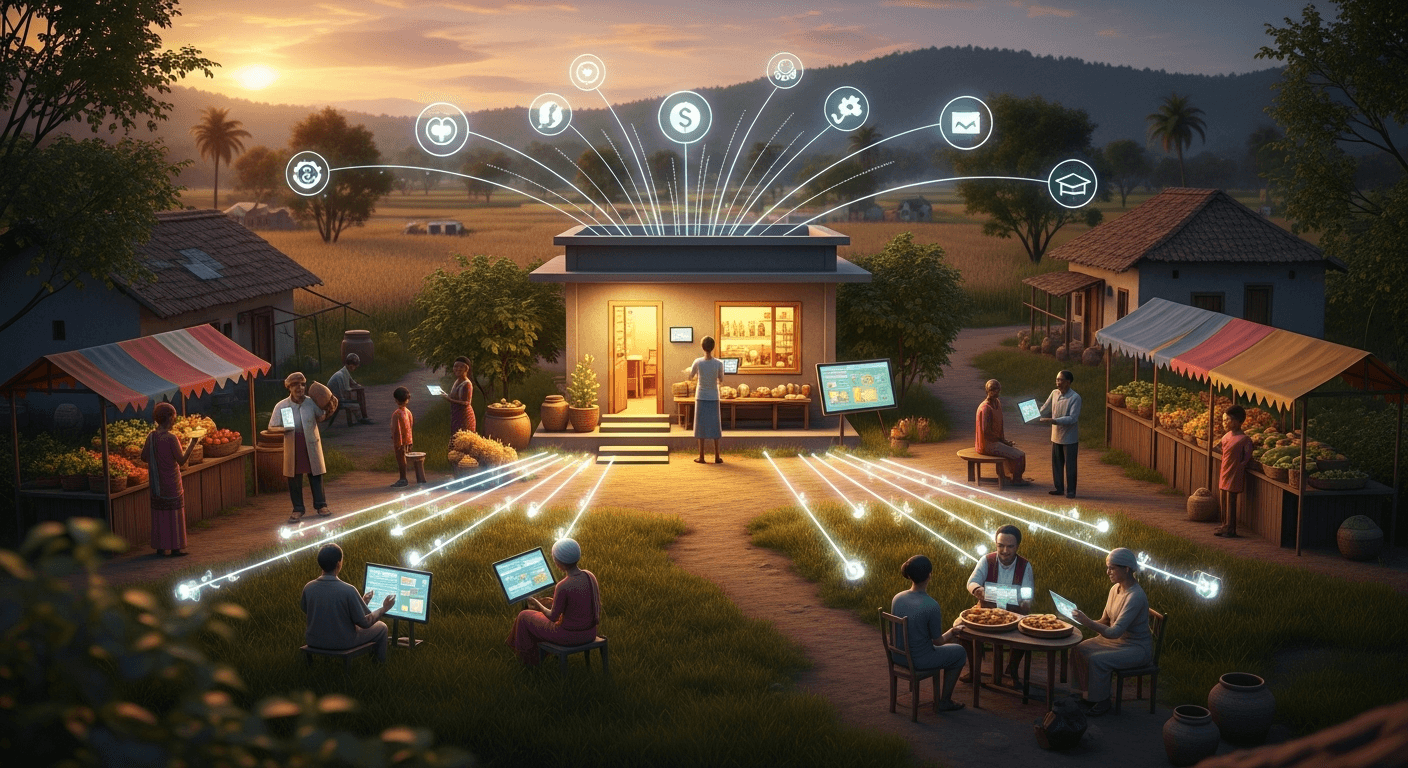
A hidden hub is a locally rooted, multipurpose centre — sometimes physical, often "phygital" (physically present and digitally enabled) — where people access information, training, market links, financial services and social support in one place. Think of it as a one-stop neighbourhood platform that combines know-how, connections and basic infrastructure.
This model is not hypothetical. Researchers and practitioners label similar entities as Rural Development Hubs or Digital/Village Hubs (Aspen Institute report; FAO’s Digital Villages work) and show how compact, flexible hubs can catalyse systems-level change rather than short-term fixes.
How it operates
Hidden hubs work through a few simple, repeatable mechanics:
- Convening: they bring diverse stakeholders together — farmers, youth, local administrators, service providers — in an accessible space.
- Aggregation of services: extension advice, skilling, e-governance, fintech and market information co-exist under one roof or platform.
- Intermediation: hub staff or local entrepreneurs act as interpreters of technology and policy for villagers, lowering adoption barriers.
- Market linkages: hubs aggregate supply and negotiate better terms with buyers, logistics providers or input suppliers.
- Learning loops: data and feedback from the hub inform continuous improvement and local decision-making.
Practical examples include digitally-enabled Youth Hubs that connect rural youth to jobs and entrepreneurship pathways (GOYN case study) and digital village initiatives that provide telehealth, e-extension and market platforms (FAO’s Digital Villages). My earlier commentary about digital Common Service Centers also highlighted this principle — bundling services improves reach and value for rural users (my post on Common Service Centers going Digital).
Impacts on livelihoods
When a hub functions well, its effects stack up quickly:
- Increased incomes: better market information and collective marketing improve prices; targeted training increases yields or value-addition.
- Diversification: access to new skills and microfinance reduces dependence on seasonal agriculture and creates off-farm jobs.
- Inclusion: hubs can be deliberately designed to reach women, youth and marginalized groups through safe spaces and tailored programming.
- Resilience: hubs aggregate risk management tools (weather advisories, crop insurance links, savings groups) that stabilize incomes.
Evidence from multiple initiatives shows impressive outcomes: Youth Hubs in rural India recorded thousands of youth placed in jobs or supported to start businesses; digital agriculture pilots have improved adoption rates and productivity when combined with community-driven demonstration and training (see World Bank and Digital Green work on decentralized digital libraries and video-based extension).
Challenges and practical solutions
Hidden hubs are powerful but not magic. Common challenges include:
- Financial sustainability: donor funding can seed hubs, but sustainability requires diversified revenue (service fees, anchor tenants like schools, local government contracts).
- Trust and governance: hubs must be accountable to the community; co-design and local governance boards help.
- Digital access and skills: connectivity and device access remain uneven. A phased model — human intermediaries plus low-bandwidth services (SMS/voice) — widens reach.
- Fragmentation of services: without coordination, multiple single-purpose efforts can compete. Hubs succeed when they focus on local priorities and knit partners together.
Practical fixes I’ve seen work:
- Start small and modular: pilot a few services, prove impact, then scale.
- Invest in local intermediary roles (hub managers, digital entrepreneurs) who bridge technology and people.
- Structure public–private partnerships so the public sector anchors core services while private actors add market-driven value.
- Measure outcomes that matter locally (income stability, number of households accessing services), not just outputs.
Future outlook
Over the next decade hidden hubs can shift from pilots to the backbone of rural service delivery. Advances in low-cost connectivity, richer open-data platforms and affordable local entrepreneurship models make hubs more viable at scale. But scale must remain context-sensitive: hubs will look different across regions — some primarily digital platforms, others cooperative-managed physical centres.
Policy choices will matter. When governments recognize hubs as legitimate delivery partners and align procurement, training and social programs, the pace of change accelerates (the Aspen and FAO literature point to the catalytic role of enabling policy). My own early writings on bridging digital divides and Common Service Centers pointed to this same policy imperative: technology must be anchored in local institutions to deliver durable change.
Conclusion
Hidden hubs are not glamorous. They’re simple, often invisible architectures of connection — a chair, a computer, a facilitator and a network. Yet they are where ideas meet markets, knowledge meets practice, and resilience is built. If we want rural livelihoods to move beyond survival toward dignity and choice, the hub model deserves more attention, more patient funding and more trust in local leadership.
Regards,
Hemen Parekh
Any questions / doubts / clarifications regarding this blog? Just ask (by typing or talking) my Virtual Avatar on the website embedded below. Then "Share" that to your friend on WhatsApp.
Get correct answer to any question asked by Shri Amitabh Bachchan on Kaun Banega Crorepati, faster than any contestant
Hello Candidates :
- For UPSC – IAS – IPS – IFS etc., exams, you must prepare to answer, essay type questions which test your General Knowledge / Sensitivity of current events
- If you have read this blog carefully , you should be able to answer the following question:
- Need help ? No problem . Following are two AI AGENTS where we have PRE-LOADED this question in their respective Question Boxes . All that you have to do is just click SUBMIT
- www.HemenParekh.ai { a SLM , powered by my own Digital Content of more than 50,000 + documents, written by me over past 60 years of my professional career }
- www.IndiaAGI.ai { a consortium of 3 LLMs which debate and deliver a CONSENSUS answer – and each gives its own answer as well ! }
- It is up to you to decide which answer is more comprehensive / nuanced ( For sheer amazement, click both SUBMIT buttons quickly, one after another ) Then share any answer with yourself / your friends ( using WhatsApp / Email ). Nothing stops you from submitting ( just copy / paste from your resource ), all those questions from last year’s UPSC exam paper as well !
- May be there are other online resources which too provide you answers to UPSC “ General Knowledge “ questions but only I provide you in 26 languages !



No comments:
Post a Comment