
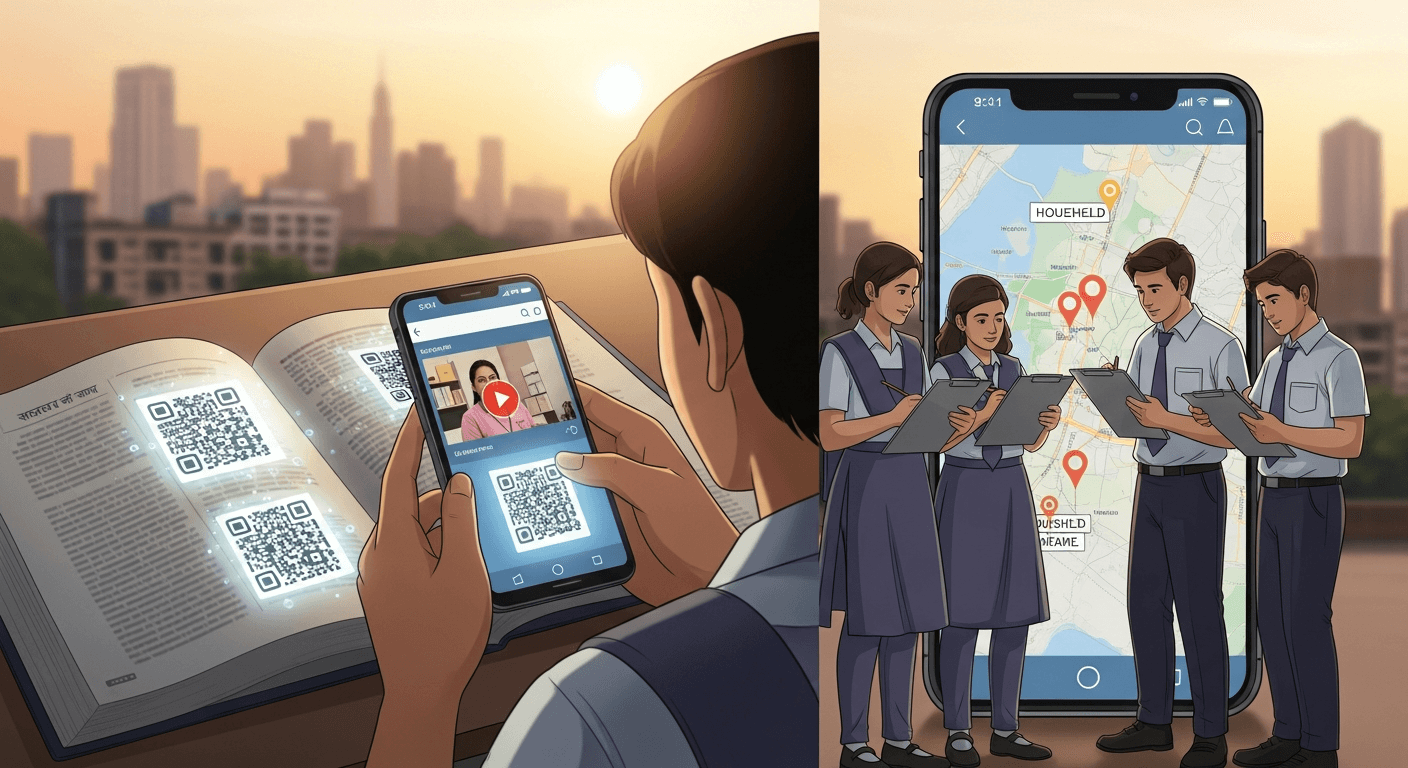
I read a short report in The Times of India about a recent SCERT research-paper contest in Maharashtra that surfaced some quietly powerful ideas: embedding QR codes in state textbooks, student-led geo-surveys for geography practicals, teacher-strengthening modules and simple local strategies to boost enrolment (QR codes in textbooks, geo-surveys… ideas at SCERT contest).
Why this matters to me
- I keep returning to the same intuition: technology is most effective in classrooms when it amplifies human relationships rather than replaces them. The suggestion to embed short, teacher-led videos behind textbook QR codes is an elegant example — students revise to the voice and examples of their own teacher, not to a distant anonymous lecture.
- The geo-survey idea brings textbook geography off the page and into neighbourhoods. Asking students to collect simple socio-economic data from households, map it and reflect on it turns rote map skills into lived civic inquiry.
What I liked about the SCERT ideas
- Pragmatic simplicity: QR codes are cheap to print and link to dozens of lightweight resources. They don’t require a full school computer lab — just a phone and small video files that can be cached for low-bandwidth use.
- Local relevance: teacher-created videos and community geo-surveys mean content is contextual, language-appropriate and anchored in children’s environment.
- Teacher empowerment: modules that strengthen teachers’ conceptual understanding before they teach (especially when they handle subjects outside their specialisation) are low-cost, high-impact interventions.
Practical hurdles we cannot ignore
- Access and equity: not every child or parent has a smartphone or reliable internet. QR code benefits must be paired with offline distributions (preloaded USBs, school kiosks, or community viewing slots) and policies that avoid widening the digital divide.
- Quality and curation: QR links must be curated and reviewed. A QR leading to an unvetted video or an unstable link is worse than no link at all. A lightweight editorial workflow and periodic audits are essential.
- Assessment integrity and privacy: geo-surveys are brilliant pedagogically but raise questions about data protection and consent. Students should collect anonymised, neighbourhood-level data with clear ethical guidelines and teacher supervision.
- Teacher time and incentives: creating short, locally relevant videos is time-consuming. Systems should compensate teachers: recognition, small honoraria, or workload adjustments.
How to scale ideas without breaking them
- Start with pilot clusters: test teacher-made QR content and geo-survey practicals in a handful of districts, measure uptake and learning outcomes, then iterate.
- Make videos short and modular: 2–3 minute clips focused on a single concept are easier to produce, review and reuse.
- Build offline-first delivery: allow videos to be downloadable in low-resolution, or provide school-level caching points so students without data can still access resources.
- Create simple editorial standards: a checklist for accuracy, language, accessibility (subtitles) and link longevity.
- Train and recognise teachers: a short micro-credential for teachers who create or validate content will professionalise the practice and build ownership.
Continuity with what I’ve written before
I have long written about the power of QR codes and location-based mapping to make public information tangible — from QR-augmented street signs to GPS and three-word addressing for real-world problems (my earlier reflections on QR mapping and what3words). Seeing SCERT surface similar, classroom-focused ideas reassures me: the same simple tools that make cities and history discoverable can also make school learning more intimate and local.
A small personal ask
If policy-makers want impact, pair innovation contests with implementation grants. SCERTs and DIETs are excellent incubators. Give the winning classroom ideas modest funding, a short production bootcamp for teachers, and a rubric to evaluate learning gains after six months.
Closing thought
The magic is not in QR codes or geo-surveys themselves; it is in the choices educators make when they use them. When technology extends teacher voice and students’ connection to their community, textbooks stop being static and become portals to local inquiry. That is a change worth supporting.
Regards,
Hemen Parekh
Any questions / doubts / clarifications regarding this blog? Just ask (by typing or talking) my Virtual Avatar on the website embedded below. Then "Share" that to your friend on WhatsApp.
Get correct answer to any question asked by Shri Amitabh Bachchan on Kaun Banega Crorepati, faster than any contestant
Hello Candidates :
- For UPSC – IAS – IPS – IFS etc., exams, you must prepare to answer, essay type questions which test your General Knowledge / Sensitivity of current events
- If you have read this blog carefully , you should be able to answer the following question:
- Need help ? No problem . Following are two AI AGENTS where we have PRE-LOADED this question in their respective Question Boxes . All that you have to do is just click SUBMIT
- www.HemenParekh.ai { a SLM , powered by my own Digital Content of more than 50,000 + documents, written by me over past 60 years of my professional career }
- www.IndiaAGI.ai { a consortium of 3 LLMs which debate and deliver a CONSENSUS answer – and each gives its own answer as well ! }
- It is up to you to decide which answer is more comprehensive / nuanced ( For sheer amazement, click both SUBMIT buttons quickly, one after another ) Then share any answer with yourself / your friends ( using WhatsApp / Email ). Nothing stops you from submitting ( just copy / paste from your resource ), all those questions from last year’s UPSC exam paper as well !
- May be there are other online resources which too provide you answers to UPSC “ General Knowledge “ questions but only I provide you in 26 languages !


No comments:
Post a Comment