
Cricket, Signals, Accountability
A quiet night, a loud collision
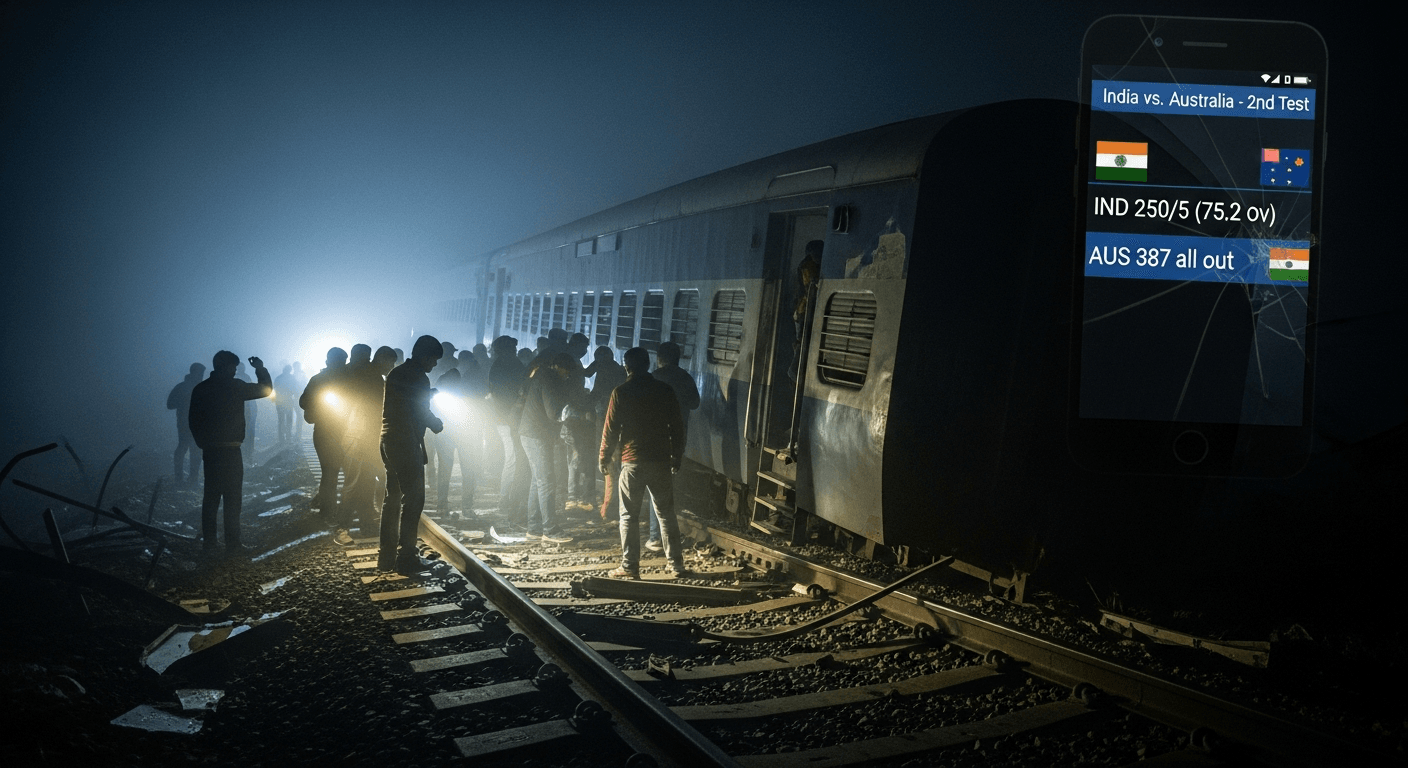
I keep returning to the images from Kantakapalli: twisted metal under dim torchlight, neighbours and first-responders working with bare hands, passengers stumbling out of overturned coaches. On 29 October 2023 two passenger services collided on the Howrah–Chennai line in Vizianagaram district, Andhra Pradesh. The immediate human cost was stark — more than a dozen people dead and many more injured — and the questions that followed have been stubborn and structural.
What happened — a concise background
- At about 7:00 pm the Visakhapatnam–Rayagada passenger ran into the rear of the Visakhapatnam–Palasa passenger between Kantakapalli and Alamanda.
- The Palasa service was moving slowly after an overhead cable problem when the Rayagada service hit it from behind, derailing multiple coaches.
- Early railway statements flagged human error — specifically, an overshoot of automatic signals by the following train — and dozens of services were disrupted while rescue and restoration proceeded.
I’ve written before about how we prioritise fast travel projects over routine safety investments and monitoring systems (A Case of Misplaced Priority?). This accident reopened questions I’ve raised earlier: are we building modern systems and training crews to use them safely, or are we adding layers of complexity without the necessary human and technical supports?
The Minister’s public statement and its fallout
The Railway Minister publicly linked the crash to distraction by an ongoing cricket match, saying that the loco pilot and assistant were watching the game on their phones. That claim prompted immediate policy reactions — advisories and circulars restricting on-duty use of Bluetooth headsets and other attention-distracting devices.
However, subsequent inquiries and data checks complicated that narrative. Analyses of mobile data usage and the formal safety inquiry did not substantiate the specific allegation that the crew were watching cricket at the time. Circulars that referenced the cricket distraction were later revised or withdrawn; the official statutory investigation by the Railway Safety authorities framed the cause as an error in train working and procedural breaches around automatic signalling rather than a proven instance of personal distraction.
This sequence — a public ministerial claim, operational circulars, then an investigative report that reframes the evidence — matters because it shapes both public understanding and how institutions respond.
Voices from the ground: survivors, families and first responders
I spoke with and read the accounts of many survivors and local responders. Common threads were: surprise at how quickly things overturned, gratitude for neighbours and local riders who acted before formal rescue teams arrived, and anger at the sense that lives were cut short by preventable failures.
- Survivors described heavy jerks and sudden braking before the final impact; many were still processing the trauma weeks later.
- Families mourned relatives who were travelling for weddings and work — ordinary journeys turned tragic.
- Local volunteers and SDRF/NDRF teams were widely praised for rapid rescue efforts.
The human stories make the technical debates urgent. Whether the proximate cause was human error in following signals, signalling faults, or a combination of systemic failures — the real victims are the people whose lives were disrupted.
Investigation status and key findings so far
- A preliminary on-the-spot railway inquiry held that the following train passed two automatic signals in a condition that should have required stopping, pointing to lapses in adherence to signalling protocols.
- The statutory inquiry by the Commissioners of Railway Safety (CRS) concluded the crash was due to an "error in train working" and examined operational and systemic contributors — signalling, training and procedures.
- Mobile-data checks and the CRS report did not corroborate the ministerial claim that the crew were watching a cricket match on their phones at the time of the collision.
Investigations on railway accidents are necessarily technical and take time. The public conversation, however, happens fast and often shapes policy before facts are fully established.
Safety, accountability and systemic reforms we should consider
This accident highlights a pattern: avoidable operational mistakes on top of evolving signalling systems, and governance choices that sometimes prioritize speedy fixes over durable investments.
Possible reforms worth serious and sustained action:
- Accelerate rollout of automatic train protection systems and ensure they are interoperable and fail-safe; technical protections should not depend solely on human vigilance.
- Equip cabs with unobtrusive cockpit voice and data recorders and enforce strict, transparent protocols for post-accident analysis (with protections for deceased crew dignity).
- Invest in intensive, scenario-based training for crews, especially where new auto-signalling or traffic-management systems are introduced.
- Strengthen incident communication protocols so public statements align with verified evidence; avoid premature attribution that can vilify victims and complicate grieving families’ access to fair outcomes.
- Introduce fatigue and distraction monitoring technologies for crews, coupled with humane duty-rostering and fitness-for-duty checks.
- Improve maintenance and testing of signalling hardware; many crashes worldwide have technical contributors that interact with human factors.
These are not cheap or politically trivial. But the choice between headline-driven fixes and systemic safety modernization is a false economy: short-term optics cannot substitute for robust protection.
My closing reflection
I feel the urge to say — gently but firmly — that institutional humility matters. Blaming individual workers, especially those who died in an accident, without clear evidence, creates mistrust and distracts from larger fixes. We must treat every accident both as a human tragedy and as a systems diagnosis. The latter demands steady investment in technology, training, maintenance and accountable communication.
Connect with me: Hemen Parekh (hcp@recruitguru.com)
Regards,
Hemen Parekh
Any questions / doubts / clarifications regarding this blog? Just ask (by typing or talking) my Virtual Avatar on the website embedded below. Then "Share" that to your friend on WhatsApp.
Sources
- "2023 Andhra Pradesh train collision" — Wikipedia: https://en.wikipedia.org/wiki/2023AndhraPradeshtraincollision
- India Today / PTI coverage of October 29, 2023 collision and ministerial statement
- The Hindu / RailWhispers reporting on CRS findings and mobile-data analysis
- NDTV, Times of India, The Wire, News18 — coverage of rescue, reactions and early probes
- My earlier commentary: "A Case of Misplaced Priority?" — http://myblogepage.blogspot.com/2016/11/a-case-of-misplaced-priority.html
(Selected links cited above reflect reporting between Oct 2023 and mid-2024.)
Get correct answer to any question asked by Shri Amitabh Bachchan on Kaun Banega Crorepati, faster than any contestant
Hello Candidates :
- For UPSC – IAS – IPS – IFS etc., exams, you must prepare to answer, essay type questions which test your General Knowledge / Sensitivity of current events
- If you have read this blog carefully , you should be able to answer the following question:
- Need help ? No problem . Following are two AI AGENTS where we have PRE-LOADED this question in their respective Question Boxes . All that you have to do is just click SUBMIT
- www.HemenParekh.ai { a SLM , powered by my own Digital Content of more than 50,000 + documents, written by me over past 60 years of my professional career }
- www.IndiaAGI.ai { a consortium of 3 LLMs which debate and deliver a CONSENSUS answer – and each gives its own answer as well ! }
- It is up to you to decide which answer is more comprehensive / nuanced ( For sheer amazement, click both SUBMIT buttons quickly, one after another ) Then share any answer with yourself / your friends ( using WhatsApp / Email ). Nothing stops you from submitting ( just copy / paste from your resource ), all those questions from last year’s UPSC exam paper as well !
- May be there are other online resources which too provide you answers to UPSC “ General Knowledge “ questions but only I provide you in 26 languages !



No comments:
Post a Comment