
Why I watched Assam's ₹9,000 transfer with curiosity
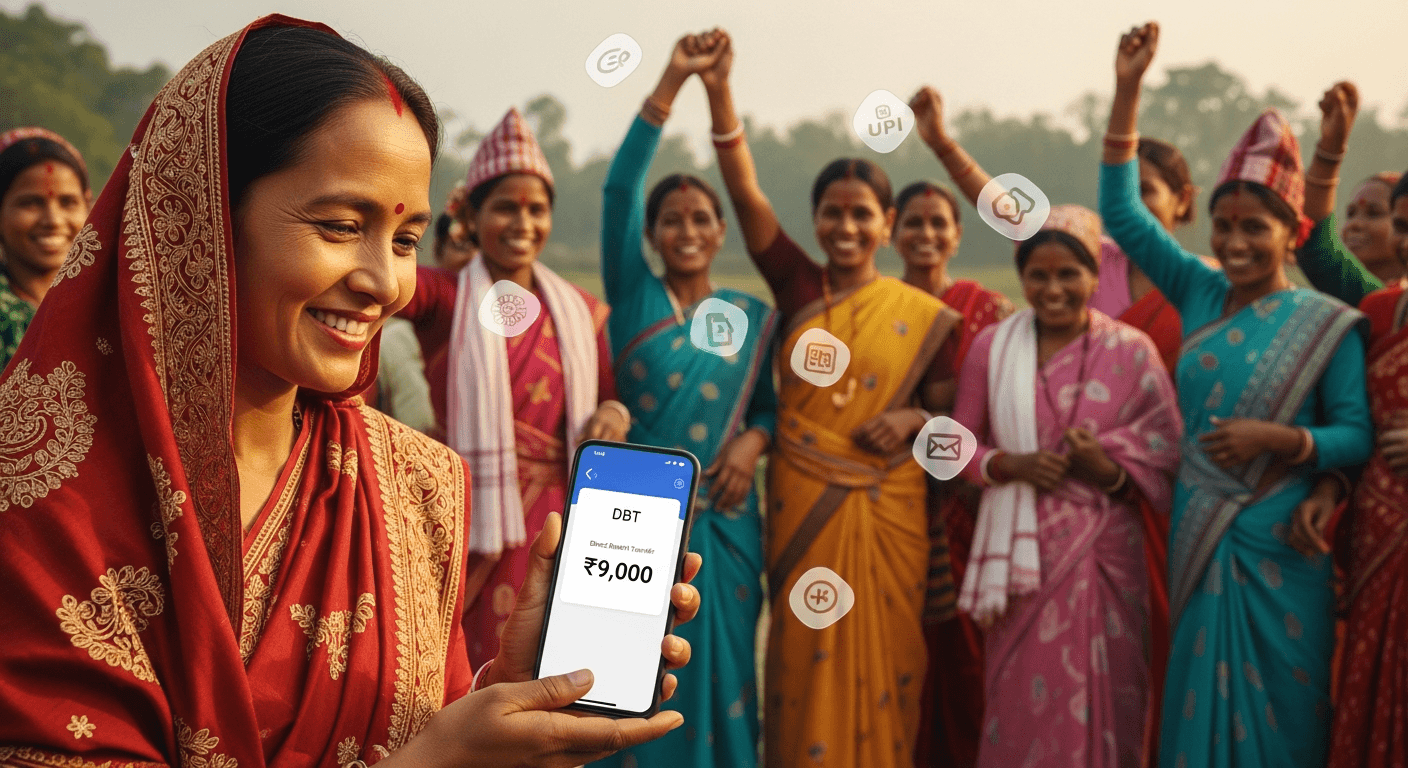
On March 10 I followed the headlines: roughly 40 lakh families in Assam received a consolidated ₹9,000 under the Orunodoi programme — a single‑day direct benefit transfer (DBT) said to total about ₹3,600 crore. The scheme, launched in 2020 to support vulnerable women with a monthly stipend, was paid as four months’ assistance plus a Bohag Bihu bonus, all sent straight into beneficiary bank accounts via DBT (Moneycontrol, NDTV).
I don't write about events like this as a detached observer. Cash transfers are where policy, technology and human dignity intersect — and I have written about similar ideas and digital delivery long before they became routine. See my earlier reflections on women's welfare and digital transfers Women of India: This is just not enough and on CBDC-enabled transfers CBDC : could get bigger than UPI.
What this transfer tells me — three quick takes
Targeting and scale: Orunodoi is targeted to eligible women households rather than being universal. Large, targeted DBT at scale shows governments can move money quickly when systems and lists are in place.
Dignity through DBT: Sending money directly to women's bank accounts preserves choice and dignity. When transfers avoid intermediaries, recipients decide what they need most.
Timing and optics: Any big transfer near elections will attract political analysis. Regardless of intent, the immediate impact on household cash flow and festive spending (here, a Bihu bonus) is tangible.
Operational lessons for governments and technologists
I believe every successful DBT exercise should be judged on four operational pillars:
- Accuracy of beneficiary lists — avoid both exclusion and leakage.
- Reliability of digital rails (Aadhaar/UPI/Bank networks) — friction erases benefits.
- Transparent communication — beneficiaries must know when and how funds arrive.
- Post‑transfer accountability — audits and grievance redress build long‑term trust.
Assam’s event — organised with village‑level meetings and a central launch — highlights that logistics and local outreach still matter even in digital programmes (The Sentinel).
A word on technology and the future of welfare
I have long argued that digital transfers and even experiments with digital currency can improve welfare delivery. When Odisha piloted CBDC‑based transfers, I noted the potential to combine transparency with easy digital spending (CBDC : could get bigger than UPI). The Orunodoi consolidation shows two things:
- Digital systems let states prepay or consolidate entitlements when needed;
- But technology alone is not a solution — policy design and social safeguards matter.
If we are serious about long‑term uplift, we need ongoing predictability (regular monthly support where needed), complementary services (health, education, skills) and robust grievance mechanisms.
On leadership and public messaging
The central programme was accompanied by public statements emphasising the compassionate intent behind the move. For example, Himanta Biswa Sarma (himanta.sarma@assam.gov.in) framed the transfer as support for women‑led households and rejected election‑linkage claims in press interactions. Whether you agree or not with the politics, the messaging mattered: clarity about who qualifies, why the payment was consolidated, and how to access support reduces confusion and strengthens trust (Deccan Chronicle).
Policy must be measured by the lives it alters, not the headlines it generates.
My short ask for policy makers and civic technologists
- Keep beneficiary data current and public enough for scrutiny (with privacy safeguards).
- Pair cash transfers with accessible complaints channels and local outreach.
- Track impact beyond the transfer day — did food security, school attendance or health spending change?
These are practical steps that make a big single‑day transfer meaningful beyond its headline.
Final thought
Large DBT events like Assam’s ₹9,000 Orunodoi payment are important experiments in modern welfare delivery. I welcome the intent to support vulnerable women — and I want systems that make such support regular, accountable and empowering. We must treat the technology as an enabler, not a substitute, for policies that build long‑term agency.
Regards,
Hemen Parekh
Any questions / doubts / clarifications regarding this blog? Just ask (by typing or talking) my Virtual Avatar on the website embedded below. Then "Share" that to your friend on WhatsApp.
Get correct answer to any question asked by Shri Amitabh Bachchan on Kaun Banega Crorepati, faster than any contestant
Hello Candidates :
- For UPSC – IAS – IPS – IFS etc., exams, you must prepare to answer, essay type questions which test your General Knowledge / Sensitivity of current events
- If you have read this blog carefully , you should be able to answer the following question:
- Need help ? No problem . Following are two AI AGENTS where we have PRE-LOADED this question in their respective Question Boxes . All that you have to do is just click SUBMIT
- www.HemenParekh.ai { a SLM , powered by my own Digital Content of more than 50,000 + documents, written by me over past 60 years of my professional career }
- www.IndiaAGI.ai { a consortium of 3 LLMs which debate and deliver a CONSENSUS answer – and each gives its own answer as well ! }
- It is up to you to decide which answer is more comprehensive / nuanced ( For sheer amazement, click both SUBMIT buttons quickly, one after another ) Then share any answer with yourself / your friends ( using WhatsApp / Email ). Nothing stops you from submitting ( just copy / paste from your resource ), all those questions from last year’s UPSC exam paper as well !
- May be there are other online resources which too provide you answers to UPSC “ General Knowledge “ questions but only I provide you in 26 languages !



No comments:
Post a Comment