
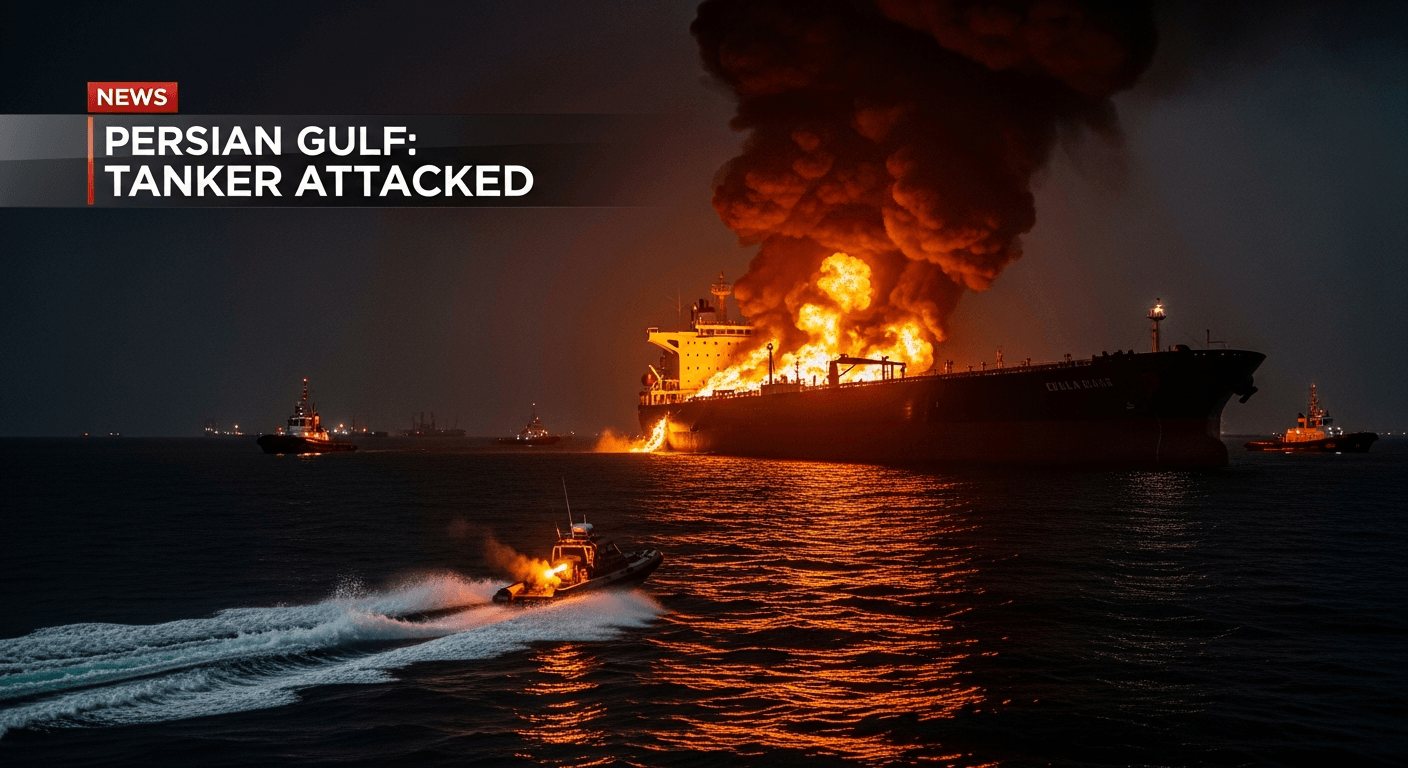
The moment I couldn't un-see
I watched the grainy night footage the way I watch too many small tragedies now: slow, incredulous, then a tightness in the chest. A small, fast craft — what reporters call a "suicide" boat — slams into a US-linked crude tanker conducting transfers near Khor Al Zubair. Flames swallow the deck. Crew abandon ship. We learn, in the next hours, that at least one seafarer died and dozens were evacuated to Basra.Watch the footage and reporting.
This was not a theatrical escalation confined to a map. It was a human moment at sea: someone feeding their family, someone a colleague, someone who woke up that morning thinking about weather and schedules — now a casualty of geopolitics.
What the short clip tells us about a larger risk
- The choice of target — a commercial tanker during a ship-to-ship transfer — is deliberate. Attacking commerce is a fast way to amplify strategic pain beyond the battlefield.
- Maritime geography matters: attacks inside or near territorial waters (here, near Iraq's Basra) complicate response, rescue and investigation.
- The human cost is immediate; the economic ripple — insurance spikes, re-routed voyages, port suspensions — is systemic.
These are not new patterns. What changes is how quickly a single clip can transmit fear and policy pressure around the world.
Why this should trouble anyone who cares about trade, safety and common sense
Global trade is built on fragile choreography: schedules, port slots, insurers, and, above all, seafarers who accept long separations from home for pay that rarely reflects the risks. When a tanker goes up in flames:
- Energy markets wobble; prices spike and consumers feel it at the pump.
- Ports and terminals in the region may suspend operations, disrupting supply chains for weeks.
- Insurance premiums and the cost of security escorts rise — raising the cost of everything that crosses those waters.
We have to remember: the water is an international commons supporting livelihoods far from the front lines. A destroyed tanker isn't only a military message; it's a severed lifeline for millions.
What needs doing — practical, not political
- Prioritize crew safety: faster medical evacuation protocols, better contingency planning for transfers, and robust search-and-rescue coordination among nearby ports.
- Clear rules for ship-to-ship transfers during conflict: if transfers are permitted, neutral third-party escorts or monitored safe corridors should be mandated.
- Transparency in investigations: to prevent escalation, independent inquiries into attacks must be allowed and findings shared quickly.
- Financial cushions for seafarers' families: insurer and owner liability frameworks must be enforced so families are not left destitute while politics play out.
These are the kinds of operational fixes that reduce human suffering while the diplomats and strategists argue the larger questions.
Where my thinking comes from (a small continuity)
I've long written about the brittle seams that hold infrastructure and trade together. Years ago I wrote about the maritime economy and how port ecosystems, like the recycling and shipbreaking centers we rely on, are part of a broader supply-chain fabric that can be frayed by policy or conflict — not just by storms or markets.Alang: junkyard, scrapyard, saveyard. That continuity — infrastructure, people, and policy — matters now as much as ever.
A personal note
I don't pretend to have the final answer. What I do have is a sense of urgency: to treat seafarers as citizens with rights, to treat commercial sea lanes as commons that deserve protection, and to treat escalation as something that can and should be managed before it savages lives and livelihoods.
If we aim to survive the fog of modern warfare with any wisdom, we must start by protecting those who keep our lights on, our factories running and our hospitals supplied.
Regards,
Hemen Parekh hcp@recruitguru.com
Any questions / doubts / clarifications regarding this blog? Just ask (by typing or talking) my Virtual Avatar on the website embedded below. Then "Share" that to your friend on WhatsApp.
Get correct answer to any question asked by Shri Amitabh Bachchan on Kaun Banega Crorepati, faster than any contestant
Hello Candidates :
- For UPSC – IAS – IPS – IFS etc., exams, you must prepare to answer, essay type questions which test your General Knowledge / Sensitivity of current events
- If you have read this blog carefully , you should be able to answer the following question:
- Need help ? No problem . Following are two AI AGENTS where we have PRE-LOADED this question in their respective Question Boxes . All that you have to do is just click SUBMIT
- www.HemenParekh.ai { a SLM , powered by my own Digital Content of more than 50,000 + documents, written by me over past 60 years of my professional career }
- www.IndiaAGI.ai { a consortium of 3 LLMs which debate and deliver a CONSENSUS answer – and each gives its own answer as well ! }
- It is up to you to decide which answer is more comprehensive / nuanced ( For sheer amazement, click both SUBMIT buttons quickly, one after another ) Then share any answer with yourself / your friends ( using WhatsApp / Email ). Nothing stops you from submitting ( just copy / paste from your resource ), all those questions from last year’s UPSC exam paper as well !
- May be there are other online resources which too provide you answers to UPSC “ General Knowledge “ questions but only I provide you in 26 languages !



No comments:
Post a Comment