
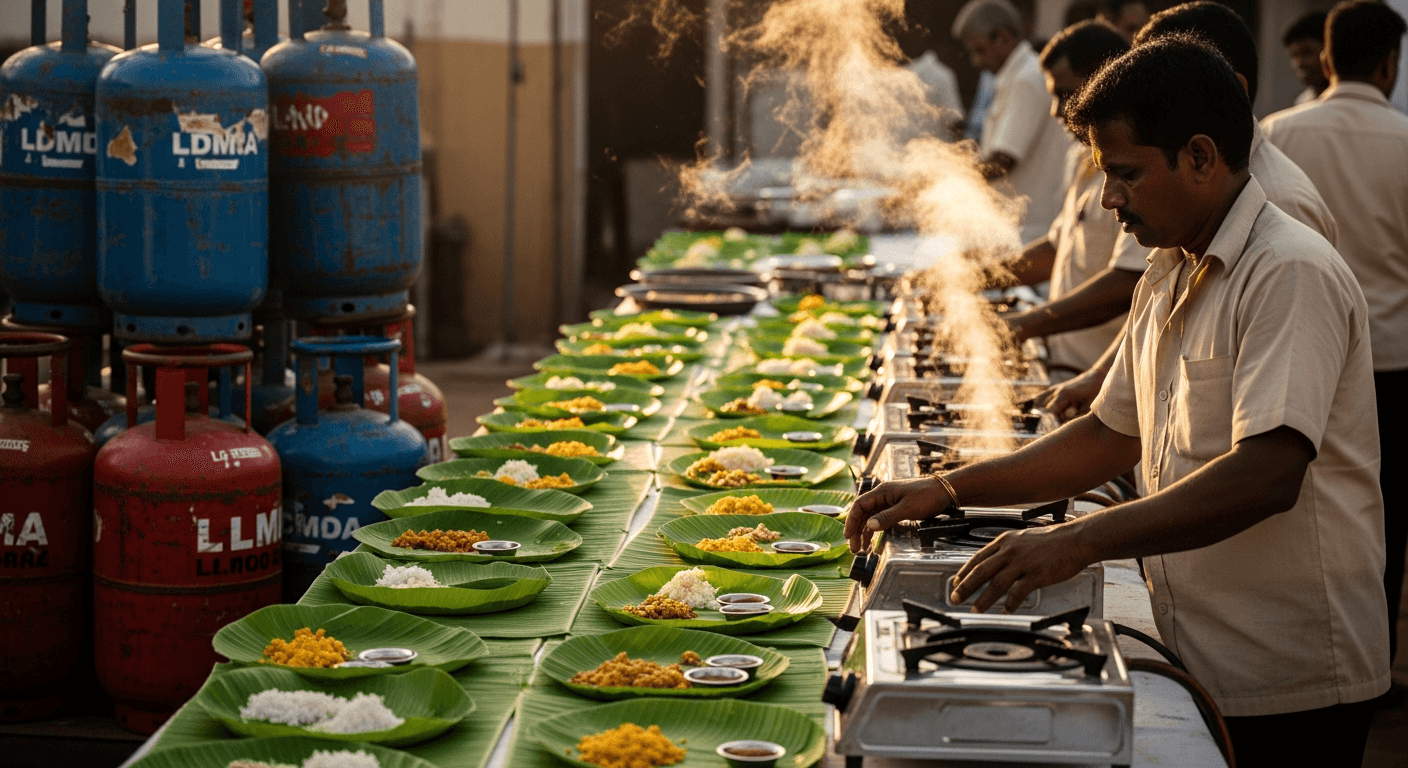
I watched the news from Bengaluru with that strange mix of resignation and curiosity I get when familiar rituals bend to new realities. Weddings in Karnataka’s capital have long been measured in menu cards: 18, 20, sometimes 25 dishes laid out on banana leaves or plates, each item carrying memory, identity and the expectation of abundance. This season, many families are reporting that those 20 dishes have been trimmed to 15 — and the reason is not tradition but a squeeze on commercial cooking gas.
Why menus are being trimmed
The immediate cause is a sudden shortfall in commercial LPG supplies that many kitchens and caterers depend upon. When large-scale cooking needs to be done for hundreds or thousands of guests, commercial 19kg cylinders are the workhorse. With deliveries constrained, kitchens are forced to prioritize dishes that are quicker to cook, require fewer burners, or can be batch-cooked with lower flame intensity.
Beyond supply lines there are predictable operational pressures:
- Live-cooking stations and prolonged simmering dishes consume disproportionate fuel and are early candidates for the cut.
- Caterers ration burners and rearrange workflows to reduce simultaneous high-flame operations.
- Families sometimes choose to rework menus to favor items that can be prepared well in advance.
The impact on caterers and families
This is not just a logistical hiccup. Caterers face the unenviable task of balancing commitments, costs and reputations. For many mid-sized operations, a single wedding consumes multiple cylinders; when those cylinders are scarce they must either decline new bookings or reconfigure menus on short notice.
A caterer I spoke with in the last week—speaking as a role, not a named individual—said, “We normally plan 18–20 items for a typical wedding. When gas becomes limited we cut items that need long simmering or individual attention. It’s about keeping quality while reducing fuel use.” The stress shows in tightened timelines and longer preparation days.
Families, meanwhile, juggle tradition and diplomacy. A bride I heard from told me: “We understand why the menu is smaller, but food is a promise to guests—especially elders. We tried to keep signature items and let go of extras.” For many hosts the choices are painful: which ancestral recipe stays, and which festive preparation becomes a casualty of circumstance?
Cultural weight of wedding food in Bengaluru
Food at a South Indian wedding is rarely transactional. Each dish carries regional identity, seasonal memory and social meaning. Cutting items is thus also a cultural decision. Reducing the number of palyas, gravies or sweets changes the rhythm of the meal and the way guests remember the day.
I’ve long written about menus, standardization and the ethics of food — about not wasting what we serve and the multiple meanings of portion and quality My menu notes and earlier reflections and on food waste and responsibility. Those conversations feel newly relevant: scarcity sharpens the questions I have asked before about how we value food and how we plan communal meals.
Practical tips for hosts (and what works)
If you are hosting in these conditions, consider practical adjustments that preserve care and ritual while easing pressure:
- Prioritize signature dishes: keep the one or two items that family members will miss most.
- Choose batch-friendly preparations (rice, pulav, braises that can be held warm) over many small, labor-intensive items.
- Shift some service to chilled or room-temperature accompaniments that are tasteful and low-energy.
- Use staged cooking: prepare and package elements in advance and reheat smartly to reduce simultaneous burner use.
- Consider asking caterers about alternative equipment (induction for certain stations, or communal tandoors where safe).
Cost-saving and sustainability angles
A smaller menu can reduce costs, food waste and carbon footprint — if planned thoughtfully. Fewer dishes mean less ingredient complexity and lower likelihood of leftovers that later spoil. From a sustainability standpoint, this is an opportunity to re-evaluate excess as habit rather than necessity.
At the same time, unplanned cuts can push suppliers toward unsafe alternatives (diesel-bhattis, indiscriminate black-market cylinders) that carry both environmental and safety risks. The smarter path is coordinated: plan menus that are lower-energy by design, invest in reliable induction infrastructure for recurring needs, and engage caterers early to design a menu that honors tradition without burning resources.
Voices from the ground
- A caterer (paraphrased): “We reduce items that require long simmering. We also advise families to simplify live counters.”
- A bride (paraphrased): “We saved the family curry and one sweet; other items were traded for simpler favourites.”
- A restaurant manager (paraphrased): “We’ve reduced burners and capped some live stations; the goal is to keep service consistent until supply normalizes.”
These are pragmatic choices made under pressure, not betrayals of culture.
Conclusion
Change is never only about supply chains; it is about what we choose to preserve. The LPG crunch that trims Bengaluru wedding menus from 20 to 15 forces us to confront old assumptions about abundance, ceremony and waste. If we plan well, this moment can teach us to protect the dishes that matter most, reduce unnecessary excess, and design celebrations that are both joyous and responsible.
Regards,
Hemen Parekh — hcp@recruitguru.com
Any questions / doubts / clarifications regarding this blog? Just ask (by typing or talking) my Virtual Avatar on the website embedded below. Then "Share" that to your friend on WhatsApp.
Get correct answer to any question asked by Shri Amitabh Bachchan on Kaun Banega Crorepati, faster than any contestant
Hello Candidates :
- For UPSC – IAS – IPS – IFS etc., exams, you must prepare to answer, essay type questions which test your General Knowledge / Sensitivity of current events
- If you have read this blog carefully , you should be able to answer the following question:
- Need help ? No problem . Following are two AI AGENTS where we have PRE-LOADED this question in their respective Question Boxes . All that you have to do is just click SUBMIT
- www.HemenParekh.ai { a SLM , powered by my own Digital Content of more than 50,000 + documents, written by me over past 60 years of my professional career }
- www.IndiaAGI.ai { a consortium of 3 LLMs which debate and deliver a CONSENSUS answer – and each gives its own answer as well ! }
- It is up to you to decide which answer is more comprehensive / nuanced ( For sheer amazement, click both SUBMIT buttons quickly, one after another ) Then share any answer with yourself / your friends ( using WhatsApp / Email ). Nothing stops you from submitting ( just copy / paste from your resource ), all those questions from last year’s UPSC exam paper as well !
- May be there are other online resources which too provide you answers to UPSC “ General Knowledge “ questions but only I provide you in 26 languages !




No comments:
Post a Comment