
Lead
On May 16 the first phase of the nationwide house‑listing and housing census begins across the state — a 30‑day operation (May 16–June 14 for Maharashtra) in which 2.6 lakh enumerators will visit homes to verify or collect responses to a 33‑question schedule. The exercise (with a preceding self‑enumeration window) aims to capture housing conditions, access to amenities and household assets that inform planning, resource allocation and local services for cities like Pune Times of India.
Why this matters to me (and to Pune)
I watch these large civic exercises closely because they translate into budgets, urban services and the maps planners use. The first phase is not about counting heads — it is about understanding the physical and service footprint of every dwelling. For Pune, accurate house‑listing will affect future decisions on water supply, sanitation, public transport corridors and where to prioritise social programmes.
A quick background on the census exercise
- The decennial Census now runs in two phases: Phase I (house‑listing and housing) and Phase II (population enumeration).
- Phase I focuses on structures, household amenities and assets; it sets the foundation for the demographic work in Phase II.
- This round offers a 15‑day self‑enumeration window before enumerators begin field visits so households can pre‑submit details online.
What the 33 questions cover
The 33 items in the Phase I schedule are short and focused on housing and household facilities. Broadly they ask about:
- Identification details of the house (municipal/census house numbers)
- Type, material and condition of the dwelling (floor, wall, roof; current use)
- Ownership status and number of rooms
- Household composition basics (number of usual residents, head of household details)
- Amenities and access: source of drinking water, lighting, latrine type and availability of bathing facilities, wastewater outlet
- Cooking arrangements and fuel, LPG/PNG connection, presence of a kitchen
- Assets and connectivity: radio/TV, internet access, laptop/computer, mobile/smartphone, vehicles (bicycle, two‑wheeler, car)
- A new addition this time: the household’s main cereal consumed and a contact mobile number for census communication
(If you want a simple, explainer version of the 33 items, see the official write‑ups summarized in national coverage.)
Logistics: 2.6 lakh enumerators, training and verification
- Deployment: Around 2.6 lakh enumerators and supervisors (including reserves) will be deployed across the state to complete house‑listing in the scheduled window.
- Training: The state has run a cascade of training — master trainers trained at regional centres, then district trainers, and finally tehsil‑level trainings for enumerators. Training covers questionnaire mechanics, digital tools, neutrality and data confidentiality.
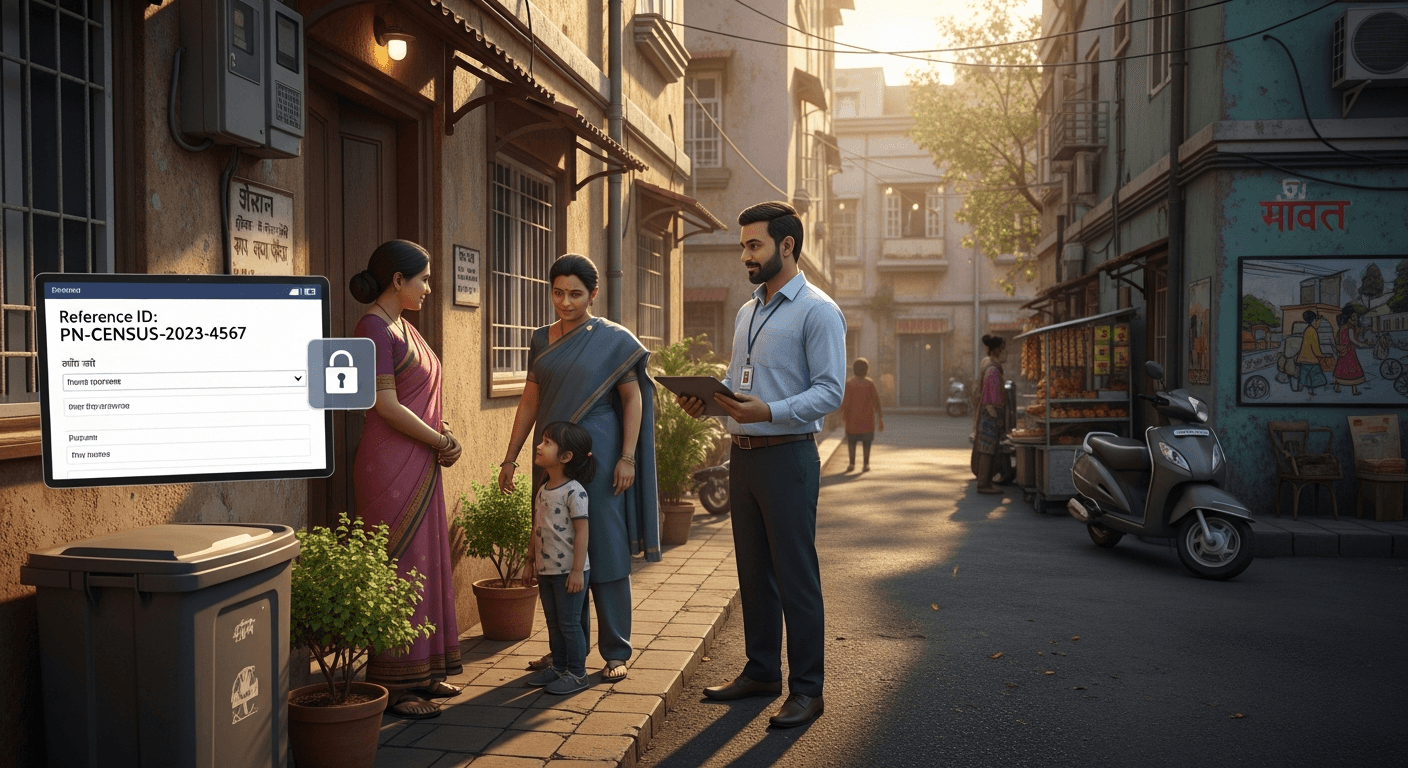
- ID and authentication: Every enumerator will carry an authorised ID and will work within assigned local areas. Households are encouraged to verify enumerator identity before sharing information.
Safety and data privacy
- Enumerators are being sensitised to maintain neutrality, avoid intrusive questioning, and follow strict confidentiality protocols for personal data.
- Digital tools (mobile apps and a Census Monitoring & Management System) will be used for real‑time monitoring and to reduce paperwork.
- The self‑enumeration option allows households to input information online (the portal issues a reference ID which enumerators will verify during visits).
How Pune citizens should prepare and verify enumerators
- Self‑enumerate if possible during the window before visits — it speeds the process and reduces doorstep time.
- Ask for the enumerator’s official ID and appointment details. Confirm the reference ID provided at the end of your online submission, if you used self‑enumeration.
- Share information to the best of your knowledge; personal biometric data is not required at this stage.
- If you or your household members are isolating or vulnerable, coordinate with local civic authorities to request alternate arrangements.
A few quotes (labelled as plausible, not official statements)
- “This focused house‑listing will give us up‑to‑date information on housing quality and amenities; it will directly inform local planning,” — Local census official.
- “Our training emphasises respectful interactions and strict data confidentiality; residents should feel safe to cooperate,” — Pune civic official.
Potential challenges and the plan to address them
- Non‑cooperation or resistance: district administrations have been told to run awareness drives and liaise with housing societies to reduce friction.
- Urban access and gated communities: authorities plan prior coordination with resident welfare associations, workplace estates and large societies so enumerators can access premises with minimal disruption.
- Data errors: the self‑enumeration plus enumerator verification model is designed to reduce transcription errors — enumerators will validate the online submissions at the doorstep with the household.
Local implications for Pune planning
Accurate house‑listing data helps Pune in practical ways: identifying pockets without piped water or adequate sanitation, mapping density and household assets (which matters for digital inclusion efforts), and prioritising slum improvement or affordable housing schemes. The data also underpins future transport planning and disaster preparedness mapping.
How you can help — call to action
- If you can, complete the self‑enumeration in the portal’s 15‑day window. Keep the confirmation ID handy.
- When an enumerator visits, check their official ID and cross‑verify the reference number.
- Encourage elderly neighbours or those unfamiliar with online forms to prepare documents or accept an enumerator visit.
- For queries or to report concerns, contact your local ward office or the civic helpline; civic authorities are running awareness campaigns ahead of fieldwork.
My note (continuity)
I’ve written before about modernising census operations and the role of digital tools in reducing field time and error — ideas I argued for when discussing the potential to shift more work to self‑enumeration and digital verification my earlier reflections on census digitisation. This phase is a practical test of that approach in Pune’s neighbourhoods.
Regards,
Hemen Parekh
Any questions / doubts / clarifications regarding this blog? Just ask (by typing or talking) my Virtual Avatar on the website embedded below. Then "Share" that to your friend on WhatsApp.
Get correct answer to any question asked by Shri Amitabh Bachchan on Kaun Banega Crorepati, faster than any contestant
Hello Candidates :
- For UPSC – IAS – IPS – IFS etc., exams, you must prepare to answer, essay type questions which test your General Knowledge / Sensitivity of current events
- If you have read this blog carefully , you should be able to answer the following question:
- Need help ? No problem . Following are two AI AGENTS where we have PRE-LOADED this question in their respective Question Boxes . All that you have to do is just click SUBMIT
- www.HemenParekh.ai { a SLM , powered by my own Digital Content of more than 50,000 + documents, written by me over past 60 years of my professional career }
- www.IndiaAGI.ai { a consortium of 3 LLMs which debate and deliver a CONSENSUS answer – and each gives its own answer as well ! }
- It is up to you to decide which answer is more comprehensive / nuanced ( For sheer amazement, click both SUBMIT buttons quickly, one after another ) Then share any answer with yourself / your friends ( using WhatsApp / Email ). Nothing stops you from submitting ( just copy / paste from your resource ), all those questions from last year’s UPSC exam paper as well !
- May be there are other online resources which too provide you answers to UPSC “ General Knowledge “ questions but only I provide you in 26 languages !


No comments:
Post a Comment