
Induction Rush
Why a stove can tell us about geopolitics
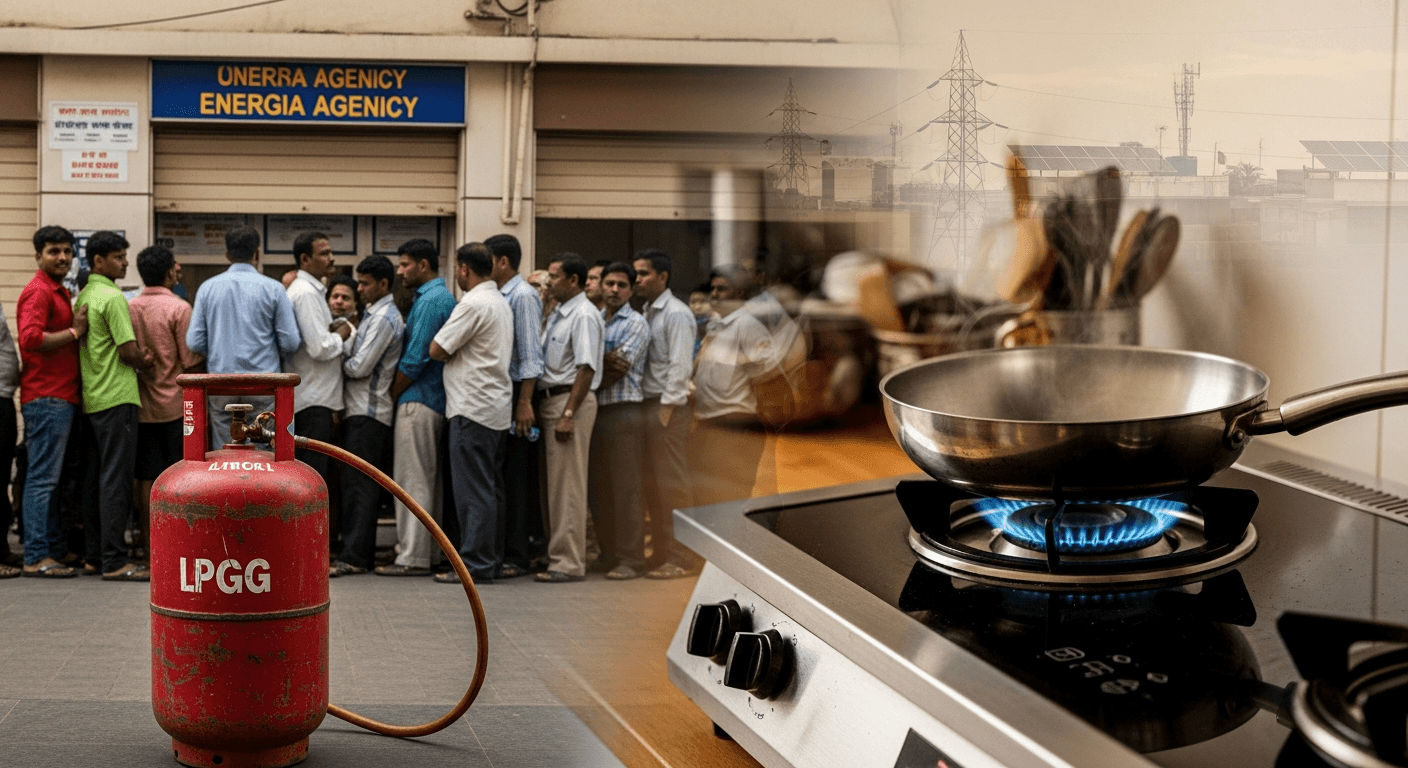
Over the past week I watched a familiar domestic panic unfold — queues at appliance stores, quick-commerce apps showing "out of stock" for induction hobs, and friends calling to ask whether they should buy one today. What began as worries about LPG deliveries and prices has become an instant experiment in how households adapt when the fuel they rely on feels suddenly fragile.
This is not just retail drama. Reports from multiple outlets show induction cooktops selling out across metro neighbourhoods and compatible cookware is vanishing from shelves too (India Today, News18, NDTV).
Four practical threads I keep returning to
1) Cookware matters — and many households underestimate that cost
Induction requires magnetic bottoms. If your aluminium kadhai or non-magnetic stainless pots are the only cookware you own, the shift to induction means another purchase. Retailers and field reports confirm cookware sales jumped alongside hobs — the total switching cost is therefore induction hob + compatible utensils (India Today).
Practical tip I tell friends: start with one hob and one multipurpose induction-compatible vessel, learn how timings translate from flame to induction, then expand. Buying dozens of single-use gadgets in a panic is expensive and often unnecessary.
2) The grid can absorb a lot — but not everywhere, not instantly
Induction cooking is significantly more energy-efficient at the point of use than LPG, but it shifts demand from cylinders to the electricity system. Urban grids are much stronger today than five years ago, and India’s installed capacity has climbed past 500 GW — yet distribution networks (discoms) and wiring in older buildings can be constraints (Energy Connects summary; IISD analysis, https://www.iisd.org/system/files/2026-02/india-clean-cooking.pdf).
Two points to note:
- Local wiring upgrades matter more than national capacity. A single apartment may need a dedicated connection or an electrical upgrade to run multiple high-power induction burners reliably.
- If millions of households switch quickly, peak load patterns change — policy and distribution companies need to anticipate and manage that (smart metering, demand shifting, targeted incentives for off‑peak charging of thermal/e-cooking devices).
3) Policy can smooth transitions — or deepen inequities
The government has tools: from prioritising PNG allocations and invoking essential-supplies rules for LPG, to targeted subsidies and mass procurement for induction devices (we have seen emergency measures and reassurances from authorities). But a durable move toward e-cooking requires:
- Subsidy design that recognises upfront cost barriers (device + cookware + wiring)
- Focused support for commercial kitchens and small eateries, which face expensive retrofits
- Integration with rooftop solar and battery programmes for resilient off-grid options in weaker-grid areas
I’ve written before about battery-powered electric cookers and hybrid solar-electric appliances as practical complements to grid-led solutions — and how swappable batteries and retail networks could lower adoption friction (my earlier note on electric-solar hybrid ovens and battery ideas).
4) Behavioural response will shape the long-term outcome
What we are seeing right now is partly precaution: households buying induction as insurance against LPG uncertainty. Panic and precaution often co-exist — we’ve seen customers purchase multiple units, and quickcommerce channels exhaust inventories within days (CNBC-TV18, Open).
Two likely behavioural patterns:
- Some households will keep induction as a permanent second stove (hybrid kitchens), easing future transitions.
- Others will revert to LPG if supplies stabilise, leaving a boom‑and‑bust demand cycle that strains manufacturers and retailers.
Policy nudges and affordable finance for appliances and wiring upgrades will shift behaviour from temporary hedging to long-term adoption.
Short, practical checklist for households and small eateries
- Evaluate: Is your building wiring adequate? If older, consult an electrician before buying multiple high-power burners.
- Buy smart: start with one good induction hob + one multipurpose compatible wok/pati; test timings.
- For restaurants: measure conversion cost (power upgrade + burners) vs temporary use of electric pressure cookers and rice cookers; plan phased retrofits.
- Watch tariffs: understand how increased consumption moves you between slabs; sometimes time-of-use or off-peak cooking (where available) can cut costs.
Policy ideas I’d like to see implemented quickly
- Rapid SKU (stock-keeping) support: subsidised bulk procurement channels (like earlier EESL pilots) to stabilise prices and ensure quality.
- Targeted grants or low-interest loans for wiring upgrades in older apartment blocks and commercial kitchens.
- Incentives for manufacturers to scale induction‑compatible cookware domestically, avoiding short supply and price gouging.
I have argued in previous posts that pairing electric cooking with modular battery solutions and rooftop solar could accelerate clean-cooking adoption — and current events only make that case more urgent (see my earlier analyses).
Final reflection
A scramble for stoves is a small, messy mirror of big geopolitical and energy transitions. Households act fast when they feel vulnerable; markets and policy must act just as fast — not to panic-buy, but to plan. If we make sensible choices now (on cookware, wiring, distribution support and smart subsidies) we can turn this nervous buying into a constructive acceleration toward cleaner, more resilient cooking.
Regards,
Hemen Parekh
Any questions / doubts / clarifications regarding this blog? Just ask (by typing or talking) my Virtual Avatar on the website embedded below. Then "Share" that to your friend on WhatsApp.
Get correct answer to any question asked by Shri Amitabh Bachchan on Kaun Banega Crorepati, faster than any contestant
Hello Candidates :
- For UPSC – IAS – IPS – IFS etc., exams, you must prepare to answer, essay type questions which test your General Knowledge / Sensitivity of current events
- If you have read this blog carefully , you should be able to answer the following question:
- Need help ? No problem . Following are two AI AGENTS where we have PRE-LOADED this question in their respective Question Boxes . All that you have to do is just click SUBMIT
- www.HemenParekh.ai { a SLM , powered by my own Digital Content of more than 50,000 + documents, written by me over past 60 years of my professional career }
- www.IndiaAGI.ai { a consortium of 3 LLMs which debate and deliver a CONSENSUS answer – and each gives its own answer as well ! }
- It is up to you to decide which answer is more comprehensive / nuanced ( For sheer amazement, click both SUBMIT buttons quickly, one after another ) Then share any answer with yourself / your friends ( using WhatsApp / Email ). Nothing stops you from submitting ( just copy / paste from your resource ), all those questions from last year’s UPSC exam paper as well !
- May be there are other online resources which too provide you answers to UPSC “ General Knowledge “ questions but only I provide you in 26 languages !


No comments:
Post a Comment