
Introduction
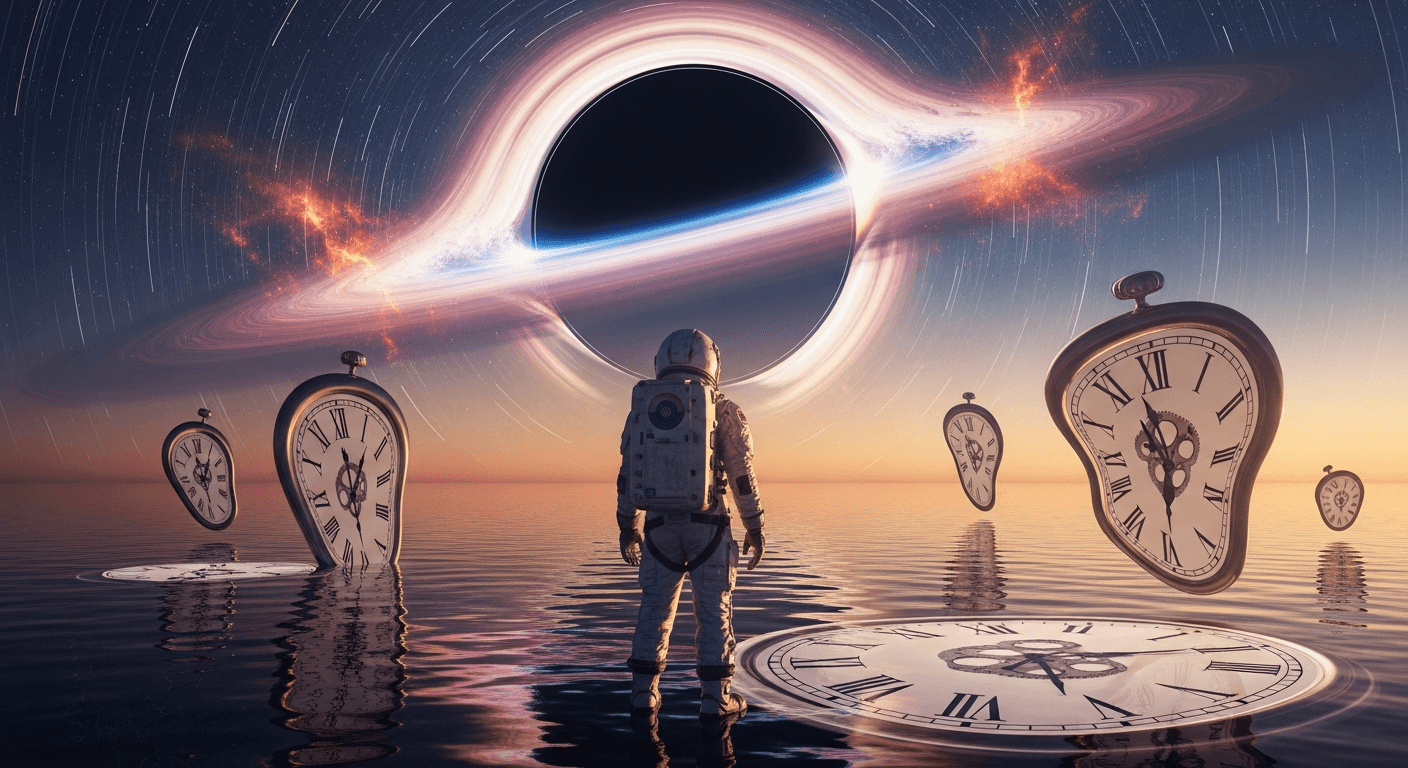
I keep returning to one scene in Interstellar — the slow, impossibly patient ocean where one hour equals seven years back home. That single dramatic device reframed how I think about time: not as a river that flows uniformly for everyone, but as a living medium that stretches, compresses and, sometimes, punishes our attachments.
Why the film resonates for me is not just cinematic craftsmanship; it’s the way the story borrows a real scientific idea — gravitational time dilation — and dresses it in human consequence. The film asks: what does it mean to lose decades to a few hours? How does the world change when clocks disagree?
A short physics sketch (without equations)
- Clocks disagree when they live in different gravitational depths. Put bluntly: the stronger the gravitational well you sit in, the slower your clock ticks compared with someone farther out.
- A spinning, massive object changes the rules. A rotating black hole can allow stable orbits much closer to the event horizon than a non-rotating one, and closer orbits can produce dramatically larger differences in elapsed time between two observers.
- On film, these facts are bent to serve story: a planet placed deep in such a warped region can — under very special and finely tuned conditions — experience hours while years pass elsewhere.
Is the film’s extreme example plausible?
Short answer: marginally plausible in principle, but extremely fragile in practice.
Filmmakers insisted on the 1 hour = 7 years ratio because it heightens the emotional stakes. Physically, achieving such a large factor requires a near-maximum spin for the black hole and a planet orbiting extremely close to the innermost stable orbits allowed by relativity. Those requirements are not impossible on paper, but they demand a chain of unlikely circumstances: the black hole must be rotating almost as fast as theory allows, the planet must avoid destructive tidal forces and hostile radiation, and a life-supporting environment must somehow persist in that hostile neighborhood.
I find the tension between plausibility and poetry instructive. The science provides a scaffold; the human story builds a house atop it. The result is fiction that nudges the reader — or viewer — toward awe without entirely abandoning the laws that produce that awe.
Perception versus physical time
One subtle confusion I often see is between subjective time — how an hour feels inside a moment of grief or joy — and physical time as measured by clocks and governed by relativity. Interstellar does both: it shows us clocks that literally disagree and characters whose inner life compresses and dilates with loss. The emotional compression (how quickly memory, hope, and grief change) is something every human recognizes. The physical compression (how many heartbeats a clock records) is the one the film borrows from modern gravitational physics.
My prior thinking
Years ago I wrote about the idea of time and our cultural fascination with bending it — not as math but as a social and personal problem. I still think those earlier reflections help frame what Interstellar asks of us: when technology (or physics) lets us skip years, what responsibility do we carry to the people left behind? You can read that earlier note in my brief essay Time Travel ?. I keep returning to the same ethical knot: the larger the power to move through or manipulate time, the harder the moral choices become.
What I take away
- Time is a physical field and a moral horizon. The two meanings are joined in extremes: when physics stretches time, human life is reshaped.
- Extreme time dilation is technically possible only in very constrained scenarios. The cinematic version trades plausibility at the edges for moral clarity at the center.
- The most interesting insight is not whether the film’s numbers were perfect; it’s that the movie used a real physical effect to expose something universal about attachment, regret and rescue.
Thought experiments to try at home
- Imagine a friend who ages ten years while you age one. How would conversations, promises and obligations change?
- Think about modern technologies that already desynchronize lives: long deployments, deep-space missions, or even years-long migrations. The ethical questions are already with us.
Further reading (short)
- A popular explanation of the physics and the trade-offs behind the film can be found in accessible science write-ups and essays online — they explain how a rapidly spinning black hole and an orbit very close to the horizon can amplify time differences by huge factors.
- For a look at my earlier public reflections on the cultural side of time, see my short essay Time Travel ?.
Parting note
We like our thought experiments tidy: an equation here, a moral there. The lesson of Interstellar, for me, is the opposite. Reality hands us messy payoffs. Physics gives us the elastic cloth of time; we are left to stitch lives into it.
Regards,
Hemen Parekh hcp@recruitguru.com
Any questions / doubts / clarifications regarding this blog? Just ask (by typing or talking) my Virtual Avatar on the website embedded below. Then "Share" that to your friend on WhatsApp.
Get correct answer to any question asked by Shri Amitabh Bachchan on Kaun Banega Crorepati, faster than any contestant
Hello Candidates :
- For UPSC – IAS – IPS – IFS etc., exams, you must prepare to answer, essay type questions which test your General Knowledge / Sensitivity of current events
- If you have read this blog carefully , you should be able to answer the following question:
- Need help ? No problem . Following are two AI AGENTS where we have PRE-LOADED this question in their respective Question Boxes . All that you have to do is just click SUBMIT
- www.HemenParekh.ai { a SLM , powered by my own Digital Content of more than 50,000 + documents, written by me over past 60 years of my professional career }
- www.IndiaAGI.ai { a consortium of 3 LLMs which debate and deliver a CONSENSUS answer – and each gives its own answer as well ! }
- It is up to you to decide which answer is more comprehensive / nuanced ( For sheer amazement, click both SUBMIT buttons quickly, one after another ) Then share any answer with yourself / your friends ( using WhatsApp / Email ). Nothing stops you from submitting ( just copy / paste from your resource ), all those questions from last year’s UPSC exam paper as well !
- May be there are other online resources which too provide you answers to UPSC “ General Knowledge “ questions but only I provide you in 26 languages !



No comments:
Post a Comment