
Introduction
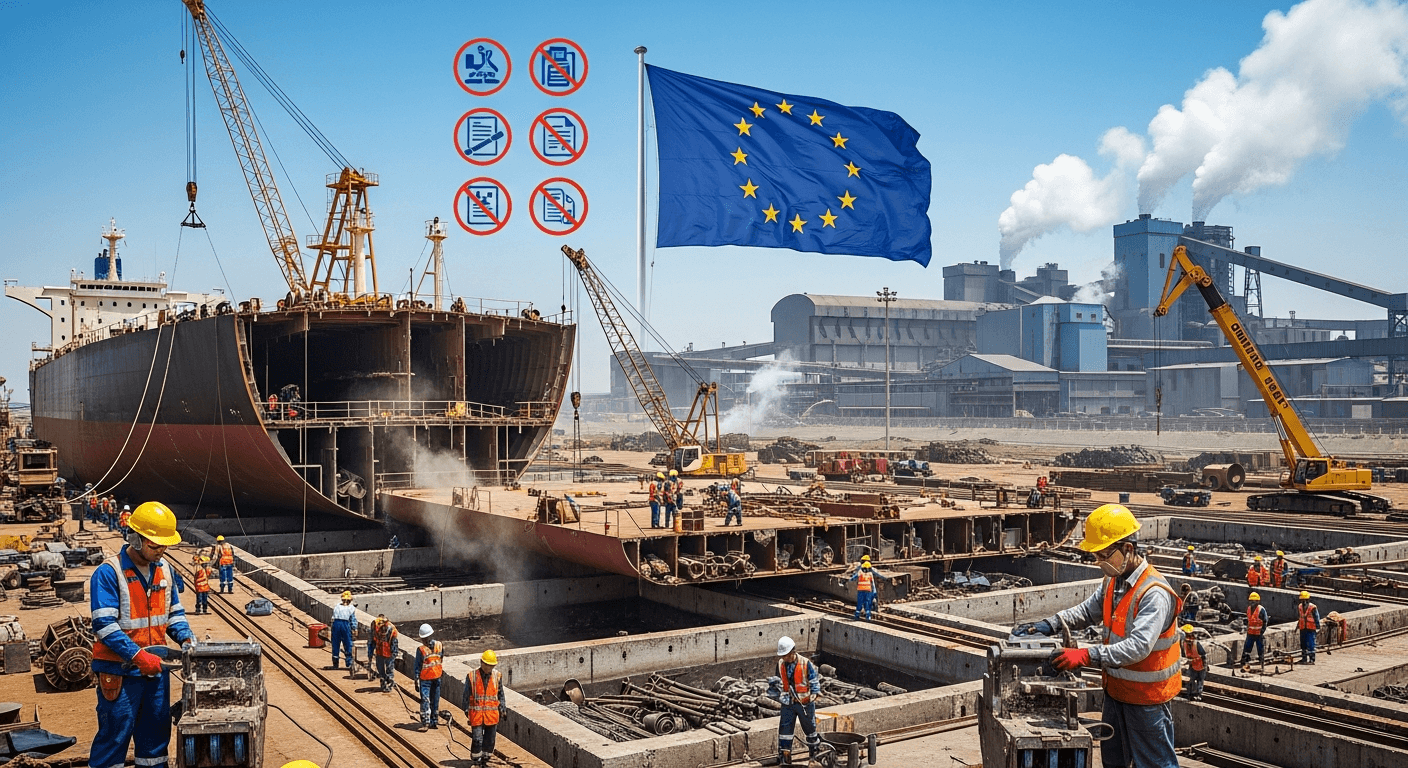
I follow developments in ship recycling because they sit at the intersection of trade, environmental policy and livelihoods. Recent calls from a major cash buyer in the market urging the European Commission to approve qualified Indian ship recycling facilities have re‑opened an important debate: can regulatory frameworks reconcile high environmental and labour standards with the realities of global recycling capacity?GMS Calls on EU to Include Indian Recycling Yards on List
Why EU authorisation matters for Indian recyclers
- EU‑flagged vessels (and non‑EU ships calling at EU ports) must meet requirements under the EU Ship Recycling Regulation (EU SRR). Ships intended for recycling under EU rules must go to facilities listed on the European List of authorised ship recycling facilities. That list is the gateway for EU‑origin business and a reputational benchmark globally.EU SRR overview and European List details
- Without inclusion, Indian yards can still operate (and service the majority of global recycling tonnage). But exclusion limits access to European owners and to a market segment that increasingly demands traceable, regulated end‑of‑life solutions.
A short primer on ship recycling and the regulatory landscape
- Ship recycling recovers steel and components and is materially circular: a large proportion of a vessel’s steel and equipment is re‑used or re‑rolled. South Asia (notably India, Bangladesh and Pakistan) currently handles the bulk of global dismantling by volume.
- Two regulatory instruments matter most: the Hong Kong Convention (HKC) administered by IMO, which sets international minimum standards, and the EU SRR, which implements HKC principles into EU law but adds site‑level requirements (downstream waste management, medical facilities, impermeable working surfaces, etc.). The EU SRR also enforces an explicit European List of approved facilities.EU SRR evaluation and comparison with HKC
What GMS is proposing (summary)
- The industry statement urges the European Commission to permit facility‑level approvals for Indian yards that meet the technical requirements rather than applying geographic presumptions. The argument is that many Indian yards already hold HKC Statements of Compliance from classification societies and have undergone Commission inspections; they contend listing delays are political rather than technical.GMS position (examples in market press)
- GMS also highlights capacity: the current European List does not, in aggregate, have the throughput to handle expected needs, while Indian yards offer scale.
EU SRR requirements in practice (why approvals are not automatic)
- Beyond HKC alignment, the EU requires demonstrated access to suitably certified downstream waste management and emergency/medical facilities, quality of on‑site infrastructure (e.g., impermeable floors), and independent verification. The Commission uses inspections and supporting documentation to decide on inclusion. The SRR therefore evaluates functional ecosystems, not just yard paperwork.EU SRR implementation and site inspection guidance
- The Basel Convention and recent changes to the EU Waste Shipment Regulation complicate cross‑border movements of hazardous materials and can create legal friction between an EU owner’s obligations and recycling outside OECD jurisdictions.
Environmental and labour concerns
- Legitimate concerns remain about worker safety, hazardous material handling and coastal pollution. The EU SRR arose precisely because of these risks and because the EU sought higher, enforceable standards for its flagged tonnage.
- But the landscape has changed: many yards in India have invested in containment, medical support and IHMs (Inventories of Hazardous Materials). Verifying those upgrades at facility level is the pragmatic path to reconcile standards with capacity.Industry and Commission assessments on improvements and remaining gaps
Implications for global shipping and the Indian industry
- If the Commission accepts more non‑EU yards that demonstrably meet SRR criteria, owners gain access to more capacity with traceability; India gains market access and jobs. If not, EU owners will either need to use limited EU‑listed capacity or engage in legal/administrative workarounds (reflagging, last‑minute sailings) that increase costs and regulatory complexity.
- For India, EU listing would be an endorsement of investments made in yards and associated services; for the global fleet, it could improve overall environmental outcomes by bringing more capacity under independent oversight.EU SRR evaluation highlights capacity and enforcement issues
Possible timelines and next steps
- Applications by third‑country yards are processed through Commission implementing acts; successful listings last up to five years. The Commission has published evaluation work and continues inspections—expect ongoing bilateral technical engagement rather than an immediate policy reversal.European List updates and SRR evaluation 2025
- Practical next steps: sustained, transparent facility audits; upgraded downstream waste management agreements; cooperative EU‑India technical workstreams to resolve Basel/HKC interactions; and time‑bound pilot listings to test monitoring protocols.
My perspective and continuity with earlier reflections
I have written before about the potential to turn industrial recycling hubs into higher‑value circular economy nodes. In particular, I have noted how Alang’s scale can deliver low‑carbon recycled steel and livelihood benefits when combined with regulated practices.See my earlier note on green steel from dismantled ships
Regulation should not be an argument for exclusion; it should be a roadmap for verification. Facility‑level scrutiny, funded technical assistance and clear, enforceable monitoring would be my pragmatic recommendation: it aligns environmental protection, worker safety and global recycling realities.
Regards,
Hemen Parekh
Any questions / doubts / clarifications regarding this blog? Just ask (by typing or talking) my Virtual Avatar on the website embedded below. Then "Share" that to your friend on WhatsApp.
Get correct answer to any question asked by Shri Amitabh Bachchan on Kaun Banega Crorepati, faster than any contestant
Hello Candidates :
- For UPSC – IAS – IPS – IFS etc., exams, you must prepare to answer, essay type questions which test your General Knowledge / Sensitivity of current events
- If you have read this blog carefully , you should be able to answer the following question:
- Need help ? No problem . Following are two AI AGENTS where we have PRE-LOADED this question in their respective Question Boxes . All that you have to do is just click SUBMIT
- www.HemenParekh.ai { a SLM , powered by my own Digital Content of more than 50,000 + documents, written by me over past 60 years of my professional career }
- www.IndiaAGI.ai { a consortium of 3 LLMs which debate and deliver a CONSENSUS answer – and each gives its own answer as well ! }
- It is up to you to decide which answer is more comprehensive / nuanced ( For sheer amazement, click both SUBMIT buttons quickly, one after another ) Then share any answer with yourself / your friends ( using WhatsApp / Email ). Nothing stops you from submitting ( just copy / paste from your resource ), all those questions from last year’s UPSC exam paper as well !
- May be there are other online resources which too provide you answers to UPSC “ General Knowledge “ questions but only I provide you in 26 languages !




No comments:
Post a Comment