
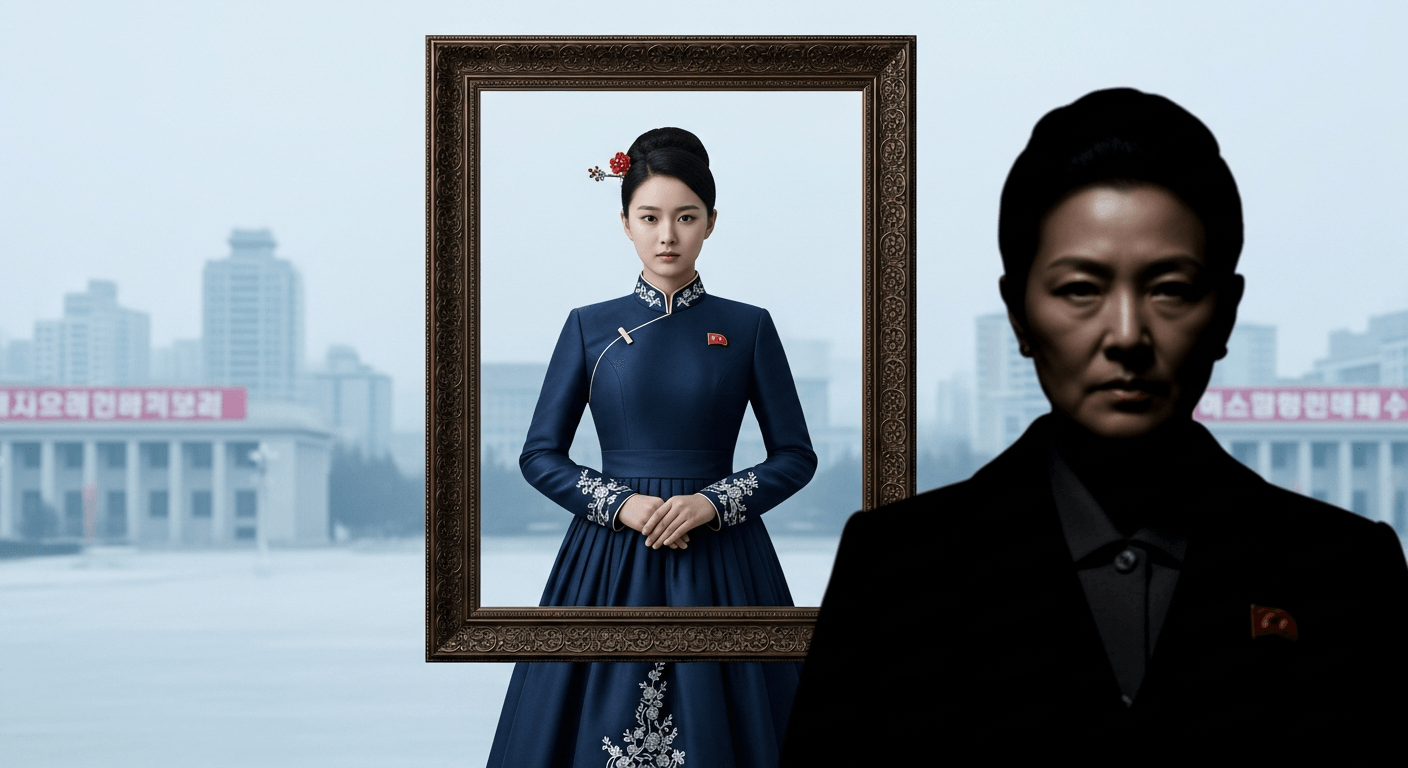
I write often about power as both spectacle and machine. In the case of the Korean peninsula the two are braided: ritualized images, dynastic liturgy and brittle institutions that survive by controlling ceremony as much as coercion. The phrase "girl in frame and an aunt in shadows" — part literal, part metaphor — captures a possibility that has long intrigued outside observers: could North Korea, after three male supreme leaders, see its first woman occupy the apex of state power?
Succession and the Kim-family logic: a short primer
North Korea's succession has been dynastic since its founding. Authority is concentrated in a small family network that fuses revolutionary mythology with personal loyalty. The regime has repeatedly shown it can adapt ritual and institution to ensure continuity: elevation ceremonies, party congresses, and state media choreography are all used to naturalize the transfer of authority.
Yet succession is not automatic. The system rests on three pillars that matter for any would‑be successor:
- The dynastic claim — membership in the ruling bloodline and the symbolic lineage tied to the country's founding myths.
- Control of the party and security organs — the bureaucratic levers that staff, punish, and reward.
- Military acquiescence — an armed apparatus accustomed to a particular chain of command and culture.
Within that starker frame, female figures can be powerful in practice, even if norms and the ideology of the state have been publicly male-centric.
Reading the metaphor: girl in frame, aunt in shadows
When I use "girl in frame," I mean the young woman placed intentionally in the public photograph: visible, tendered as both heir and living symbol. The "aunt in shadows" evokes a different posture — a woman who exercises influence behind the curtain, consolidating personnel, steering propaganda, and coordinating elites.
Together they represent two realistic configurations for female power in a dynastic authoritarian setting:
- A visible heir whose legitimacy rests primarily on bloodline and performance as a symbolic bridge to the past.
- A backstage power broker who marshals institutions and loyalists, potentially acting as regent, caretaker, or effective ruler without adopting full formal titles.
Both are historically plausible in modern monarchies and dynasties; both collide with local constraints that make a female supreme leader far from certain.
Profiles of plausible female actors (without naming)
Rather than name individuals, I describe the types of women who matter to any succession calculation:
- The sibling/close relative who already occupies senior party or propaganda roles. This figure usually has access to the leader, manages messaging and appointments, and appears at diplomatic junctures.
- The matriarchal or aunt figure with an old guard reputation — once a visible power broker, now less public but still capable of mobilizing networks formed over decades.
- The young daughter presented in state sightlines as "the future" — a symbolic seed for dynasty continuity whose actual political power depends entirely on who protects and translates that symbolism into institutional authority.
- Elite women from the security, intelligence or party apparatus who command patronage networks at lower tiers and can tip factional balances.
Each type has a distinct power base: access and influence (sibling), institutional memory and networks (aunt), dynastic symbolism (daughter), and bureaucratic control (elite cadres).
Constraints: why a woman’s path to the top is narrow
There are structural and cultural obstacles:
- Patriarchal norms: North Korean public ideology and social rituals are deeply gendered. While exceptional women can reach power, broader cultural resistance endures.
- Military-first politics: the armed forces are central in elite bargaining. Senior military leaders may resist a leader perceived as lacking military credentials.
- Elite factionalism: succession is a negotiation among party, security organs and provincial elites; any candidate requires enough patronage to neutralize rivals.
- Succession mechanics: there is no transparent constitutional process. Power transfers often occur through informal coalitions, purges, and staged rituals — instruments that both help and hurt non-traditional contenders.
Historical precedents and analogues
Authoritarian histories contain female leaders who rose through dynastic, partisan, or military-backed routes. In East Asia, female heads of state have emerged in electoral democracies and, less commonly, within autocratic systems as regents or dynastic placeholders. Those precedents show two things: female authority often leans on established familial legitimacy, and where military or party legitimacy is weak, female leaders tend to rely on regency or coalition governance rather than unilateral rule.
Anecdote — the public face as diplomacy: the Olympics delegation
I remember how a young female relative was once sent as the visible face of outreach during a high-profile multinational sporting event. Her appearance softened the regime’s image briefly and created diplomatic openings. That episode illustrated how visibility can be a foreign‑policy tool while also signaling interior succession priorities.
Anecdote — the cautionary purge
Another telling vignette: the dramatic fall of a high-ranking male official decades ago served as a public warning that family status does not guarantee safety. That purge hardened elites' calculations; it reminds us that the ruler's favor is both a shield and a sword — and that any future woman at the top would need swift control of coercive organs to survive.
Scenario analysis: plausible paths to a first female supreme leader
I consider several routes, with rough probability and timeline impressions:
Dynastic, generational succession (medium probability, medium-to-long term): The leader’s child is styled as heir; a trusted female relative acts as regent until adulthood. This preserves bloodline continuity and is institutionally familiar.
Direct elevation of a senior female relative (low-medium probability, short-to-medium term): If the leader becomes incapacitated and a sister or close female deputy already controls key organs, a rapid elevation could happen — but only with clear military and party backing.
Military-backed caretaker or coup (low probability, short-term): Hard to imagine without broader elite fractures; the military’s conservative culture makes a female-led coup less likely unless presented as temporary regency.
Proxy or collective leadership (medium probability, medium term): Female leaders might anchor a collective triumvirate where she is nominal head while real power is dispersed across loyalists.
Foreign influence (very low probability): Outside actors can encourage jokers but cannot install a leader — foreign backing would likely delegitimize any female claimant domestically.
Probabilities and timelines (a simple heuristic)
- Short term (1–3 years): Low probability for a formal female supreme leader; higher for female regent or temporary coordinator.
- Medium term (3–10 years): Medium probability for regency-first models transitioning to dynastic succession with a female acting as steward.
- Long term (10+ years): Higher probability for a woman to hold supreme authority if the symbolic heir is female and institutions have been reshaped to accept that narrative.
Domestic and international implications
Domestically, a female leader would not automatically mean liberalization. She would inherit the regime’s priorities: survival, control, and deterrence. Internationally, the West and regional powers would re-evaluate signaling and engagement strategies — cautiously testing whether a change in gender meant a change in policy. Allies and adversaries would watch elite purges and appointments closely to infer the true locus of power.
Conclusions
A first female supreme leader in that state is plausible but far from inevitable. The most realistic path is not a sudden ascension born of progressive gender norms, but a dynastic, symbolic logic combined with the backstage consolidation of power by an experienced female insider acting as regent or steward.
For analysts and policymakers the takeaway is practical: look beyond headlines and photographs. Track institutions — the party departments, security organs, and military chains of command — and measure who controls appointments and discipline. Those levers, not optics alone, will determine whether the next leader is a woman in a frame, an aunt in the shadows, or a more conventional successor.
Regards,
Hemen Parekh
Any questions / doubts / clarifications regarding this blog? Just ask (by typing or talking) my Virtual Avatar on the website embedded below. Then "Share" that to your friend on WhatsApp.
Further reading
- "Kim Yo-Jong | Facts, Biography, & Family" — Britannica: https://www.britannica.com/biography/Kim-Yo-Jong
- "Power and Perception: A Review of Sung-Yoon Lee’s 'The Sister'" — 38 North: https://www.38north.org/2024/01/power-and-perception-a-review-of-sung-yoon-lees-the-sister/
Get correct answer to any question asked by Shri Amitabh Bachchan on Kaun Banega Crorepati, faster than any contestant
Hello Candidates :
- For UPSC – IAS – IPS – IFS etc., exams, you must prepare to answer, essay type questions which test your General Knowledge / Sensitivity of current events
- If you have read this blog carefully , you should be able to answer the following question:
- Need help ? No problem . Following are two AI AGENTS where we have PRE-LOADED this question in their respective Question Boxes . All that you have to do is just click SUBMIT
- www.HemenParekh.ai { a SLM , powered by my own Digital Content of more than 50,000 + documents, written by me over past 60 years of my professional career }
- www.IndiaAGI.ai { a consortium of 3 LLMs which debate and deliver a CONSENSUS answer – and each gives its own answer as well ! }
- It is up to you to decide which answer is more comprehensive / nuanced ( For sheer amazement, click both SUBMIT buttons quickly, one after another ) Then share any answer with yourself / your friends ( using WhatsApp / Email ). Nothing stops you from submitting ( just copy / paste from your resource ), all those questions from last year’s UPSC exam paper as well !
- May be there are other online resources which too provide you answers to UPSC “ General Knowledge “ questions but only I provide you in 26 languages !




No comments:
Post a Comment