
Faster Data, Better Policy
Lead
In a clear push to modernise India's statistical infrastructure, the Ministry of Statistics and Programme Implementation (MoSPI) has signalled a programme of new surveys and expanded high‑frequency economic indicators (HFIs). The ministry’s recent public statements and interviews lay out a near‑term calendar of new household and enterprise surveys, trial service‑production indices, city‑level products for million‑plus urban areas, and stronger use of administrative and digital data sources to reduce reporting lags and improve policy relevance Economic Times PIB.
Background: MoSPI and the office driving this agenda
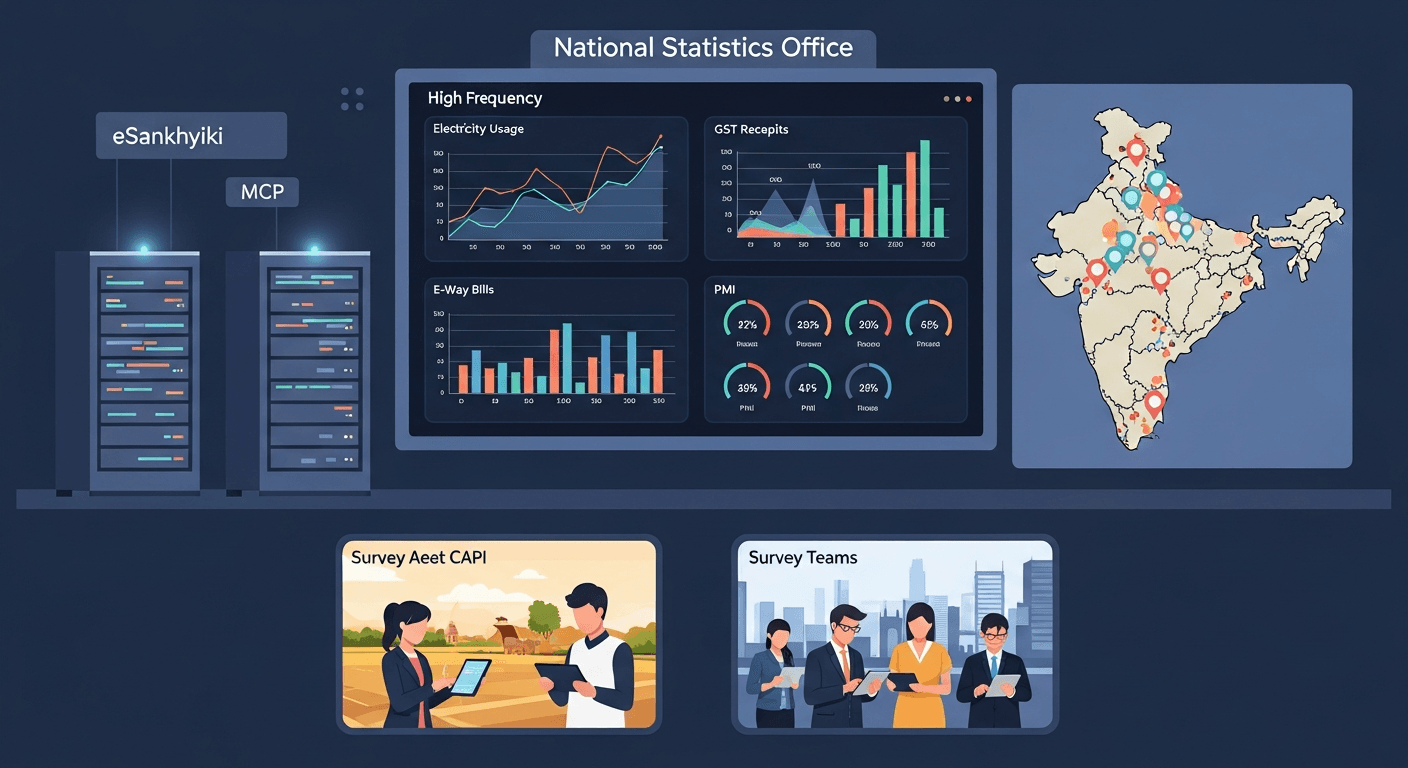
I’ve long believed that the quality and cadence of official statistics matter as much as intellectual frameworks. MoSPI is the central agency charged with national statistical standards, censuses, sample surveys, national accounts and metadata frameworks. Over the past 18 months the ministry has completed major base‑year revisions (GDP, CPI and IIP), introduced CAPI for price collection, and set up institutional tools—such as a Technical Advisory Committee for a proposed Index of Services Production (ISP), the Data Innovation Lab and the MCP server—to accelerate data modernisation PIB.
Operationally, the secretary’s office has been emphasising two linked priorities: (1) fill domain gaps (notably services and the unincorporated sector) and (2) shrink time‑lags via HFIs and administrative/digital sources. The announcements under discussion are practical manifestations of those priorities Economic Times.
What are high‑frequency indicators and why they matter
High‑frequency indicators are timely, often near‑real‑time measures of economic activity (daily, weekly or monthly) that complement conventional quarterly or annual statistics. Examples include electricity consumption, GST collections and filings, e‑way bills, railway and port freight, air passenger traffic, PMI indices, bank credit flows, and industrial production series. HFIs enable nowcasting, early detection of turning points, and faster calibration of monetary and fiscal policy—especially useful in economies with rapid structural change or frequent shocks PIB.
For policy makers and markets, HFIs reduce information asymmetry and shorten the lag between policy action and feedback on outcomes. But they are not substitutes for carefully designed sample surveys and national accounts; rather, they are complementary inputs for triangulation and real‑time analysis.
The new surveys and products: specifics and data design
MoSPI’s near‑term programme, as described in public briefings, includes:
- National Household Income Survey (NHIS) — a refreshed household income/expenditure instrument to underpin consumption and distributional analysis.
- Annual Survey of Incorporated Services Sector Enterprises — to fill long‑standing blind spots in corporate services measurement.
- Rapid Survey of Functional Cooperatives — focused, high‑frequency coverage of the cooperative segment.
- City‑level report for million‑plus cities — a dedicated product for unincorporated non‑agricultural enterprises in large urban areas.
- Surveys on Common Property Resources (2026) and Adult Skills (2027), plus continuation and enhancement of the Quarterly Bulletin of Unincorporated Sector Enterprises Economic Times.
Design features worth noting:
- Sample types: a mix of household panels (for income and time‑use), enterprise panels (formal and unincorporated), and focused rapid‑response modules for sectoral pain points.
- Frequency: some labour indicators (PLFS) are already moving to monthly or continuous modes; others (NHIS, ASUSE) are annual but will feed into higher‑frequency nowcasts.
- Digital/admin sources: explicit plans to leverage GST records, corporate filings, e‑way bills, electricity and fuel consumption, and platform data; integration via eSankhyiki APIs and the MCP server is being pursued PIB.
- Collection technology: wider use of CAPI and secure online transmission to improve timeliness and data validation.
These choices—mixed samples, hybrid frequency and administrative linkage—will materially improve timeliness and sectoral granularity if implemented with robust metadata and documentation.
Policy and market implications
If executed well, this agenda will:
- Improve the Federal and state policy response through more accurate GSDP/DDP estimation and faster feedback loops for fiscal transfers.
- Enhance monetary policy decision‑making by supplying timely consumption and services activity proxies between quarterly GDP releases.
- Strengthen market transparency, reducing forecast dispersion and improving pricing of risk in real time.
- Enable targeted sectoral interventions through sub‑sectoral ISPs and city‑level enterprise reporting.
The agenda dovetails with international best practice on nowcasting and with India’s broader move to incorporate non‑traditional data sources into official statistics [Economic Times; PIB].
Challenges and limitations
Ambition does not eliminate classical trade‑offs. Key risks include:
- Data quality and comparability: administrative datasets vary in coverage and incentives; harmonisation is hard and requires reconciliation protocols and metadata standards.
- Confidentiality and access: making rich administrative feeds usable for public statistics without compromising privacy or commercial confidentiality is non‑trivial.
- Sampling and representativeness: converting detailed household surveys (e.g., HCES) to very high frequency is constrained by cost and respondent burden; some series will remain inherently periodic.
- Institutional capacity: states/UTs need training and resources to produce timely GSDP/DDP under new methodologies.
Transparent release calendars, open methodology papers and stakeholder consultation will be essential to manage these risks Economic Times.
Conclusion
This is a pragmatic, technically coherent push: expand domain coverage (services, unincorporated sector, cities), modernise collection (CAPI, APIs) and shorten lags through HFIs. For policy makers and analysts, the next six to eighteen months will be a test of execution—how well MoSPI can convert these plans into documented, comparable and timely products. I welcome the transparency steps promised so far; success will hinge on clear metadata, state capacity building and open access for independent nowcasting work.
Regards,
Hemen Parekh
Any questions / doubts / clarifications regarding this blog? Just ask (by typing or talking) my Virtual Avatar on the website embedded below. Then "Share" that to your friend on WhatsApp.
Get correct answer to any question asked by Shri Amitabh Bachchan on Kaun Banega Crorepati, faster than any contestant
Hello Candidates :
- For UPSC – IAS – IPS – IFS etc., exams, you must prepare to answer, essay type questions which test your General Knowledge / Sensitivity of current events
- If you have read this blog carefully , you should be able to answer the following question:
- Need help ? No problem . Following are two AI AGENTS where we have PRE-LOADED this question in their respective Question Boxes . All that you have to do is just click SUBMIT
- www.HemenParekh.ai { a SLM , powered by my own Digital Content of more than 50,000 + documents, written by me over past 60 years of my professional career }
- www.IndiaAGI.ai { a consortium of 3 LLMs which debate and deliver a CONSENSUS answer – and each gives its own answer as well ! }
- It is up to you to decide which answer is more comprehensive / nuanced ( For sheer amazement, click both SUBMIT buttons quickly, one after another ) Then share any answer with yourself / your friends ( using WhatsApp / Email ). Nothing stops you from submitting ( just copy / paste from your resource ), all those questions from last year’s UPSC exam paper as well !
- May be there are other online resources which too provide you answers to UPSC “ General Knowledge “ questions but only I provide you in 26 languages !



No comments:
Post a Comment