
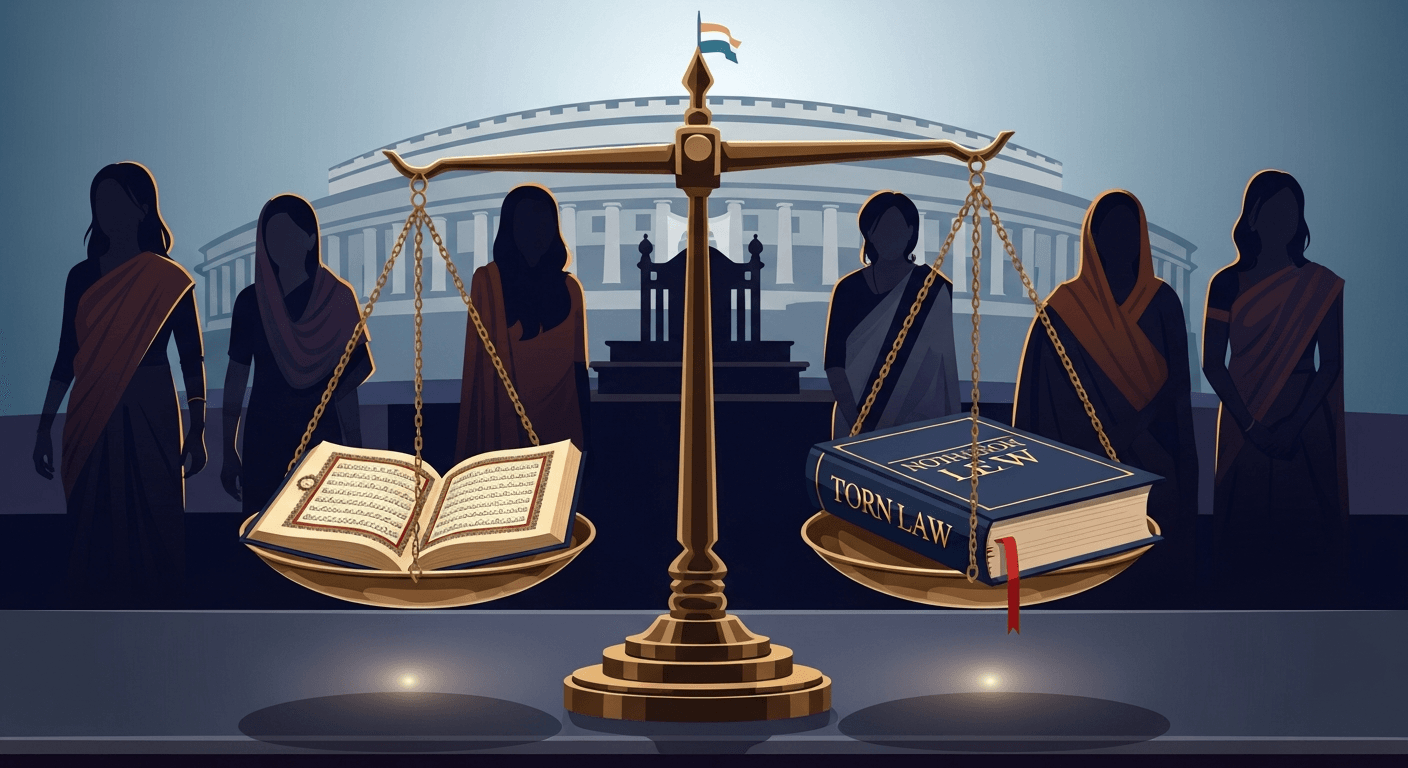
Only Way: UCC?
I write this as someone who watches law and polity not merely as texts on a page but as lived rules that shape people’s daily hopes and vulnerabilities. The recent Supreme Court hearing on public interest litigation seeking equal inheritance rights for Muslim women — in which the Court observed that a Uniform Civil Code (UCC) may be a solution — raises hard questions about constitutional values, democratic process, and the limits of judicial action. I want to set out the factual background, the legal tensions at play, comparative vantage points, plausible paths forward, and the likely social and political fallouts.
Background: what the petition asks and what the Court said
The petitions before the Court challenge aspects of Muslim personal law on succession and inheritance as discriminatory and violative of fundamental rights (Articles 14 and 15), asking that Muslim women be permitted equal shares on par with men. Petitioners have also sought the option for those who wish to be governed instead by the secular Indian Succession Act, 1925.
During a recent hearing the bench observed — while expressing concern about sudden legal vacuums — that one way to secure equal rights for all women might be the enactment of a Uniform Civil Code, and asked petitioners to clarify the legal consequences if certain religiously based succession rules were struck down by the Court ‘Only way is to bring in Uniform Civil Code’: Times of India and related coverage of the hearing NDTV coverage. A recent legal note tracking the petitions outlines how courts have been asked to determine whether discriminatory succession practices survive constitutional scrutiny LiveLaw summary.
The central legal issues
Equality vs. religious freedom: The petitions raise Article 14 (equality before the law) and Article 15 (non-discrimination on grounds including sex). Respondents (and broader constitutional theory) invoke Article 25 (freedom of religion) and the space it gives for religious practices — the classic clash between equality claims and the autonomy of personal laws.
The status of personal law: Indian jurisprudence has sometimes treated personal laws as part of the constitutional order yet subject to constitutional limits. The central question here is whether specific succession rules that systematically disadvantage women can be classified as ‘essential religious practice’ and therefore protected, or whether they are civil rules subject to equality review.
Remedies and legal lacunae: If a Court were to invalidate specific provisions of Muslim succession law, what law would fill the void? Would the Indian Succession Act, 1925 automatically apply? Would the state need to legislate interim rules? The bench’s concern about unintended legal vacuums is legally and practically acute.
Article 44 and the UCC: Article 44 of the Constitution urges the State to endeavour to secure a Uniform Civil Code. The Court’s references to UCC reflect both a legal and policy consideration: a UCC would resolve divergence in personal laws, but its adoption is a legislative and political decision.
Comparative and historical perspectives
Domestic precedents: The Court’s intervention in the triple talaq matter (striking down instant triple talaq as unconstitutional) and earlier reforms affecting Christian succession (notably Mary Roy’s case) show judiciary-driven change on personal-law issues. Those precedents demonstrate both the Court’s capacity to enforce constitutional guarantees and the political sensitivities that follow.
International comparisons: Countries with sizable Muslim populations have adopted varied approaches. Pakistan and Bangladesh retain significant elements of Muslim personal law while also enacting statutory reforms; several European countries allow religious arbitration in family matters but retain secular minimum standards of equality; the UK recognizes certain religious practices informally but enforces secular law where rights are engaged. These models show a spectrum: full assimilation into secular law, incremental statutory reform, or hybrid arrangements with individual choice.
Paths forward: realistic options
Legislative UCC: A nationally debated, democratically produced UCC would be the most comprehensive route. But politics complicate this — the subject is ideologically freighted and requires broad consensus, careful drafting, and transitional safeguards.
Targeted statutory reform: Parliament (or state legislatures where applicable) could enact focused succession reforms — either a gender-equal codification of succession applicable to all communities or an option-based statute allowing individuals to opt into the Indian Succession Act.
Community-led codification: Internal reform within communities — through codification of religiously-informed rules that are reinterpreted to satisfy constitutional equality — can be quicker and less polarising, if community leadership embraces gender equality.
Judicial incrementalism: Courts can invalidate discriminatory practices when they clearly violate constitutional norms, but must provide clear transitional arrangements to prevent legal vacuums. Subsidiary legislation or directions to the legislature may be necessary.
Political and social reactions to expect
Support from women’s groups and progressive civil society actors who have long campaigned for gender-equal succession.
Resistance from conservative religious bodies and political actors who view UCC as an intrusion on minority rights and religious freedom.
Risk of polarisation: Public debates risk becoming identity-driven rather than rights-driven if not carefully managed.
Grassroots voices: Importantly, many Muslim women’s groups themselves have expressed both support for equal succession and fear of a top-down UCC; their perspectives are diverse and essential to policy legitimacy.
Implications and my take
I believe the core normative point is simple: the Constitution enshrines equality and dignity. Any legal system that systematically diminishes the rights of half the population on the basis of sex requires constitutional attention. That said, the method matters as much as the goal. Court rulings that unsettle legal regimes without clear transitional law can inadvertently harm the very people they aim to protect.
A UCC could deliver uniformity and gender equality, but only if enacted after broad consultation, careful drafting, and protective measures for minorities — and crucially after democratic deliberation. In the interim, a practical path would be a combination of (a) targeted statutory reform guaranteeing equal succession rights, (b) an opt-in mechanism for individuals seeking secular succession rules, and (c) state-supported initiatives to codify and reform personal laws in dialogue with communities.
The judiciary must continue to police clear constitutional violations. But for durable justice, the legislature and society must take the lead: equality cannot be achieved by judicial fiat alone; it requires democratic ownership and sensitive implementation.
Regards,
Hemen Parekh
Any questions / doubts / clarifications regarding this blog? Just ask (by typing or talking) my Virtual Avatar on the website embedded below. Then "Share" that to your friend on WhatsApp.
Get correct answer to any question asked by Shri Amitabh Bachchan on Kaun Banega Crorepati, faster than any contestant
Hello Candidates :
- For UPSC – IAS – IPS – IFS etc., exams, you must prepare to answer, essay type questions which test your General Knowledge / Sensitivity of current events
- If you have read this blog carefully , you should be able to answer the following question:
- Need help ? No problem . Following are two AI AGENTS where we have PRE-LOADED this question in their respective Question Boxes . All that you have to do is just click SUBMIT
- www.HemenParekh.ai { a SLM , powered by my own Digital Content of more than 50,000 + documents, written by me over past 60 years of my professional career }
- www.IndiaAGI.ai { a consortium of 3 LLMs which debate and deliver a CONSENSUS answer – and each gives its own answer as well ! }
- It is up to you to decide which answer is more comprehensive / nuanced ( For sheer amazement, click both SUBMIT buttons quickly, one after another ) Then share any answer with yourself / your friends ( using WhatsApp / Email ). Nothing stops you from submitting ( just copy / paste from your resource ), all those questions from last year’s UPSC exam paper as well !
- May be there are other online resources which too provide you answers to UPSC “ General Knowledge “ questions but only I provide you in 26 languages !



No comments:
Post a Comment