
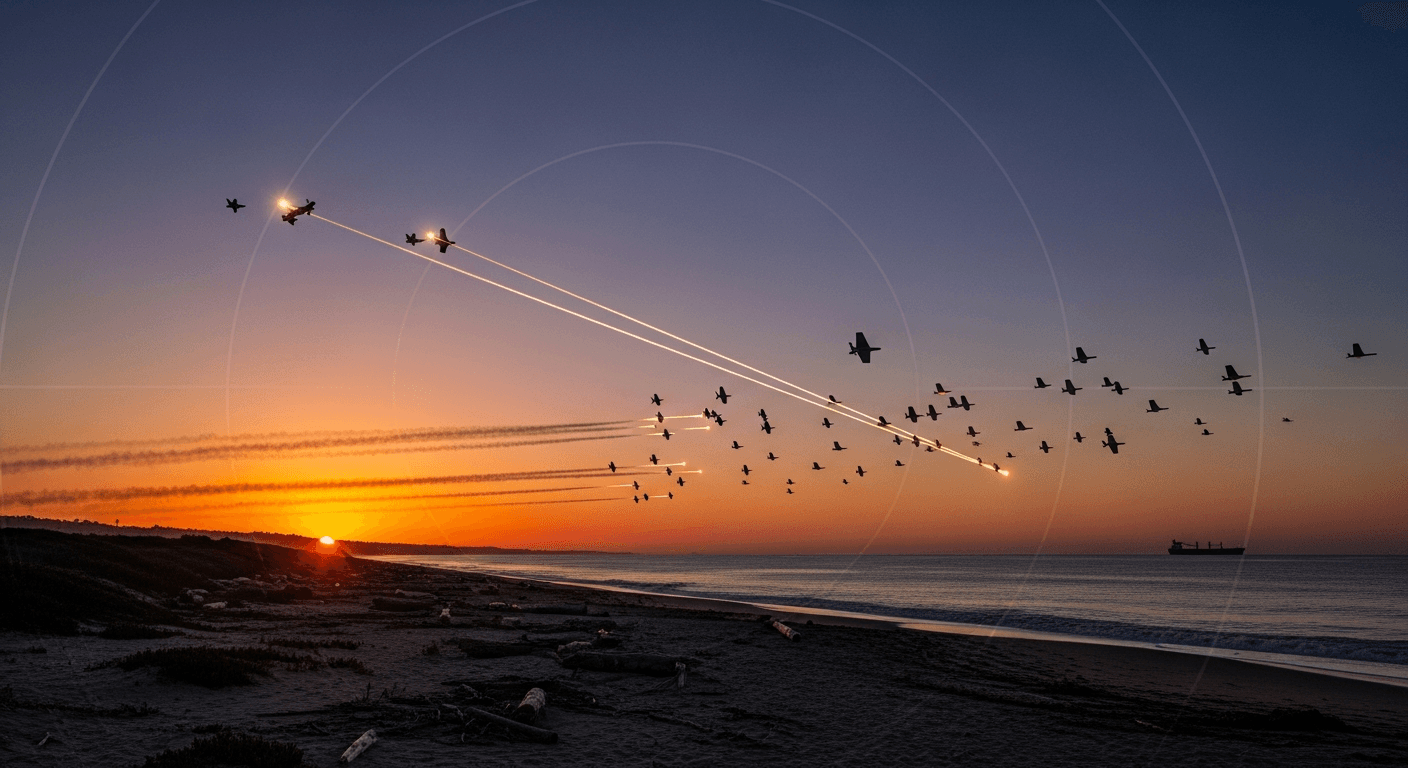
I woke this morning to the kind of alert that catches the public imagination: an intelligence bulletin warning that Iran had “aspired” to mount a surprise drone strike from a vessel off the U.S. West Coast, with California named as a possible focus. The bulletin, distributed to state and local partners, was explicitly unverified. It was a reminder — as much about our fears as about facts — that cheap, capable unmanned systems have changed the shape of risk.
Why I care (and why you should too)
I've been writing about drones for years — not as a technologist, but as an observer who worries about how cheap autonomy changes power, commerce and safety. Back in 2017 and 2018 I wrote about swarm dynamics and the need for governance and tracking systems for drones "A Swarm-O-Drone is born" and proposed tighter controls and digital flight management in "Drone – a – Charya". Those posts were asking the same question this bulletin surfaced: when ubiquitous, inexpensive aerial systems exist, how do we distinguish routine use from malicious intent — and how do we prepare?
What the bulletin actually said (in practical terms)
- The intelligence described an aspiration — not a confirmed, timed plot — that Iran might use unmanned aerial vehicles launched from an unidentified ship offshore to strike unspecified targets in California. Reporting emphasized the information was unverified and cautionary (LA Times, ABC News).
- Public discussion has centered on Iran’s long-range loitering munitions (the Shahed family), sea-based launch experiments, and the political motive of retaliation — all plausible ingredients in an intelligence desk’s spreadsheet of risk (TIME).
Can Iran physically reach California with a kamikaze drone?
Short answer: technically possible under narrow conditions; operationally difficult.
Why it’s technically possible:
- Long-range loitering munitions attributed to Iran have been estimated at ranges measured in the low thousands of kilometers in some configurations. That range could place parts of the U.S. West Coast within reach if launch platforms were placed much closer to shore than Iran itself (Centered America analysis).
Why it’s difficult in practice:
- You do not need only range. You need a launch platform near enough to be in effective range, the ability to covertly position and sustain that platform, logistics to maintain and launch swarms, intelligence and navigation accuracy for fixed targets, and a plan to defeat layered U.S. maritime and air surveillance systems.
- The U.S. maintains substantial maritime domain awareness, a global naval presence, and layered air defenses. Detecting and interdicting a suspicious vessel or an inbound small aircraft is far from trivial, but it is far from impossible.
How such an attack might be attempted (the scenarios analysts discuss)
- Offshore launch from a pre-positioned ship or converted merchant vessel. Iran has experimented with shipborne drone launch concepts; a vessel placed in international waters closer to the U.S. could, in theory, shorten the required flight envelope.
- Proxy or surrogates: use of third-party vessels, or operatives in other littoral states, to mask origin and complicate attribution.
- Smuggling and domestic assembly: covertly moving components or whole UAVs into the U.S. and launching from land — riskier logistically but requiring no long-range maritime deployment.
Each path multiplies points of failure: detection while moving or loitering offshore, mechanical failure, navigation drift, and U.S. interception capability.
What makes kamikaze drones dangerous even if they can’t reach every target
- Cost asymmetry: a small, cheap loitering munition can force expensive defensive posture changes and create psychological impact disproportionate to its physical lethality.
- Swarm saturation: defenses designed for single, high-value missiles struggle against many low-cost, coordinated flyers. Saturation is not just about destroying assets — it’s about eroding confidence and forcing costly redundancy.
- Target choice: these drones are best for fixed coordinates — critical infrastructure, symbolic buildings, energy nodes — which makes hardened/defended mobile military targets less likely but civilian infrastructure more vulnerable if detection fails.
How prepared are we? Where are the gaps?
- Federal, state and local agencies treat bulletins like the one circulated as triggers for coordination rather than proof of an imminent attack; they are part of a daily intelligence diet. That means preparedness upticks without public panic. Still, detection of small, slow, low-signature UAVs over maritime approaches is a harder problem than classic air-defense scenarios (LA Times).
- Many anti-drone technologies exist — from jammers to directed-energy systems and kinetic interceptors — but they must be deployed and integrated into a layered defense to be effective at scale.
What should we do (policy and practical steps)
- Improve maritime domain awareness: better automatic identification, cooperative tracking of merchant traffic, and stricter inspection regimes for suspicious patterns.
- Harden and decentralize critical infrastructure so a small strike causes less systemic damage and fewer cascading failures.
- Expand and integrate counter-UAS technology at ports, critical coastal facilities and major events: detection, attribution and proportionate defeat options.
- Invest in international norms and shipping transparency: the easiest way to avoid miscalculation at sea is to reduce the gray-zone space where a merchant ship becomes a weapons platform.
- Keep public messaging sober: warnings should inform preparedness without amplifying fear. Intelligence is often probabilistic and unverified; governments must balance disclosure with preventing needless panic.
A personal take — fear, foresight and habit
Technology compresses time and distance between intent and effect. That is both its promise and its peril. When I wrote about swarms and the need for digital flight management years ago, I worried less about a single attack and more about the structural shift: drones change who can project power, how cheaply, and how anonymously. The bulletin about a possible California attack is a prompt to finish the work we started: better sensing, clearer rules, and resilient cities and infrastructure.
We should treat these alerts seriously — as signals to close gaps — while resisting the urge to let imagination outrun evidence. Preparing intelligently means investing in detection, defense and resilience, and in policies that make gray-zone maritime operations more visible and riskier to those who contemplate them.
Regards,
Hemen Parekh
Any questions / doubts / clarifications regarding this blog? Just ask (by typing or talking) my Virtual Avatar on the website embedded below. Then "Share" that to your friend on WhatsApp.
Get correct answer to any question asked by Shri Amitabh Bachchan on Kaun Banega Crorepati, faster than any contestant
Hello Candidates :
- For UPSC – IAS – IPS – IFS etc., exams, you must prepare to answer, essay type questions which test your General Knowledge / Sensitivity of current events
- If you have read this blog carefully , you should be able to answer the following question:
- Need help ? No problem . Following are two AI AGENTS where we have PRE-LOADED this question in their respective Question Boxes . All that you have to do is just click SUBMIT
- www.HemenParekh.ai { a SLM , powered by my own Digital Content of more than 50,000 + documents, written by me over past 60 years of my professional career }
- www.IndiaAGI.ai { a consortium of 3 LLMs which debate and deliver a CONSENSUS answer – and each gives its own answer as well ! }
- It is up to you to decide which answer is more comprehensive / nuanced ( For sheer amazement, click both SUBMIT buttons quickly, one after another ) Then share any answer with yourself / your friends ( using WhatsApp / Email ). Nothing stops you from submitting ( just copy / paste from your resource ), all those questions from last year’s UPSC exam paper as well !
- May be there are other online resources which too provide you answers to UPSC “ General Knowledge “ questions but only I provide you in 26 languages !



No comments:
Post a Comment