
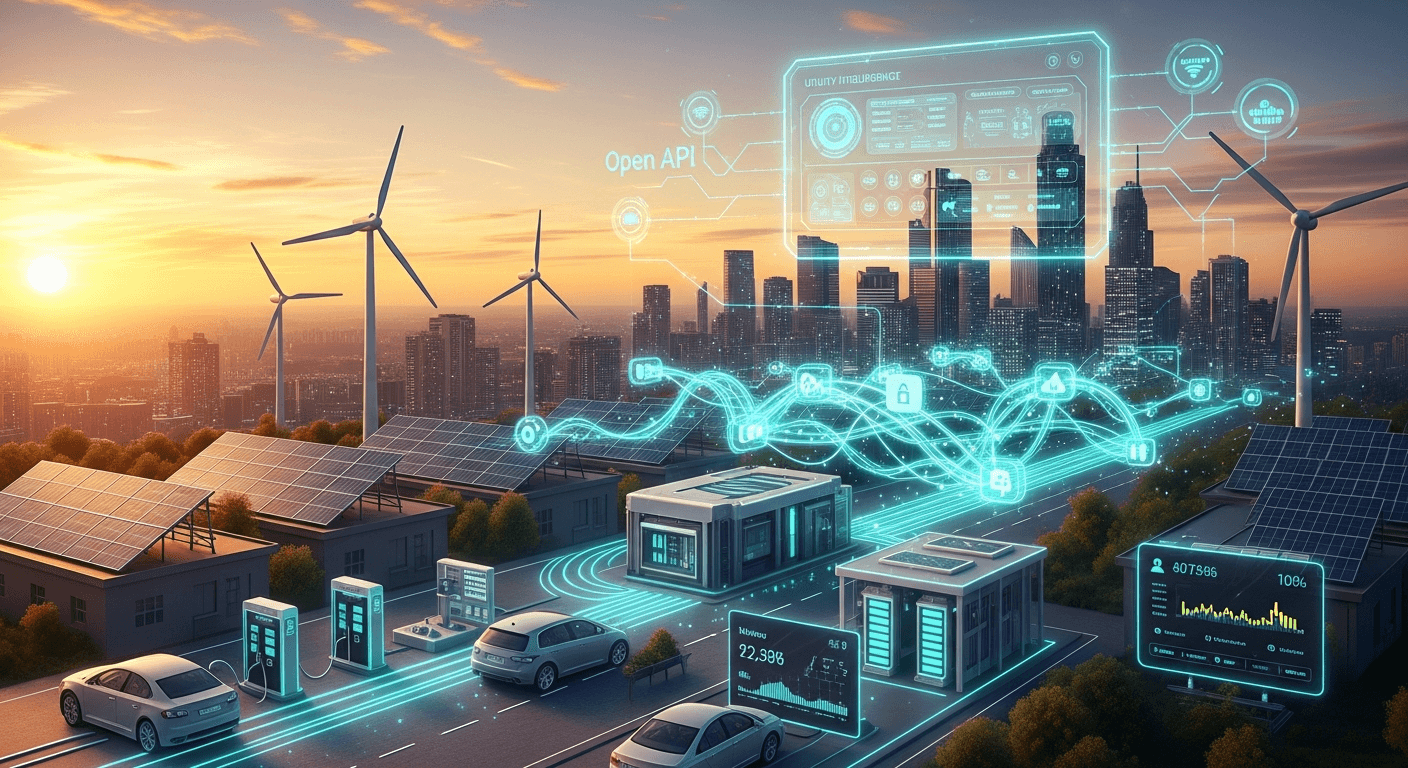
Electrifying India Energy Stack
Introduction
The India Energy Stack (IES) is not just a digital architecture—it's a lever that will amplify electrification across the economy. As I watch the IES move from concept to pilots and architecture v0.3, I see its potential to transform how we generate, store, move and use electricity in India. This piece walks through the practical interactions between electrification and the IES, the opportunities and risks, a few illustrative examples, and five actionable recommendations for policymakers and energy professionals.
Background: what is the IES?
In short, the IES is being designed as a Digital Public Infrastructure (DPI) for the power sector: open registries, unique digital IDs for assets and consumers, standardized data formats, and open APIs that enable interoperable services across generation, transmission, distribution and end-use applications PIB press release. The IES architecture and the Utility Intelligence Platform (UIP) piloted under it will provide real-time visibility and a sandbox for market and consumer-facing innovations RenewableWatch overview.
I have argued before for practical pilots that combine smart metering, behavioural incentives and carbon credits to shift consumption patterns—my SEEM proposal (Save Energy, Earn Money) is one such example of demand-side transformation that aligns well with the IES vision SEEM pilot proposal.
How electrification interacts with the IES
The IES is the digital fabric that makes large-scale electrification not only possible but efficient and equitable. Below I break this down across key domains.
1) Generation — visibility, forecasting and market participation
- Real-time asset registries and standardized telemetry let renewable generators (utility-scale and distributed rooftop) publish accurate, auditable generation forecasts. Better forecasts reduce reserves and improve market efficiency.
- IES-enabled identity and settlement layers will allow small generators and aggregators to participate in markets (P2P trading, VPPs) without bespoke integration work.
Practical effect: higher renewable dispatch, lower curtailment, and faster monetisation for prosumers.
2) Storage — integration, services and valuation
- Storage becomes a tradable, visible asset in the IES: charging/discharging schedules, ancillary services (frequency, inertia replacement), and state-of-health can be standardized.
- Market designs that recognise multi-service value (capacity, arbitrage, ancillary, deferred T&D) become implementable when the IES provides transparent telemetry and settlement.
Result: investors can underwrite storage projects with clearer revenue stacking, driving deeper penetration of batteries, pumped hydro, and emerging chemistries.
3) Grids — distributed control and resilient operations
- Feeder- and device-level visibility enables near real-time topology-aware control. The UIP layer can host digital twins for scenario planning and outage restoration.
- Dynamic line ratings, demand response orchestration and automated islanding for microgrids are practical when the data plumbing is standardized.
Outcome: fewer faults, better hosting capacity for DERs, and lower operational losses.
4) Sector coupling — EVs, heat, industry
- Electric vehicles, heat pumps, and industrial electrification become controllable loads and flexible resources when registered in IES with agreed interfaces (V2G, V2X).
- The IES enables coordinated charging, time-of-use incentives, and integration of EV batteries into grid services under clear consent frameworks.
What that means: the same electrification that increases demand becomes a source of dispatchable flexibility.
Economic and social impacts
- DISCOM efficiency: real-time energy accounting and automated settlements reduce commercial losses and billing disputes.
- Consumer empowerment: unified consumption dashboards, green-tariff choices, and easier switching lower barriers for prosumers and micro-enterprises.
- Jobs & industry: platform standards catalyze startups and local manufacturing in storage, smart devices and energy fintech.
- Inclusion risk: if not designed with multi-channel access, vulnerable populations may be excluded from benefits.
Challenges and risks
- Data governance & privacy: consent, anonymization and access controls must be ironclad.
- Cybersecurity: increased attack surface across devices and market interfaces needs national-grade protections.
- Legacy systems and skill gaps: many utilities will need structured upgrades and capacity building.
- Market design misalignment: absent robust settlement rules, prosumer participation can create settlement disputes and hidden subsidies.
Policy and market measures I recommend
- Mandate open API standards and device-level metadata schemas; adopt them in procurement for any publicly financed asset.
- Create a cleared, multi-service valuation framework for storage and flexibility that regulators can adopt for tariffs and tenders.
- Launch capacity-building programmes for DISCOMs on IT-OT integration and cybersecurity under Revamped Distribution Sector Scheme pilots.
- Set up a national data-governance charter for energy DPI—consent-first, auditable access logs, and tiered anonymisation.
- Design sandboxed market pilots (UIP-hosted) where P2P trading, dynamic tariffs and VPP aggregation can be trialled with consumer protection guardrails.
Case studies & examples
- UIP pilots in Mumbai, Delhi and Gujarat are already being used to validate IES use cases such as feeder-level analytics and consumer dashboards source overview.
- My SEEM proposal (Save Energy, Earn Money) demonstrates how smart metering plus behavioural and carbon incentives can drive measurable residential savings—an excellent match for IES-enabled consumer services SEEM pilot proposal.
- Large renewable build-outs (for example, recent project pipelines in Rajasthan) will benefit from IES-enabled inter-state scheduling, forecasting, and transmission optimisation—reducing curtailment and improving bankability.
Conclusion
Electrification without a coherent digital foundation will be costly and slow. The India Energy Stack is that foundation: when implemented with open standards, strong data governance and market-savvy regulation, it turns electrification into a flexible, inclusive, investible transition. IES is not a magic bullet—technical, institutional and social work remains—but it is the multiplier that will make the next decade of India’s power revolution deliver cleaner, cheaper, and more reliable electricity for all.
Five actionable recommendations
- Pilot storage-as-a-service revenue stacking in UIP sandboxes with clear settlement rules.
- Require open API compliance for all central funds to DISCOM digital upgrades.
- Fund a national cyber-incident response centre dedicated to energy DPI.
- Launch consumer-facing inclusion programs (SMS, call-centres, community kiosks) for IES services.
- Fast-track regulator-approved templates for P2P and VPP participation agreements to reduce legal uncertainty.
Regards,
Hemen Parekh (hcp@recruitguru.com)
Any questions / doubts / clarifications regarding this blog? Just ask (by typing or talking) my Virtual Avatar on the website embedded below. Then "Share" that to your friend on WhatsApp.
Get correct answer to any question asked by Shri Amitabh Bachchan on Kaun Banega Crorepati, faster than any contestant
Hello Candidates :
- For UPSC – IAS – IPS – IFS etc., exams, you must prepare to answer, essay type questions which test your General Knowledge / Sensitivity of current events
- If you have read this blog carefully , you should be able to answer the following question:
- Need help ? No problem . Following are two AI AGENTS where we have PRE-LOADED this question in their respective Question Boxes . All that you have to do is just click SUBMIT
- www.HemenParekh.ai { a SLM , powered by my own Digital Content of more than 50,000 + documents, written by me over past 60 years of my professional career }
- www.IndiaAGI.ai { a consortium of 3 LLMs which debate and deliver a CONSENSUS answer – and each gives its own answer as well ! }
- It is up to you to decide which answer is more comprehensive / nuanced ( For sheer amazement, click both SUBMIT buttons quickly, one after another ) Then share any answer with yourself / your friends ( using WhatsApp / Email ). Nothing stops you from submitting ( just copy / paste from your resource ), all those questions from last year’s UPSC exam paper as well !
- May be there are other online resources which too provide you answers to UPSC “ General Knowledge “ questions but only I provide you in 26 languages !





No comments:
Post a Comment