
What the UN’s First Article 6 Credits Mean
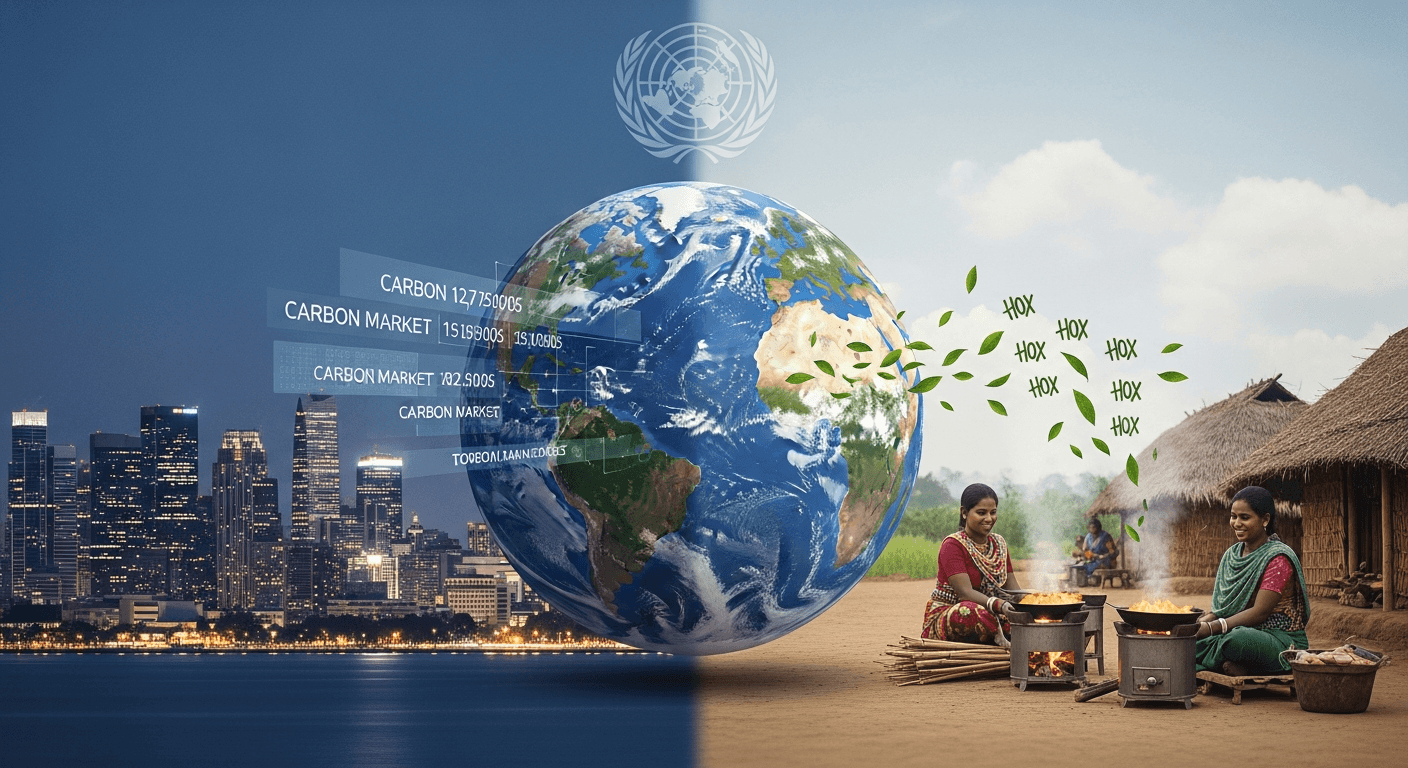
On 26 February 2026, a UN body approved the first carbon credits to be issued under the Paris Agreement’s new market mechanism (often called the Article 6.4 or Paris Agreement Crediting Mechanism). The credits come from a clean‑cooking project in Myanmar that distributes more efficient cookstoves, and they were coordinated with authorised participants in the Republic of Korea. A portion of the credits is expected to be used by Korea under its emissions trading system and the remainder used by Myanmar toward its nationally determined contribution (NDC) UNFCCC press release.
I want to explain why this matters, what the mechanism is, and how policymakers and market participants should respond.
Background: Article 6 and the Paris market mechanism
Article 6 of the Paris Agreement creates pathways for countries and non‑state actors to cooperate on mitigation. It includes:
- cooperative approaches (often referenced as Article 6.2), which allow direct transfers of internationally transferred mitigation outcomes (ITMOs) between parties; and
- the Article 6.4 mechanism, a UN‑supervised crediting system intended to replace the older Clean Development Mechanism (CDM) from the Kyoto era.
Article 6.4 is designed to issue internationally recognized credits for verifiable emission reductions. Compared with the CDM, the Paris mechanism applies updated methodological approaches, more conservative baselines and stronger governance designed to improve environmental integrity, avoid double counting, and channel finance to projects that can help countries meet their NDCs UNFCCC; S&P Global.
What the approval actually means
- Operational milestone: The issuance signals the transition of the UN carbon market from rules and design into real‑world operation. The Supervisory Body has applied Paris‑aligned methodologies and issued credits for a registered activity.
- Conservative issuance: The first round of credited reductions is materially smaller—roughly 40% lower—than what the same project would have received under the older CDM calculations. That reflects updated assumptions and a more conservative approach to calculating reductions UNFCCC.
- Pipeline activation: More than 165 host‑Party‑approved projects are reported to be transitioning from the CDM to this new mechanism, spanning waste, energy, industry, agriculture and more. If those move forward, supply of Paris‑aligned credits will grow steadily.
- Due process: Issuance decisions are subject to appeal and grievance windows to allow affected stakeholders to challenge or flag concerns before credits are finalised.
Potential benefits
- Mobilising finance to developing countries: A credible UN mechanism can channel international finance to projects that reduce emissions and deliver tangible local benefits (health, forest protection, livelihoods).
- Alignment with NDCs and compliance systems: Credits issued under Article 6.4 can be used to help countries meet their nationally determined contributions or to support compliance in domestic trading systems that accept them.
- Stronger environmental safeguards: Updated methodologies, downward adjustments and clearer oversight can raise the overall credibility of internationally traded credits compared with past mechanisms.
- Co‑benefits: Starting with a clean‑cooking project highlights the potential for projects to deliver improvements in public health and gender equity as well as emissions reductions.
Common criticisms and risks
- Offsetting versus real cuts: A long‑standing concern is that credits can be used to delay domestic mitigation. Offsetting should not substitute for domestic emissions reductions, especially in high‑income jurisdictions with abundant mitigation opportunities.
- Greenwashing and integrity doubts: NGOs and watchdogs remain sceptical that markets will always deliver robust additionality and avoid over‑crediting. Past experience with the CDM shows how weak baselines and poor methodologies can lead to inflated credit volumes coverage summarising NGO concerns.
- Double counting and accounting complexity: Robust corresponding adjustments and transparent registries are essential if transferred credits are to be credibly counted against a buyer’s obligations without undermining the seller’s NDC.
- Distributional questions: Which projects get financed matters. There is a risk that low‑value, high‑volume projects crowd out initiatives that require higher upfront finance but deliver longer‑term structural transformation.
Implications for global carbon markets
- Quality over quantity: By tightening baselines and lowering early issuance volumes, the Paris mechanism signals a shift toward fewer, higher‑confidence credits. That could support higher prices for credible credits and redirect demand away from cheap, low‑integrity offsets.
- Interplay with voluntary markets and CORSIA: A credible UN mechanism could become a reference point for voluntary purchasers and aviation offsetting schemes, placing pressure on voluntary providers to raise standards.
- Integration pressures: Domestic ETS designers will face choices about whether and how to allow Article 6.4 credits. Acceptance can lower compliance costs but risks diluting domestic incentives to decarbonise if limits are lax.
Next steps and practical recommendations
- Strengthen transparency and MRV: Ensure open methodologies, public project documentation and timely registry information so independent analysts can verify claims.
- Tighten additionality and baseline tests: Use conservative, sector‑specific tools and investment‑analysis safeguards to avoid crediting business‑as‑usual activities.
- Enforce corresponding adjustments: Require clear accounting rules so that transfers do not lead to net increases in global emissions through double counting.
- Limit offset reliance: Regulators should cap the use of international credits in domestic compliance pathways and emphasise domestic mitigation first, especially in high‑income countries.
- Prioritise high‑impact finance: Encourage mechanisms that channel revenue to projects with strong adaptation and development co‑benefits and to measures that enable structural decarbonisation (grids, storage, industry transitions).
- Institutionalise grievance and stakeholder participation: Ensure affected communities can challenge projects and that appeal periods are meaningful and accessible.
My takeaway
The first issuance under the Paris mechanism is an important operational milestone. It shows the mechanism can work in practice, that stricter rules reduce early issuance volumes, and that a pipeline of projects exists. But credibility will depend on rigorous technical standards, transparent accounting and a political commitment to prioritise domestic mitigation where feasible.
Carbon markets can be a useful tool if they complement—not replace—national decarbonisation. As a global community, we should treat this launch as the start of a careful testing process, not a finish line.
Regards,
Hemen Parekh
Any questions / doubts / clarifications regarding this blog? Just ask (by typing or talking) my Virtual Avatar on the website embedded below. Then "Share" that to your friend on WhatsApp.
Get correct answer to any question asked by Shri Amitabh Bachchan on Kaun Banega Crorepati, faster than any contestant
Hello Candidates :
- For UPSC – IAS – IPS – IFS etc., exams, you must prepare to answer, essay type questions which test your General Knowledge / Sensitivity of current events
- If you have read this blog carefully , you should be able to answer the following question:
- Need help ? No problem . Following are two AI AGENTS where we have PRE-LOADED this question in their respective Question Boxes . All that you have to do is just click SUBMIT
- www.HemenParekh.ai { a SLM , powered by my own Digital Content of more than 50,000 + documents, written by me over past 60 years of my professional career }
- www.IndiaAGI.ai { a consortium of 3 LLMs which debate and deliver a CONSENSUS answer – and each gives its own answer as well ! }
- It is up to you to decide which answer is more comprehensive / nuanced ( For sheer amazement, click both SUBMIT buttons quickly, one after another ) Then share any answer with yourself / your friends ( using WhatsApp / Email ). Nothing stops you from submitting ( just copy / paste from your resource ), all those questions from last year’s UPSC exam paper as well !
- May be there are other online resources which too provide you answers to UPSC “ General Knowledge “ questions but only I provide you in 26 languages !



No comments:
Post a Comment