
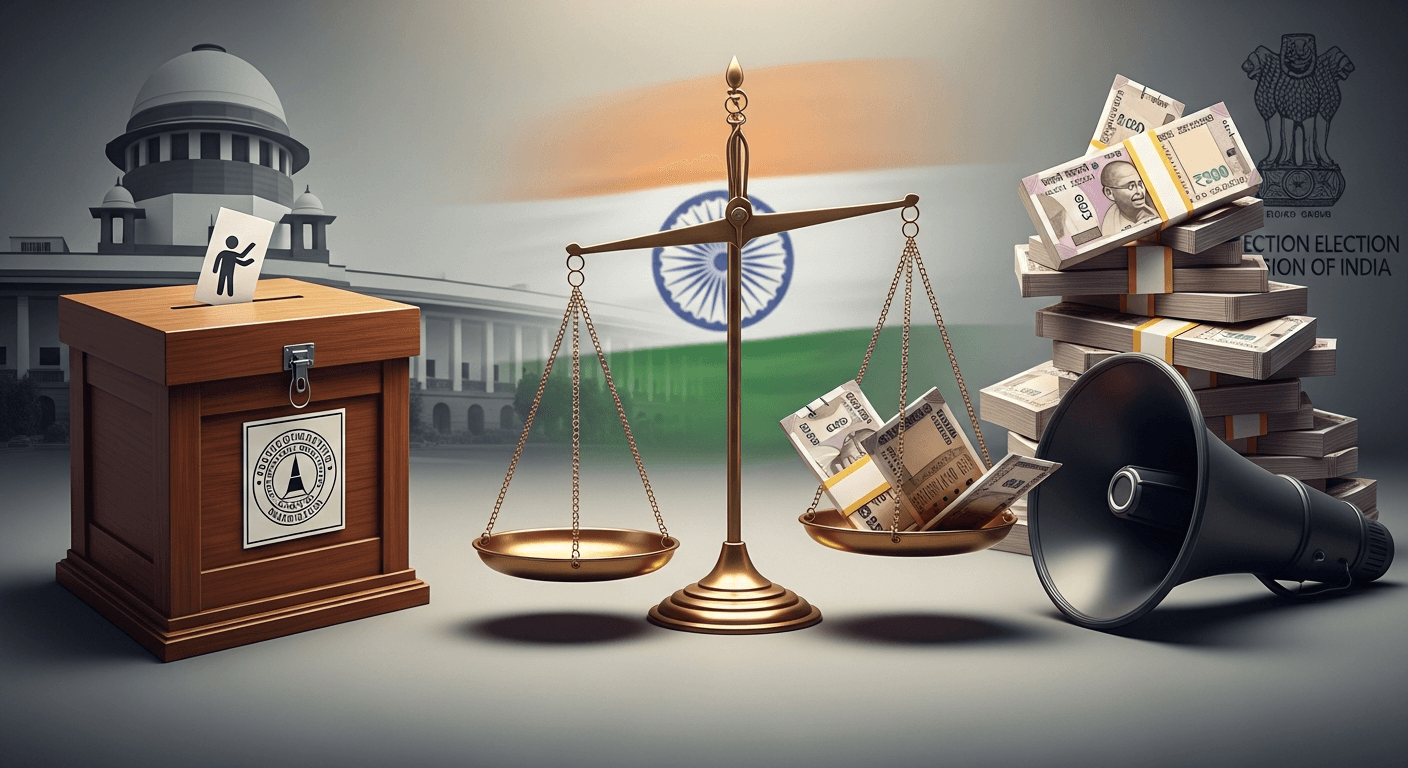
Curbing Poll Money Power
Summary
The Supreme Court has recently issued notice to the Centre and the Election Commission of India (ECI) on a public interest litigation challenging the unregulated use of money by political parties during elections. The petition—brought by civil society actors—asks the court to examine whether unchecked party spending and opaque funding practices distort the level playing field that free and fair elections require. The court asked the two respondents to file replies and has flagged complex constitutional and practical questions for fuller consideration.
Why this PIL matters: PILs and "poll money power"
A Public Interest Litigation (PIL) is a legal vehicle in India that allows concerned citizens or groups to seek judicial redress on matters of public importance where broader rights and public interest are implicated. In this case the PIL questions the role of unregulated financial power in elections—what I call “poll money power.”
Poll money power refers to the aggregate effect of large, often opaque, financial flows used to influence electoral outcomes: high party spending on advertising and ground mobilisation, large corporate donations, anonymous contributions, targeted freebies or subsidies timed around polls, and off-book mobilization through third-party groups. The concern is not only the scale of spending but the lack of transparency and enforceable limits at the level of political parties, which can allow wealth and influence to skew competition and public policy.
Legal issues the Supreme Court will likely examine
The matter raises several interlocking legal questions:
Constitutional balance: How do caps or disclosure requirements interact with freedoms such as speech and political expression? Any restriction will be tested against constitutional guarantees and the proportionality principle.
Statutory gaps: Current Indian law places limits on candidate expenditure, but party-level spending is less tightly regulated. The court will examine the Representation of the People Act, Conduct of Election Rules, and related provisions to locate legislative gaps.
Transparency and anonymity: The post-electoral-bonds jurisprudence has already underlined the democratic value of disclosure. The court will likely revisit principles from that line of cases when assessing whether anonymous or opaque donations subvert electoral fairness.
Enforcement and remedy: Even if disclosure or limits are accepted in principle, the court must consider how rules can be monitored and enforced without creating unworkable burdens or unintended consequences.
Likely responses from the Centre and the ECI
The Centre is likely to make several predictable points in its reply:
Legislative domain: The government may point out that regulations on party finance are primarily a matter for Parliament and that judicially imposed caps would raise separation-of-powers concerns.
Free speech concerns: The Centre could invoke the constitutional protection for political speech and argue against overly restrictive measures without careful calibration.
The Election Commission of India, by contrast, may stress its institutional mandate to ensure free and fair elections and offer administrative or regulatory steps it has already taken or can take, such as:
- Proposals for greater disclosure and real-time reporting of donations and party expenditure.
- Strengthened audit and reporting mechanisms for parties during election periods.
- Guidelines to curb cash transactions and require digital payment trails for campaign spending.
Both respondents may also propose incremental, implementable steps rather than sudden, comprehensive overhauls.
Political and democratic implications
Unchecked poll money power has several corrosive effects:
Distorted competition: Parties or candidates with deeper pockets can outspend rivals on advertising, field operations and incentives, weakening meritocratic competition.
Policy capture and quid pro quo: Large opaque donations raise the spectre of policy influence and preferential access to state resources.
Erosion of public trust: Perceived or actual financial manipulation reduces voter confidence in electoral integrity and democratic legitimacy.
Level-playing-field problems: Even well-intentioned spending caps for candidates become meaningless if parties or allied groups can spend unlimited sums.
Remedies and reforms — practical measures and legal changes
No single fix will solve the problem. A combination of administrative, legal and practical reforms could make a measurable difference:
Practical measures
- Mandatory real-time disclosure: Publish donations above a modest threshold and all party expenditure during election windows on a public portal.
- Digital-only funding for donations above a low limit; ban large cash donations to create an auditable trail.
- Strengthen ECI’s capacity to audit party accounts and to publish detailed election expenditure reports.
- Central Election Fund: a transparent public funding vehicle to which individuals and corporations may contribute (with strict caps and disclosure), and which distributes funds to parties on a formulaic basis for election campaigning.
Legal reforms
- Amend the Representation of the People Act and Companies Act to tighten disclosure norms and cap certain forms of political contributions.
- Introduce statutory ceilings on party-level election spending, calibrated to respect free-speech rights but designed to prevent undue advantage.
- Create criminal and civil penalties for concealment and for use of surrogate entities to launder political donations.
Institutional fixes
- Give the ECI clearer statutory powers and resources to investigate, audit and penalise violations.
- Strengthen whistleblower protections and information-sharing with financial regulators and banks for suspicious flows.
My reflection and prior notes
I have written earlier about the need for transparency in political funding and proposed structural ideas such as a Central Election Fund and digital-only donations as practical steps to reduce opacity and influence. See my previous posts where I discussed the limits of opaque funding mechanisms and the need for institutional alternatives ElectoralBonds for Transparency? and Madam: How about Central Election Fund?.
Conclusion — why this matters for India's democracy
At stake is not just electoral etiquette but the basic fairness of contests that choose our lawmakers. Money, when invisible and unaccountable, warps incentives, policy and public trust. If India wants elections that reflect the will of voters rather than the power of purse-holders, we need clear rules, credible enforcement and institutional innovation. The Supreme Court’s decision to seek replies is an important step toward a national conversation about where to draw those lines. I will watch the responses of the Centre and the ECI closely, because how we regulate money in politics will shape the quality of Indian democracy for years to come.
Regards,
Hemen Parekh
Any questions / doubts / clarifications regarding this blog? Just ask (by typing or talking) my Virtual Avatar on the website embedded below. Then "Share" that to your friend on WhatsApp.
Get correct answer to any question asked by Shri Amitabh Bachchan on Kaun Banega Crorepati, faster than any contestant
Hello Candidates :
- For UPSC – IAS – IPS – IFS etc., exams, you must prepare to answer, essay type questions which test your General Knowledge / Sensitivity of current events
- If you have read this blog carefully , you should be able to answer the following question:
- Need help ? No problem . Following are two AI AGENTS where we have PRE-LOADED this question in their respective Question Boxes . All that you have to do is just click SUBMIT
- www.HemenParekh.ai { a SLM , powered by my own Digital Content of more than 50,000 + documents, written by me over past 60 years of my professional career }
- www.IndiaAGI.ai { a consortium of 3 LLMs which debate and deliver a CONSENSUS answer – and each gives its own answer as well ! }
- It is up to you to decide which answer is more comprehensive / nuanced ( For sheer amazement, click both SUBMIT buttons quickly, one after another ) Then share any answer with yourself / your friends ( using WhatsApp / Email ). Nothing stops you from submitting ( just copy / paste from your resource ), all those questions from last year’s UPSC exam paper as well !
- May be there are other online resources which too provide you answers to UPSC “ General Knowledge “ questions but only I provide you in 26 languages !



No comments:
Post a Comment