
Introduction
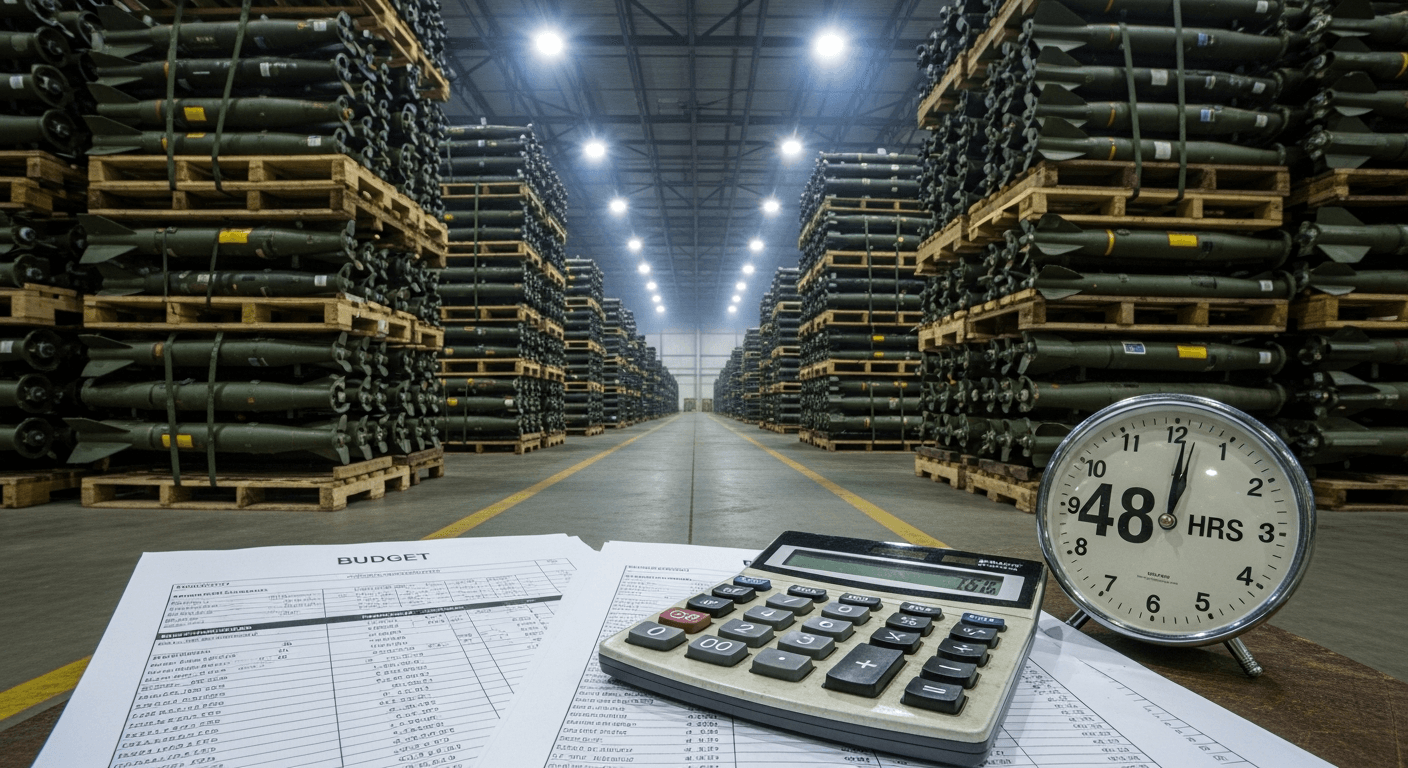
I write this as someone who studies systems — economic, technological and strategic — and watches how supply chains and decisions made in peace time show up, abruptly, in war. In the past week, headlines have asked a blunt question: is the United States burning through its most valuable munitions? The initial estimates are stark: roughly $5.6 billion of U.S. weaponry was reportedly expended in the first 48 hours of the recent operations against Iran, and thousands of precision munitions and interceptors were used in a concentrated exchange of strikes and defenses Washington Post via MoneyControl and related coverage.
What happened in the first 48 hours (a compact summary)
- The U.S. and allied forces struck hundreds to thousands of targets in Iran and reacted to dozens of Iranian-launched missiles and drones directed at U.S. forces and regional partners. Public reporting and analyst tallies place the opening-phase munitions count in the low thousands (reports have described 3,000+ munitions used by U.S. and Israeli forces in the first 36–48 hours) and ballpark Tomahawk and guided-bomb employment in the low hundreds Payne Institute / aggregated reports.
- Intercepts were intensive: open-source estimates suggest on the order of hundreds of interceptor firings — a mix of ship-based SM-series missiles, Patriot interceptors and some THAAD launches — to protect bases, ships and partner airspace. These systems are expensive and slow to produce; that is central to the concern Breaking Defense; ABC News analysis.
- Cost estimates vary by source and by accounting method. The $5.6 billion figure cited to Congress and reported in press briefings is an early, headline-grabbing estimate meant to convey order of magnitude rather than an audited accounting of unit costs and sustainment [Washington Post reporting summarized via MoneyControl].
How this fits into historical context
We should remember that the U.S. entered this crisis with thinner-than-publicly-assured inventories for some high-end categories. Stockpiles have been drawn down over several years by sustained commitments — large transfers and use in support of Ukraine and repeated regional contingencies, plus prior intensive exchanges with Iran and proxy groups. Analysts have repeatedly warned of limited inventories for certain interceptors (THAAD, Patriot PAC-3 variants, some SM-series missiles) and of slow production lines for high-end interceptors and advanced cruise missiles. Production capacity for many of these munitions is measured in hundreds per year, not thousands, and relies on complex, sometimes single-source suppliers for critical components and minerals [ABC; Politico; Breaking Defense].
Logistical and industrial constraints
This is where the arithmetic gets uncomfortable. Modern interceptors and guided long-range munitions are high-tech, assembly-line products that depend on specialized rocket motors, guidance electronics and rare materials. Even when the U.S. authorizes multiyear procurements, ramping output from peacetime rates can take many months — or longer — because of tooling, workforce training and supply-chain bottlenecks.
A few practical effects to note:
- Replacement lag: expensive interceptors used to defend bases cannot be rebuilt overnight; the gap between consumption and replenishment can be measured in months to over a year for particular models.
- Inventory trade-offs: sending high-end interceptors to one theater shifts risk to others; Congress and the White House may face agonizing choices about priorities.
- Budget pressure: early reporting suggests the administration will seek a supplemental budget request in the tens of billions to restore and accelerate production.
Paraphrased, hypothetical voices (clearly identified)
- A hypothetical senior Pentagon official (paraphrased): "We have the capacity to do the mission now, but sustained operations at this tempo will force hard choices about where to allocate scarce interceptors and cruise missiles."
- A hypothetical military analyst (paraphrased): "The core problem is not the total number of munitions across all types — it's specific shortages of high-end interceptors and some naval standard missiles that are production-constrained."
- A hypothetical defense-industry representative (paraphrased): "Our facilities can expand, but that requires predictable long-term contracts, expedited procurement authorities and unclogging critical subcontractor bottlenecks."
Effects on allies and wider strategy
Allies feel this in two ways. First, Gulf partners — many of whom rely on U.S. systems or U.S. logistical help — have been burning through interceptors too, and they cannot easily substitute production at home. Second, European commitments (supporting Ukraine) and Indo-Pacific concerns (deterring China) compete for many of the same assets and industrial capacity.
Operationally, a rapid drain of interceptors or key cruise missiles would complicate future crises. It could force commanders to shift to lower-cost weapons where appropriate, accept greater operational risk, or ask for political de-escalation while stocks recover.
Concluding assessment: are stockpiles being drained?
Short answer: yes — but with important qualifications.
- In specific, high-end categories — certain interceptors (THAAD, some Patriot PAC variants), some ship-based SM-series interceptors and a subset of precision long-range missiles — inventories have been meaningfully drawn down by recent, successive crises. Those categories are the ones most likely to be described as "drained" if operations continue at high tempo for weeks.
- Across the entire arsenal of the U.S. military — including unguided munitions, many types of bombs and some classes of missiles — the U.S. retains substantial capacity to prosecute operations. But the marginal value of each additional strike or intercept rises when you rely on your scarcest, most expensive inventories.
Policy options (practical levers)
- Short-term: request supplemental appropriations to accelerate production and authorize surge buys; prioritize allocation of existing inventories to the most urgent missions; provide allies with alternatives (short-range air defenses) to conserve high-end interceptors.
- Medium-term: expand industrial base capacity through multiyear contracts, incentives for subcontractors, and diversification of critical mineral supply chains.
- Strategic: rebalance doctrine to reduce reliance on costly single-shot interceptors where cheaper layered and passive defenses (hardened shelters, dispersal, electronic warfare, short-range counter-UAS systems) can reduce consumption.
- Political-diplomatic: push for de-escalation tracks that buy time for industrial recovery, while coordinating burden-sharing with allies.
I have written before about the strategic logic of building local manufacturing and resilience in defense supply chains; these same ideas — predictable demand, distributed production and long-term contracts — are exactly what this moment requires (see my earlier reflections on defense production and FDI in defense manufacturing in my long-form posts). Drawing down stockpiles in a short, intense campaign exposes the deeper truth: strategy and industry are two halves of the same coin. If you want a credible defense posture in peacetime, you must fund and organize production in peace.
The bottom line is sober: the United States is not out of options today, but some of its most precious munitions are consumable — and replenishment will cost time and money. Whether that becomes a strategic problem depends on political choices now about priorities, budgets and industrial mobilization.
Regards,
Hemen Parekh
Any questions / doubts / clarifications regarding this blog? Just ask (by typing or talking) my Virtual Avatar on the website embedded below. Then "Share" that to your friend on WhatsApp.
Get correct answer to any question asked by Shri Amitabh Bachchan on Kaun Banega Crorepati, faster than any contestant
Hello Candidates :
- For UPSC – IAS – IPS – IFS etc., exams, you must prepare to answer, essay type questions which test your General Knowledge / Sensitivity of current events
- If you have read this blog carefully , you should be able to answer the following question:
- Need help ? No problem . Following are two AI AGENTS where we have PRE-LOADED this question in their respective Question Boxes . All that you have to do is just click SUBMIT
- www.HemenParekh.ai { a SLM , powered by my own Digital Content of more than 50,000 + documents, written by me over past 60 years of my professional career }
- www.IndiaAGI.ai { a consortium of 3 LLMs which debate and deliver a CONSENSUS answer – and each gives its own answer as well ! }
- It is up to you to decide which answer is more comprehensive / nuanced ( For sheer amazement, click both SUBMIT buttons quickly, one after another ) Then share any answer with yourself / your friends ( using WhatsApp / Email ). Nothing stops you from submitting ( just copy / paste from your resource ), all those questions from last year’s UPSC exam paper as well !
- May be there are other online resources which too provide you answers to UPSC “ General Knowledge “ questions but only I provide you in 26 languages !



No comments:
Post a Comment