
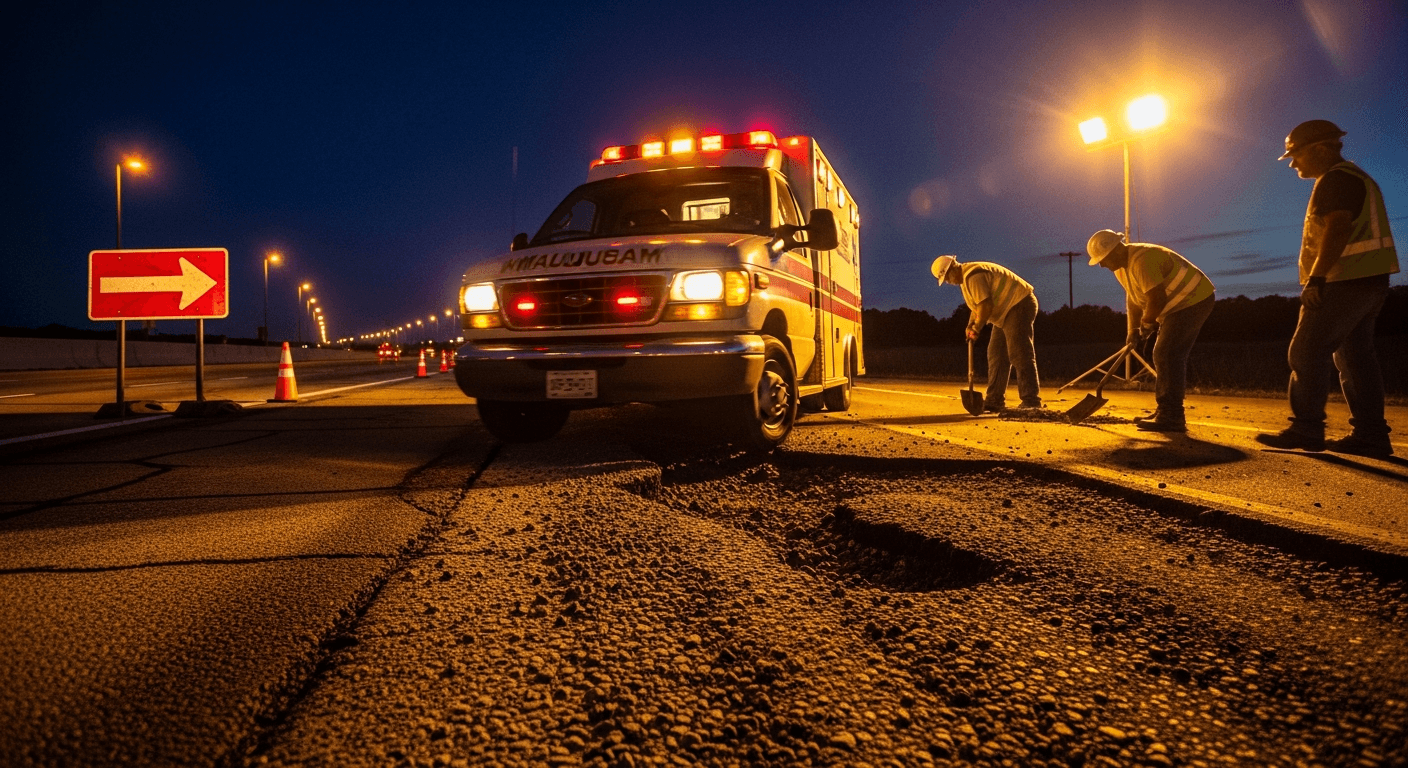
A jolt, then life — what the road revealed
I write this after reviewing multiple reports and eyewitness accounts of a startling incident on the Bareilly–Haridwar stretch of National Highway 74. An ambulance carrying a critically ill woman reportedly jolted over a rough patch near Hafizganj; family members say she began breathing again after that shake and was later treated and discharged. The episode has prompted two parallel conversations: one about a rare medical reversal and another about the condition of a national highway that authorities say is maintained to standard.
What happened (short timeline)
- A woman taken from a hospital in Bareilly to her home in Pilibhit was described by clinicians as non-responsive and gravely ill. Reporting shows her Glasgow Coma Scale score had dropped to a very low level and brainstem reflexes were reportedly absent at one point, prompting clinicians to have little expectation of recovery PTI / Tribune.
- En route on NH-74, the ambulance hit a rough patch; the family says the vehicle shook violently and the woman’s breathing returned. She was taken for urgent care in Pilibhit and, after treatment, made a recovery that surprised relatives and local doctors Times of India.
Eyewitness accounts and family statements
I reviewed multiple first-hand accounts reported by local media. Family members describe a desperate journey where relatives had begun making funeral arrangements before the ambulance jolted. One relative told reporters they had been told to prepare for last rites; shortly after the jolt, breathing reportedly resumed and plans were halted. These accounts have been carried by regional and national outlets and have driven local interest in both the medical and infrastructural aspects of the story.
NHAI’s statement and the on‑ground picture
The National Highways Authority of India issued a formal response saying the section in question is "pothole-free and traffic-worthy" and that the Bareilly–Sitarganj stretch is under construction with temporary diversions provided as per guidelines Times of India.
Independent reporting and on-site photographs published alongside newsroom visits showed cracked surfaces, depressions and temporary surfaces where widening work is underway. Those images — with GPS coordinates and timestamps in some reports — suggest the driver encountered a damaged patch or unfinished carriageway rather than a uniformly maintained road.
Local authority reactions and medical perspective
Local hospitals and treating clinicians cautioned against calling the event a miracle. The neurosurgical team that later treated the woman said the recovery was likely tied to medical intervention for a suspected neurotoxin exposure (possible insect or snake bite) rather than the jolt itself, though the sudden physical stimulus coincided with signs of renewed breathing PTI / Tribune.
Administratively, NHAI’s assertion of a traffic‑worthy stretch underscores a frequent friction: contractors and maintenance authorities often certify sections as compliant while road users and journalists document localized failures, especially where construction and temporary alignments are in place.
Road safety context: a larger, worrying pattern
This incident resonates because Uttar Pradesh continues to record high numbers of road accidents and fatalities. State-level reporting and transport department data show the scale: in 2024 the state logged roughly 46,000 accidents and over 24,000 deaths, with national-highway stretches accounting for a sizeable share of fatalities Hindustan Times. More recent tracking through 2025 also highlights thousands of crashes and deaths this year to date NDTV.
Key patterns national and state data point to: overspeeding, poor night‑time visibility, inadequate signage at worksites, and delays in emergency response all raise crash severity. Where highway widening or maintenance work is underway, temporary surfaces and unclear diversions increase risk unless managed tightly.
Remedies and pragmatic steps
Based on the incident and the broader data, practical steps would reduce both routine harm and the kind of confusion this story highlights:
- Strengthen site-level supervision during construction: ensure temporary alignments meet rideability criteria and are clearly signed with slow-speed enforcement.
- Faster black‑spot rectification: deploy mobile repair teams to fix depressions and dangerous breaks reported by users or detected via patrols.
- Improve real-time reporting: encourage an expanded iRAD/eDAR feed from district patrols so local defects trigger immediate action.
- Ambulance protocols: stabilisation protocols during transit, plus routing that prioritises smoother corridors for critical patients where feasible.
- Public communication: when an authority declares a stretch "traffic-worthy," publish site inspection reports and dates so journalists and citizens can cross-check.
What this should prompt us to do next
The human interest in this episode is understandable — a family who thought they had lost a loved one found hope. But the larger test is whether this moment leads to sharper, verifiable maintenance standards and better emergency care on our highways.
Visitors, commuters and road agencies are all stakeholders. The woman’s recovery should not be an occasion for complacency or for celebrating luck; it should be a prompt to make sure the next vulnerable traveller is protected by safer roads, clearer construction zones and faster medical response.
If you want the full reporting I reviewed, see the coverage by major outlets here: Times of India and regional wire reports that followed the medical team's statements and the NHAI reply Times of India and Tribune / PTI.
Call to action: local authorities should publish recent inspection records for the NH‑74 segment, accelerate repairs on temporary surfaces, and the transport department should prioritize black‑spot funding where construction creates new hazards. For citizens, report dangerous stretches promptly and demand public transparency about maintenance status.
Regards,
Hemen Parekh
Any questions / doubts / clarifications regarding this blog? Just ask (by typing or talking) my Virtual Avatar on the website embedded below. Then "Share" that to your friend on WhatsApp.
Get correct answer to any question asked by Shri Amitabh Bachchan on Kaun Banega Crorepati, faster than any contestant
Hello Candidates :
- For UPSC – IAS – IPS – IFS etc., exams, you must prepare to answer, essay type questions which test your General Knowledge / Sensitivity of current events
- If you have read this blog carefully , you should be able to answer the following question:
- Need help ? No problem . Following are two AI AGENTS where we have PRE-LOADED this question in their respective Question Boxes . All that you have to do is just click SUBMIT
- www.HemenParekh.ai { a SLM , powered by my own Digital Content of more than 50,000 + documents, written by me over past 60 years of my professional career }
- www.IndiaAGI.ai { a consortium of 3 LLMs which debate and deliver a CONSENSUS answer – and each gives its own answer as well ! }
- It is up to you to decide which answer is more comprehensive / nuanced ( For sheer amazement, click both SUBMIT buttons quickly, one after another ) Then share any answer with yourself / your friends ( using WhatsApp / Email ). Nothing stops you from submitting ( just copy / paste from your resource ), all those questions from last year’s UPSC exam paper as well !
- May be there are other online resources which too provide you answers to UPSC “ General Knowledge “ questions but only I provide you in 26 languages !




No comments:
Post a Comment