
Introduction
I have always believed that empowerment is less about one-off handouts and more about giving people the tools, skills and institutional support to earn with dignity. Over the years I have written about teaching people to fish rather than feeding them a fish — and nowhere is that lesson clearer than when women in rural areas come together as collectives to transform agriculture, energy access, and local markets.Teach man to fish, woman to earn
Why collectives matter in the fields
- Shared risk, shared investment: Smallholder agriculture is risky. When women pool savings, labour and knowledge through Self Help Groups (SHGs) or cooperatives, they spread risk and unlock scale.
- Faster access to assets: Groups can procure tools (drones, solar pumps, machinery) and rent them across members, making capital-intensive technologies affordable.
- Market power: A group that aggregates produce, processes it, and negotiates collectively finds buyers and better prices than isolated household sellers.
- Learning and trust: Regular collective meetings become a platform for training (new crop techniques, digital skills, data annotation for ag-tech) and for building social capital.
Examples and emerging models
I’ve pointed before to government and NGO initiatives that scale women’s participation through collectives. For example, India’s Lakhpati Didi / SHG movement already counts millions of members and shows how membership platforms can be the backbone for training and asset distribution.Teach man to fish, woman to earn
Newer innovations pair traditional collectives with technology:
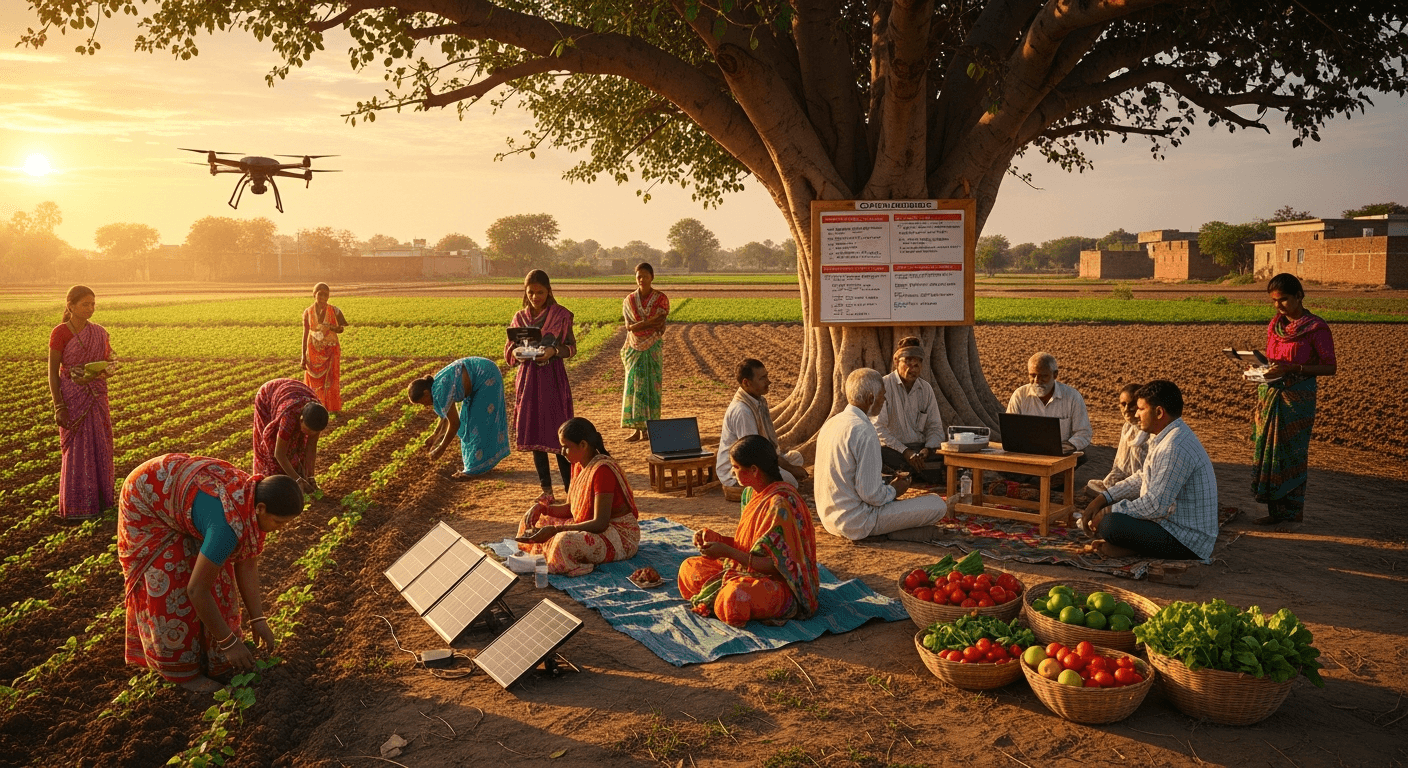
- Drone training programs for women (the ‘Drone Didi’ idea) let women operate drones for seeding, spraying, and crop health monitoring — reducing water and labour while opening up seasonal incomes.
- ‘Solar Didis’ show how women adopting rooftop and community solar become energy producers, powering irrigation and cottage industries while earning a revenue stream.Didi tera Solar Suhaana
- Digital markets and open networks (ONDC-style ideas) can let SHGs list goods and services, accept online orders, and receive timely payments — shifting them from local bazaar dependence to wider marketplaces.
What I’ve learned working through these ideas
My practical view is simple: money without tools creates dependency; tools without networks create fragmentation. The magic happens when finance, assets, training and market access are combined inside trusted collectives.
I recommend bundling interventions:
- Skills + Equipment: Train groups in both technical skills (drone operations, solar maintenance, food processing) and digital skills (e-commerce, data labelling). Provide shared assets (drones, sewing machines, cold storage) through group-owned models.
- Market integration: Help collectives register on digital marketplaces and procurement networks so orders flow directly to them rather than to intermediaries.
- Affordable, quick finance: Collateral-free, fast-disbursing loans to SHGs for capital assets — with clear repayment models linked to asset revenues.
- Connectivity & energy: Prioritise broadband (BharatNet-style) to SHG hubs and rooftop/community solar so groups can run processing and digital services reliably.
- Policy nudges: Treat local women’s collectives as eligible recipients for CSR and 80G-style incentives; simplify registration and compliance for micro-enterprises.
Practical first steps for an SHG or cooperative
- Map strengths: Identify crops, skills, seasonal labour patterns and local market gaps.
- Prioritise 2–3 assets that create immediate value (e.g., a drone service for sprayer work, a solar-powered cold box for perishables, a shared sewing/processing unit).
- Build a digital presence: a simple catalogue, payment account, phone number and a weekly schedule for group services.
- Start small, scale fast: Pilot one income stream, measure cash flows, then reinvest profits into the next asset.
- Network with other SHGs: peer learning multiplies gains faster than isolated investment.
Sustainability and values
Collectives are not just revenue machines; they are platforms for dignity, agency and local leadership. When women earn publicly and manage assets collectively, social status changes, younger generations see new role models, and local decision-making shifts.
Yet we must ensure sustainability: technology choices should reduce environmental harm (use drones intelligently; prioritise organic pest control where possible), and energy solutions should aim for clean, decentralized renewable sources.
A note on scale and policy
If we want tens of millions of women to move from subsistence to sustainable incomes, we need to think systemic. That means aligning skilling budgets, targeted subsidies for group assets, digital infrastructure, and incentives for private sector partners to buy from collectives. My earlier proposals — from supporting SHG registration on open networks to incentivising corporate gifting of assets as CSR — are designed to move that needle.Teach man to fish, woman to earn
Closing — an invitation
I remain optimistic because I have seen the shifts in small places that scale when given the right nudge. Collectives convert vulnerability into opportunity. If you run an SHG, a cooperative, a local NGO or a supportive enterprise, start with a small shared asset and a digital catalogue this season. Measure, refine and help a neighbouring group copy the model.
We are at an inflection point: combine women’s local knowledge, appropriate technology, group ownership and market access — and you get resilient rural economies led by women.
Regards,
Hemen Parekh
Any questions / doubts / clarifications regarding this blog? Just ask (by typing or talking) my Virtual Avatar on the website embedded below. Then "Share" that to your friend on WhatsApp.
Get correct answer to any question asked by Shri Amitabh Bachchan on Kaun Banega Crorepati, faster than any contestant
Hello Candidates :
- For UPSC – IAS – IPS – IFS etc., exams, you must prepare to answer, essay type questions which test your General Knowledge / Sensitivity of current events
- If you have read this blog carefully , you should be able to answer the following question:
- Need help ? No problem . Following are two AI AGENTS where we have PRE-LOADED this question in their respective Question Boxes . All that you have to do is just click SUBMIT
- www.HemenParekh.ai { a SLM , powered by my own Digital Content of more than 50,000 + documents, written by me over past 60 years of my professional career }
- www.IndiaAGI.ai { a consortium of 3 LLMs which debate and deliver a CONSENSUS answer – and each gives its own answer as well ! }
- It is up to you to decide which answer is more comprehensive / nuanced ( For sheer amazement, click both SUBMIT buttons quickly, one after another ) Then share any answer with yourself / your friends ( using WhatsApp / Email ). Nothing stops you from submitting ( just copy / paste from your resource ), all those questions from last year’s UPSC exam paper as well !
- May be there are other online resources which too provide you answers to UPSC “ General Knowledge “ questions but only I provide you in 26 languages !




No comments:
Post a Comment