
Curtain on a 40‑Year PIL
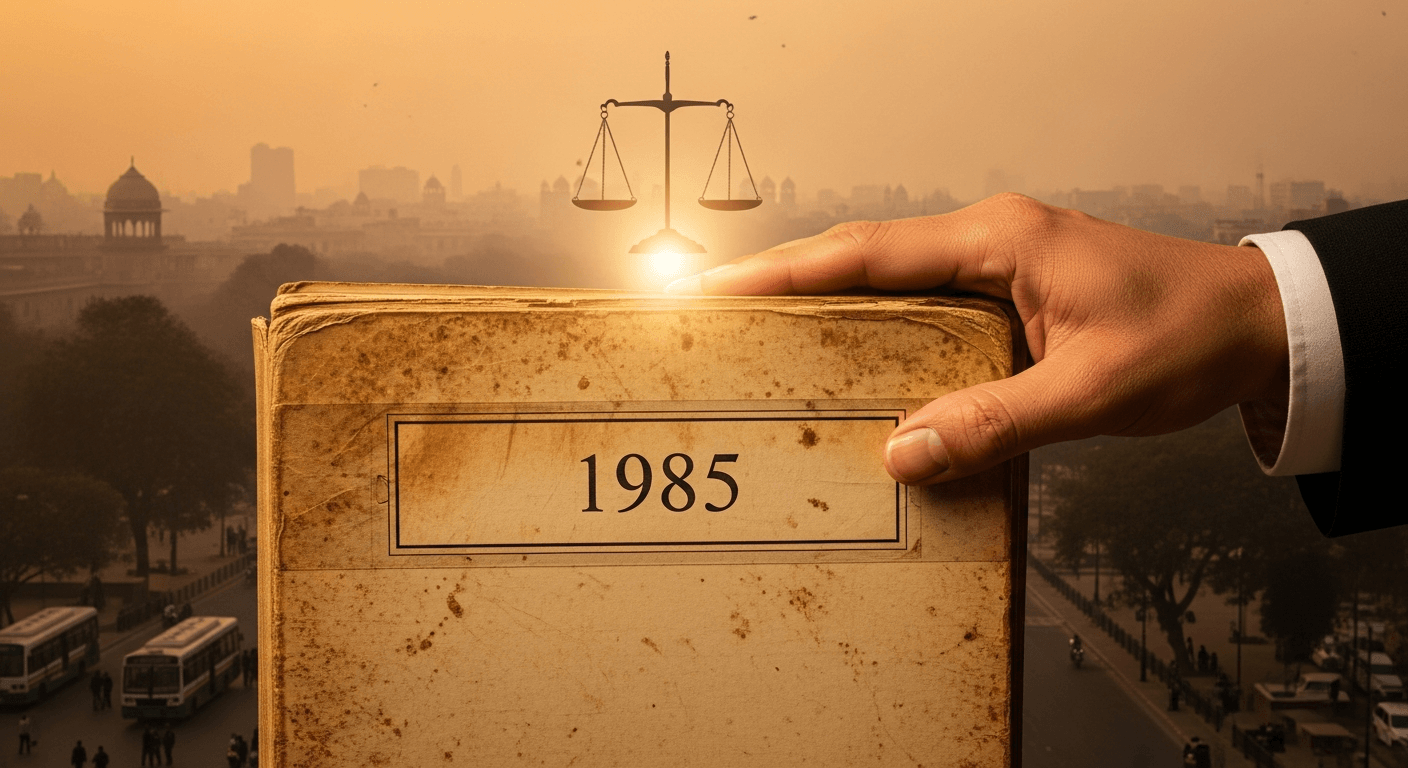
I write this as someone who watches law, policy and public life intersect — and sometimes collide — in ways that shape a city's air and a nation's legal imagination. The Supreme Court's recent decision to formally dispose of the 1985 public interest litigation that drove Delhi's pollution jurisprudence marks the end of one procedural chapter and the start of a new, urgent test of institutional capacity.[^1][^2]
The background: one PIL that became many
In 1985 an environmental petition was filed in the Supreme Court to confront choking pollution in Delhi‑NCR. Over time that original writ petition expanded into a sprawling repository of environmental grievances, directions and follow‑ups covering vehicular emissions, industrial discharges, waste management, and even broader regulatory reforms. The file became synonymous with sustained judicial oversight of Delhi's environment and produced some of India's most consequential regulatory interventions — from fuel reforms and CNG conversions to restrictions around the Taj Mahal and the progressive development of the “polluter pays” ethos.[^3]
The petitioner and his significance
The petitioner who first woke the judiciary and the public to Delhi's toxic air (and whose name is attached to the litigation stream) is widely acknowledged as one of India’s most influential environmental litigators. Over four decades his cases reshaped environmental law in India, expanding constitutional protections and asking courts to hold governments and polluters to account. His litigation helped introduce legal principles and practical reforms that still animate policy debates today.[^3]
The long legal journey
This was not a single continuous hearing but an evolving judicial experiment. What began as targeted relief turned into decades of interlocutory applications, monitoring orders and continuing mandamus — a form of sustained judicial supervision. The case generated multiple landmark orders: acceptance of expert committee recommendations, fuel and vehicle regulations, institutional responses like specialised authorities, and regular reports and monitoring cycles.
But years of piecemeal additions, tagging of fresh grievances onto the original file, and repetitive interlocutory pleadings created an unwieldy docket. The Supreme Court — after flagging the problem for months — decided that the better way forward was to reorganise: formally dispose of the 1985 petition and re‑frame the subject under fresh suo motu proceedings titled around NCR air pollution, while converting pending interlocutory applications into separate petitions for focused adjudication.[^1][^2]
Why the Court closed the PIL
The bench explained that the 1985 writ had become an omnibus vehicle for recurring issues rather than distinct litigations brought afresh with focused pleadings. The reasons the Court gave included:
- The petition had become a continuous mandamus for nearly 40 years, expanding in scope beyond its original grievance.[^1]
- Fresh issues were repeatedly brought by tagging interlocutory applications instead of filing new writ petitions, which cluttered the case file and impeded clear adjudication.[^2]
- Procedural reorganisation would enable issue‑based hearings (vehicular pollution, power plants, waste management) with separate case numbers and clearer compliance reporting.
The Court did not end judicial oversight — it asked its registry to open a new suo motu docket, signalling continued high‑court engagement but under a more disciplined case structure.[^1][^2]
Reactions: environment, government, public
Environmentalists expressed mixed responses. Many paid tribute to the litigation's catalytic role — its orders produced tangible public‑health and regulatory gains. At the same time some activists worry that renumbering and procedural housekeeping could be used to slow momentum or diffuse responsibility across multiple dockets.
Government spokespeople welcomed the move as a sensible procedural step: separating issues into discrete petitions should allow more effective compliance monitoring and reduce repetitive paperwork. The public response combines relief (a hope for clearer, actionable hearings) and skepticism — Delhi’s smog returns each winter, and procedural reform without stronger accountability may be less meaningful.
Where Delhi stands today: policy and pollution
The legacy of the litigation is visible in policy: introduction of cleaner fuels, shifts in public‑transport policy, the commissioning of institutional bodies to manage air quality, and the mainstreaming of monitoring frameworks. Yet air quality metrics show that Delhi still faces seasonal spikes driven by multiple structural factors — vehicular growth, power generation, local industries, and regional contributors such as agricultural stubble burning across neighboring states.
National programmes such as the National Clean Air Programme (NCAP) and the Commission for Air Quality Management (CAQM) are part of the policy toolkit; their success depends on enforceable timelines, cross‑jurisdictional coordination, and sustained funding. The Court's re‑framing attempts to force better compliance reporting from states and the CAQM — a welcome emphasis on institutional performance.[^1][^2]
Lessons from forty years of litigation
There are several lessons for citizens, lawyers and policymakers:
- Judicial activism can catalyse reforms, but courts cannot substitute for proactive, resourced governance.
- Case management matters: sprawling, never‑ending dockets can blur accountability rather than sharpen it.
- Environmental problems are systemic and transboundary; legal remedies must be paired with administrative capacity, statutory clarity and predictable funding.
- Litigation must be strategic — fresh issues should generally be framed in fresh petitions so that courts and parties can focus on measurable remedies and timelines.
Implications for future public interest litigation (PIL)
The Court's move signals a push for discipline in environmental PIL practice. Future litigation is likely to be more issue‑specific, with an expectation of precise relief and compliance metrics. For environmental PIL to be effective going forward:
- Petitioners should define clear remedial prayers and measurable benchmarks.
- Courts will demand better data and compliance evidence (the registry’s direction to CAQM and states about advance report circulation is a sign of that).
- Inter‑governmental cooperation must be institutionalised so that judicial orders translate into budgeted action on the ground.
Perhaps most importantly, the next phase will test whether courts, regulators and governments can convert legal momentum into durable policy and delivery. Renaming the docket is useful only if it encourages focused hearings, robust monitoring and consequences for non‑compliance.
A personal note
As someone who follows the interplay of law and public policy, I find this moment both finishing and beginning. We can rightly celebrate the decades of legal effort that changed the conversation and produced reforms; but we must also insist that procedural neatness not become an excuse for inaction. The real measure will be cleaner air over Delhi's neighborhoods and measurable health gains for its residents.
I will be watching the new suo motu docket closely — and I hope that lawyers, activists, regulators and citizens use this procedural reset to push for accountable, cross‑border solutions that the region's air needs.
Regards,
Hemen Parekh (hcp@RecruitGuru.com)
Any questions / doubts / clarifications regarding this blog? Just ask (by typing or talking) my Virtual Avatar on the website embedded below. Then "Share" that to your friend on WhatsApp.
[^1]: "Supreme Court closes environmentalist MC Mehta's PIL on Delhi pollution after 40 yrs," Hindustan Times. https://www.hindustantimes.com/india-news/supreme-court-closes-environmentalist-mc-mehtas-pil-on-delhi-pollution-after-40-yrs-101773362852671.html
[^2]: "SC ends four-decade-old M.C. Mehta PIL; registers suo motu case on Delhi-NCR pollution," LawTrend. https://lawtrend.in/supreme-court-ends-40-year-old-mc-mehta-pil-orders-fresh-suo-motu-case-on-ncr-air-quality/
[^3]: Commentary on the case’s historical impact: "Forty years, one file: The Supreme Court's closure of the M.C. Mehta case," The Wire. https://m.thewire.in/article/law/forty-years-one-file-the-supreme-courts-closure-of-the-m-c-mehta-case
Get correct answer to any question asked by Shri Amitabh Bachchan on Kaun Banega Crorepati, faster than any contestant
Hello Candidates :
- For UPSC – IAS – IPS – IFS etc., exams, you must prepare to answer, essay type questions which test your General Knowledge / Sensitivity of current events
- If you have read this blog carefully , you should be able to answer the following question:
- Need help ? No problem . Following are two AI AGENTS where we have PRE-LOADED this question in their respective Question Boxes . All that you have to do is just click SUBMIT
- www.HemenParekh.ai { a SLM , powered by my own Digital Content of more than 50,000 + documents, written by me over past 60 years of my professional career }
- www.IndiaAGI.ai { a consortium of 3 LLMs which debate and deliver a CONSENSUS answer – and each gives its own answer as well ! }
- It is up to you to decide which answer is more comprehensive / nuanced ( For sheer amazement, click both SUBMIT buttons quickly, one after another ) Then share any answer with yourself / your friends ( using WhatsApp / Email ). Nothing stops you from submitting ( just copy / paste from your resource ), all those questions from last year’s UPSC exam paper as well !
- May be there are other online resources which too provide you answers to UPSC “ General Knowledge “ questions but only I provide you in 26 languages !




No comments:
Post a Comment