
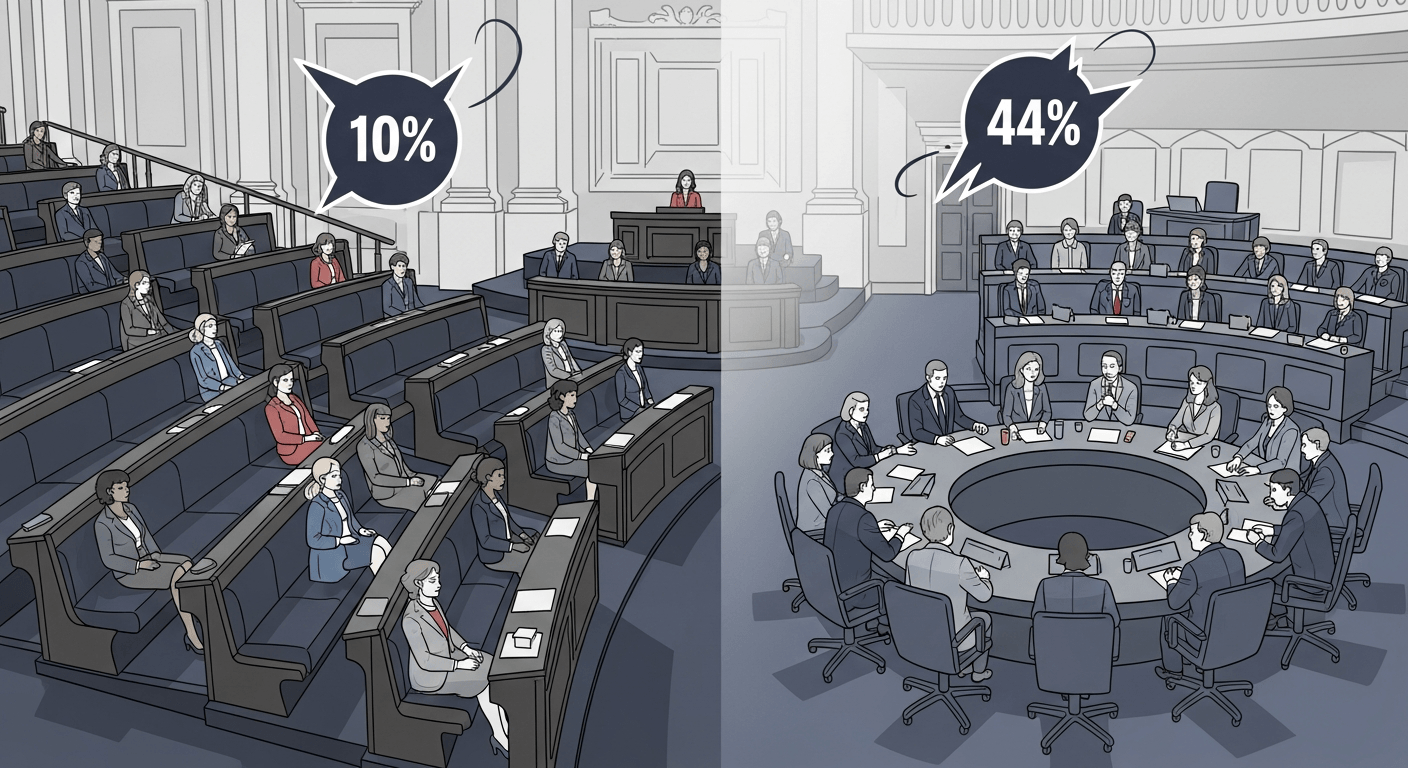
I write this as someone who cares deeply about the health of our democracy. The headline is stark but simple: according to a new report by the Association for Democratic Reforms (ADR) and National Election Watch, only about 10% of India’s MPs and MLAs are women. The findings are worth pausing over—not as an abstract statistic but as a measure of how fully our polity reflects half the population.ADR report
What the ADR report found
- Out of 4,666 combined MPs and MLAs across the country, only 464 (≈10%) are women.ADR report
- In the 18th Lok Sabha, 74 of 543 MPs are women (≈14%).ADR report
- Across state assemblies, 390 of 4,123 MLAs are women (≈9%).ADR report
- Of 51,708 candidates analysed in recent Lok Sabha and assembly polls, only 5,095 (10%) were women; in the 2024 Lok Sabha contests, only 800 of 8,360 candidates were women (≈9.6%), and 152 constituencies had no female candidate at all.ADR report
- At the local level, by contrast, women have made stronger gains: in 2022 local self-government institutions women comprised about 44% of representatives—showing that when structural measures exist, representation improves.ADR report
Why the gap persists
These numbers reflect many overlapping causes:
- Structural party practices: political parties nominate far fewer women candidates. Candidate selection remains a gatekeeper problem.
- Socio-economic constraints: women often lack the same access to campaign funds, networks, and media visibility as men.
- Patriarchal norms and safety concerns: social expectations and concerns about safety and mobility make public political life harder for many women.
- Dynastic and incumbency politics: male-dominated family successions and entrenched incumbents limit fresh female entrants.
- Institutional delays: the Nari Shakti Vandan Adhiniyam (Women’s Reservation Bill) that promises 33% reservation in Lok Sabha and assemblies is linked to census and delimitation processes—delaying implementation.ADR report
Why it matters for democracy and policy
Representation is not only symbolic; it shapes priorities. Low female representation can mean:
Policies that insufficiently reflect women’s needs—on health, safety, work, and welfare.
Fewer role models and mentors for future generations, dampening political ambition among women.
A democratic deficit: when half the population has limited voice in lawmaking, the legitimacy and responsiveness of institutions are weaker.
The local-body experience shows that when reservations and structural supports exist, women’s presence increases and governance can shift in agenda and style. That should be instructive for state and national reforms.ADR report
Examples of progress and remaining obstacles
Progress:
- Local governments: reservations for women at Panchayat and municipal levels have expanded women’s participation (≈44% at local bodies in 2022).ADR report
- Some parties and states have begun experimenting with candidate targets and leadership training for women.
Obstacles:
- Many constituencies still see zero women candidates.
- Party-wise variation is large: while some national parties field a higher share of women, many regional parties and independents field very few or none.
Steps to improve women’s political representation
I believe a combination of legal, party-level and social measures is needed:
- Implement reservations sooner rather than later: the 33% reservation in the Women’s Reservation Bill must be operationalised as soon as delimitation and census conditions permit—and policymakers should set clear timelines and public accountability.ADR report
- Party reforms: political parties should adopt internal targets, ‘zipping’ candidate lists (where applicable), and transparent selection criteria to increase the number of winnable women candidates.
- Capacity-building and funding: create sustained training, mentorship, and seed-funding programmes for prospective women leaders—government, civil society and parties can partner for this.
- Safety, mobility and media: address harassment (online and offline), ensure safe travel and campaigning conditions, and push for fair media coverage of women candidates.
- Social change and role models: civic education, local mentorship networks, and celebration of women leaders will help shift norms so more women see politics as a viable path.
A short call-to-action
These figures should move us from headline shock to collective action. Ask your local party office: what is their target for women candidates? Support and vote for credible women aspirants. Demand a clear timetable for implementing the reservation law. When citizens, parties and institutions act together, representation changes.
Regards,
Hemen Parekh
Any questions / doubts / clarifications regarding this blog? Just ask (by typing or talking) my Virtual Avatar on the website embedded below. Then "Share" that to your friend on WhatsApp.
Get correct answer to any question asked by Shri Amitabh Bachchan on Kaun Banega Crorepati, faster than any contestant
Hello Candidates :
- For UPSC – IAS – IPS – IFS etc., exams, you must prepare to answer, essay type questions which test your General Knowledge / Sensitivity of current events
- If you have read this blog carefully , you should be able to answer the following question:
- Need help ? No problem . Following are two AI AGENTS where we have PRE-LOADED this question in their respective Question Boxes . All that you have to do is just click SUBMIT
- www.HemenParekh.ai { a SLM , powered by my own Digital Content of more than 50,000 + documents, written by me over past 60 years of my professional career }
- www.IndiaAGI.ai { a consortium of 3 LLMs which debate and deliver a CONSENSUS answer – and each gives its own answer as well ! }
- It is up to you to decide which answer is more comprehensive / nuanced ( For sheer amazement, click both SUBMIT buttons quickly, one after another ) Then share any answer with yourself / your friends ( using WhatsApp / Email ). Nothing stops you from submitting ( just copy / paste from your resource ), all those questions from last year’s UPSC exam paper as well !
- May be there are other online resources which too provide you answers to UPSC “ General Knowledge “ questions but only I provide you in 26 languages !



No comments:
Post a Comment