
Why this investment matters — my quick read
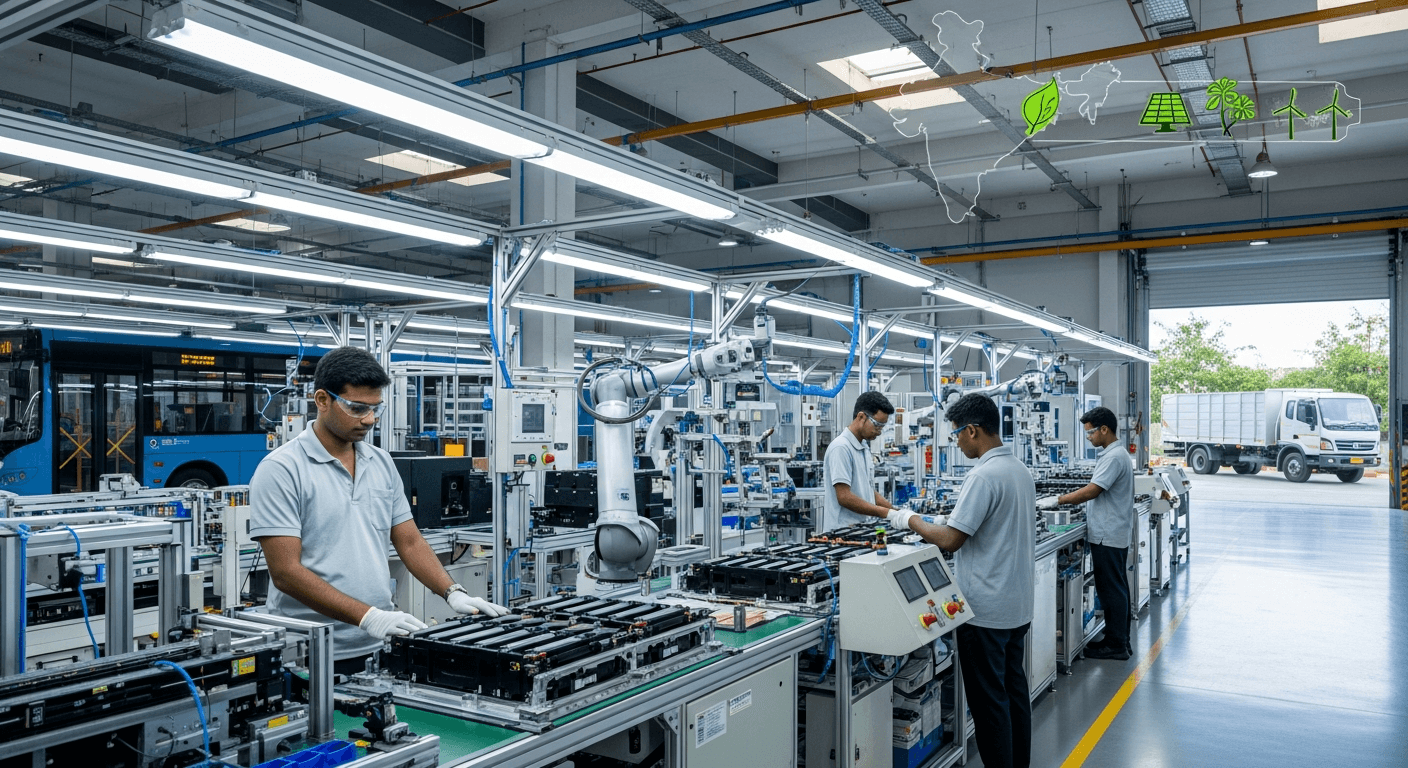
Ashok Leyland’s announcement that it will invest up to Rs 400–500 crore to build a greenfield battery-pack manufacturing facility near Chennai is more than a single-company play. It is a strategic step in the localization and industrialization of India’s electric commercial vehicle (CV) stack. I read the company statement and the market coverage carefully: the facility is presented as a battery-pack hub to support electric buses, trucks and allied energy-storage needs Economic Times report.
I have written about the importance of building domestic EV parts capacity before, and this move mirrors the localization push I’ve advocated in earlier posts Push EV Parts Production. The timing and scale are worth unpacking.
Market context
- India’s EV adoption for commercial vehicles is accelerating: fleet electrification pilots, city bus conversions, and logistics experiments have demonstrated operational savings and regulatory momentum.
- Policy tailwinds — including state EV policies and the National Mission on Transformative Mobility and Battery Storage — are creating incentives for local manufacturing, component localisation and supply-chain clustering.
- Global battery technology remains concentrated, so domestic pack assembly is a pragmatic intermediate step that captures value even while cell-level capacity scales up.
This investment therefore sits at the intersection of demand growth, supportive policy, and strategic supply-chain capture.
Strategic rationale (from my point of view)
- Control over the pack: Owning pack design and production lets a CV OEM tailor modules, thermal management and BMS (battery management systems) to vehicle duty cycles — critical for heavy-duty and municipal use-cases.
- Localisation and cost: Producing packs domestically reduces lead times, import risks, and forex exposure. It also positions the company to leverage incentives and phased manufacturing policies.
- After-sales and service advantage: For commercial fleets, reliability and predictable performance matter. Local packs enable faster warranty turnaround, cell replacements and second-life strategies.
- Platforming for energy storage: Pack expertise can be extended to stationary storage markets — a useful diversification as renewable integration grows.
Potential impacts on the EV ecosystem
- Supply-chain densification: A new pack facility will pull in local suppliers for enclosures, BMS electronics, thermal systems and testing services — strengthening an EV cluster near Chennai.
- Faster product iteration: Close integration between vehicle engineering and pack production accelerates design cycles and safety improvements.
- Competitive ripple effects: Other OEMs and Tier-1 suppliers may accelerate similar investments, improving depth and redundancy.
Jobs, skilling and local economic effects
- Direct manufacturing roles: The plant will create assembly, testing and quality-control jobs. For a greenfield facility of this scale, the initial headcount may be modest but focused on skilled production.
- High-skill opportunities: BMS software, battery testing, safety engineering and quality assurance roles become important — these are higher-value positions that require targeted training.
- Ancillary employment: Tooling, logistics, and small vendor ecosystems (sheet-metal, wiring harnesses, thermal components) will see demand, multiplying local economic impact.
Supply-chain implications
- Short-term: Expect demand for imported cells and some high-grade components to continue. The pack plant will largely assemble and integrate these into vehicle-ready modules.
- Medium-term: If cell manufacturing scales in India (policy and investment permitting), pack plants will be ready to integrate domestic cells, completing more of the value chain locally.
- Risk mitigation: Local pack production reduces single-source risks and gives fleet operators more predictable replacement cycles.
Challenges and risks
- Cell dependence: Pack production is sensitive to cell supply and cost. If cells remain expensive or supply-constrained, pack economics will be strained.
- Technology risk: Rapid changes in cell chemistry, form factors and fast-charging capability can make designs obsolete quickly; the plant must be flexible.
- Capital intensity and margins: Pack margins are thinner than vehicle margins; commercialization success depends on volume and operational efficiency.
- Safety and compliance: Manufacturing safe packs (thermal runaway mitigation, robust BMS) is critical — lapses risk recalls and reputational damage.
- Market volatility: Stock-market reactions to such announcements can be short-term negative (as we have seen with other corporate investment news) even when the long-term strategic case is strong.
What I would watch next
- Partnerships: Are there cell suppliers or technology partners tied to the plant? That will indicate how reliant the facility is on imports.
- Production timelines and capacity targets: Speed to market determines commercial benefit.
- Skill-development initiatives: Collaboration with local institutes or government skilling programs will shape workforce readiness.
- Policy incentives: How the state and central schemes translate into capital or operational support will influence unit economics.
Conclusion
This Rs 400–500 crore battery-pack investment is a pragmatic and strategically sound step for a commercial-vehicle manufacturer seeking tighter control over EV performance, after-sales and supply-chain resilience. It does not solve India’s cell-making gap overnight, but it does deepen local capability at a critical integration layer: the pack. Done well, the plant can reduce costs for fleet operators, create skilled jobs, and accelerate fleet electrification across buses and trucks.
If you follow EV policy, industrial strategy, or the commercial-vehicle market, this development is one to track closely.
Regards,
Hemen Parekh
Any questions / doubts / clarifications regarding this blog? Just ask (by typing or talking) my Virtual Avatar on the website embedded below. Then "Share" that to your friend on WhatsApp.
Get correct answer to any question asked by Shri Amitabh Bachchan on Kaun Banega Crorepati, faster than any contestant
Hello Candidates :
- For UPSC – IAS – IPS – IFS etc., exams, you must prepare to answer, essay type questions which test your General Knowledge / Sensitivity of current events
- If you have read this blog carefully , you should be able to answer the following question:
- Need help ? No problem . Following are two AI AGENTS where we have PRE-LOADED this question in their respective Question Boxes . All that you have to do is just click SUBMIT
- www.HemenParekh.ai { a SLM , powered by my own Digital Content of more than 50,000 + documents, written by me over past 60 years of my professional career }
- www.IndiaAGI.ai { a consortium of 3 LLMs which debate and deliver a CONSENSUS answer – and each gives its own answer as well ! }
- It is up to you to decide which answer is more comprehensive / nuanced ( For sheer amazement, click both SUBMIT buttons quickly, one after another ) Then share any answer with yourself / your friends ( using WhatsApp / Email ). Nothing stops you from submitting ( just copy / paste from your resource ), all those questions from last year’s UPSC exam paper as well !
- May be there are other online resources which too provide you answers to UPSC “ General Knowledge “ questions but only I provide you in 26 languages !




No comments:
Post a Comment