
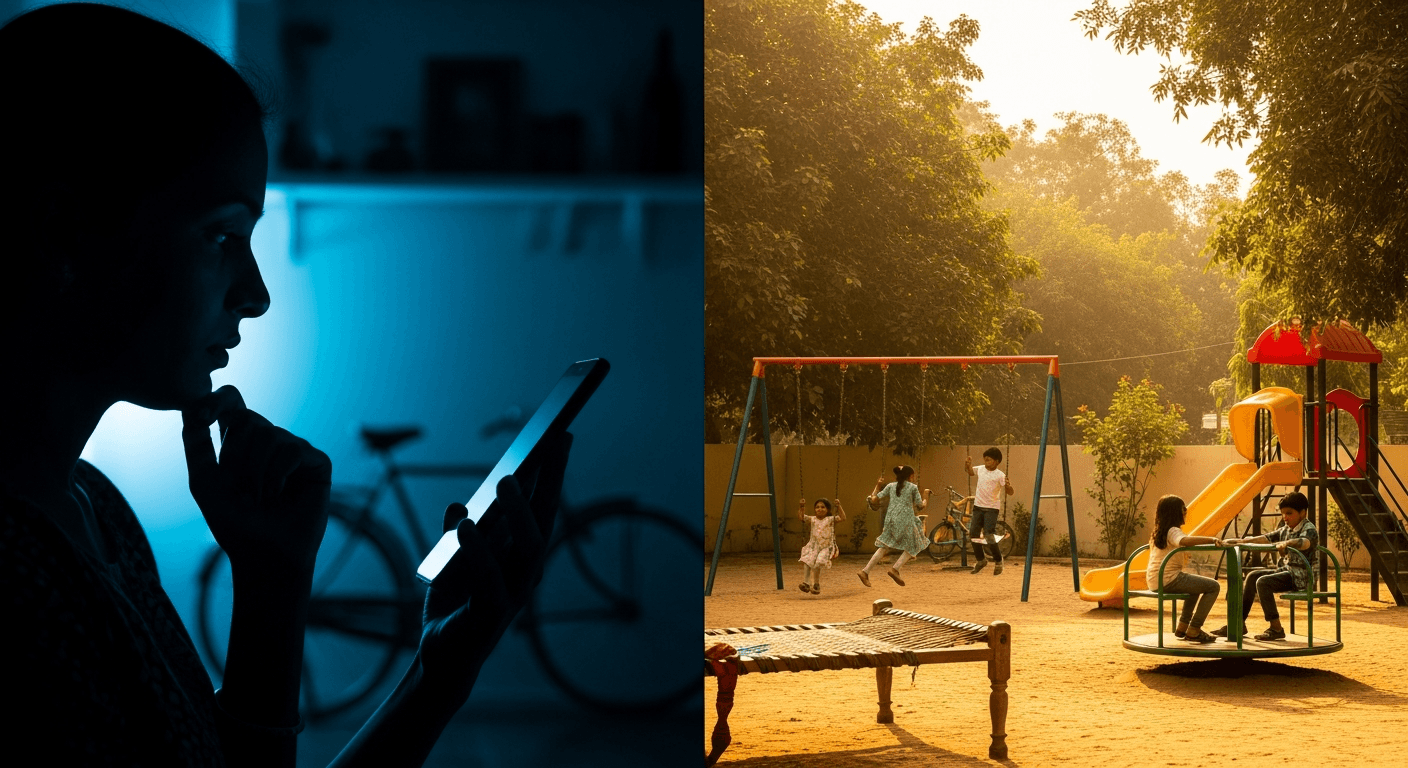
Why this Times of India report felt like a gut-punch
I read The Times of India piece, "The hidden costs of excessive screen media use in kids," and felt both alarmed and quietly unsurprised.[^1] The core finding — that many Indian children are spending well beyond the AAP/WHO recommendations and that a worrying share meet criteria for problematic or addictive screen use — is not an isolated headline. It's the visible part of a long, slow shift I’ve been tracking for years.
What the evidence (and my experience) says, briefly
- Clinic- and population-level research in India shows average daily screen time for many children and adolescents often crosses 2–3 hours, with very young children sometimes exposed far beyond recommended limits.[^1][^2]
- In samples of children attending psychiatric services, around two-thirds exceeded recommended limits and roughly one in five met screening criteria for problematic screen-media use.[^2]
- The harms are not just “time wasted.” They show up as sleep disruption, poorer dietary and activity patterns, rising obesity risk, delayed language and executive-function gains, and — in younger children — developmental risks that affect emergent literacy and social communication.[^1][^2]
The hidden costs (beyond the obvious)
Here’s how excessive screen exposure quietly widens the ledger of harm:
Physical health
Sedentary behaviour → higher obesity risk, poorer cardiovascular fitness.
Near-work and prolonged screen focus → increasing prevalence of myopia and eye strain.
Poor sleep from evening screen use → daytime tiredness, mood and concentration problems.
Cognitive and developmental
Reduced caregiver-child back-and-forth (especially with infant/toddler screen time) disrupts language learning and social cueing.
Habitual short, novel stimuli (autoplay, infinite scroll) train attention toward novelty and away from sustained focus and deep work.
Emerging neuroimaging research raises concerns about microstructural changes in very young brains exposed to excessive screens.[^2]
Emotional and social
Increased risk of anxiety, low mood and social withdrawal when screens replace real-world play and peer interactions.
More exposure to cyberbullying and unsafe content; addictive patterns heighten secrecy and family conflict.
Family and cultural dynamics (India-specific)
Screens are often used as pacifiers across households — during meals or to soothe a child — which normalises prolonged use.
Joint-family environments can produce inconsistent rules: one caregiver allows a lot, another tries limits, and the child learns to negotiate screens rather than healthy routines.
Why this matters now in India
Post-pandemic routines, cheaper devices and ubiquitous connectivity mean screens are available to children earlier and for longer. Multiple Indian studies and meta-analyses document that under-five children in many parts of India average double the safe screen exposure recommended by WHO/IAP.[^3]
When that early exposure replaces hands-on play, conversation and outdoor exploration, the consequences compound as children enter school: attention, language, social skills and sleep patterns shape learning trajectories for years.
What parents, teachers and policymakers can do (practical, realistic steps)
I try to keep recommendations pragmatic — the aim is not moralising, but to create friction around excessive use and build healthier defaults.
For families
Make a simple, written family screen plan: where, when and how long. Treat it like a chore chart: clear and visible.
Create tech-free zones/times (mealtimes, 60 minutes before bedtime, car rides where possible).
Co-view and co-play: when small children watch, watch with them and turn it into interaction.
Replace passive consumption with small, attractive alternatives: a favourite book, a sketching box, or a short outdoor game — ideally ones the child can enjoy with a caregiver.
For schools and clinicians
Teach digital hygiene as part of life-skills: how to manage notifications, understand algorithms, and practise focus.
Screen for problematic use in paediatric and mental-health visits; counselling and behavioural plans can be effective when families are guided.
For policymakers and platforms
Default youth modes (no infinite autoplay, stronger age-gating), clearer labels for educational vs recreational content, and public campaigns that treat digital hygiene like dental hygiene.
Support community-level programs that give children attractive, off-screen activities (sports, arts, maker spaces) — the best replacement for bad content is compelling good content in the real world.
A personal note — continuity in my thinking
This is not a new worry for me. Years ago I wrote about the growing permanence of screens in children’s lives and urged that we replace bad content with good content and better experiences. I still believe the same practical truth: you cannot simply ban a medium that has become essential; you have to design environments where its use is intentional and bounded. See my earlier reflections on this theme.[^4]
Final thought
Screens are tools. They can teach, connect and entertain. But when they become the default babysitter or the way we medicate boredom, the hidden costs accumulate — physically, mentally and socially. The Times of India report is a call to pay attention, to plan and to act. Small changes at home and school — sustained over months — will protect the childhood that builds the adults we hope to raise.
Regards,
Hemen Parekh
Any questions / doubts / clarifications regarding this blog? Just ask (by typing or talking) my Virtual Avatar on the website embedded below. Then "Share" that to your friend on WhatsApp.
[^1]: "The hidden costs of excessive screen media use in kids," The Times of India. https://timesofindia.indiatimes.com/india/the-hidden-costs-of-excessive-screen-media-use-in-kids/articleshow/129532086.cms
[^2]: Problematic screen media use in children and adolescents attending child and adolescent psychiatric services in a tertiary care center in North India. Indian J Psychiatry (clinic-based study). https://pmc.ncbi.nlm.nih.gov/articles/PMC9983455/
[^3]: Meta-analyses and pooled studies on under-five screen exposure in India (pooled mean ~2.2 hours/day). See: Screen Time Among Under-Five Children in India. https://pmc.ncbi.nlm.nih.gov/articles/PMC12229826/
[^4]: My earlier reflections on replacing bad content with good content: "Just replace BAD with GOOD content." https://myblogepage.blogspot.com/2024/12/just-replace-bad-with-good-content.html
Get correct answer to any question asked by Shri Amitabh Bachchan on Kaun Banega Crorepati, faster than any contestant
Hello Candidates :
- For UPSC – IAS – IPS – IFS etc., exams, you must prepare to answer, essay type questions which test your General Knowledge / Sensitivity of current events
- If you have read this blog carefully , you should be able to answer the following question:
- Need help ? No problem . Following are two AI AGENTS where we have PRE-LOADED this question in their respective Question Boxes . All that you have to do is just click SUBMIT
- www.HemenParekh.ai { a SLM , powered by my own Digital Content of more than 50,000 + documents, written by me over past 60 years of my professional career }
- www.IndiaAGI.ai { a consortium of 3 LLMs which debate and deliver a CONSENSUS answer – and each gives its own answer as well ! }
- It is up to you to decide which answer is more comprehensive / nuanced ( For sheer amazement, click both SUBMIT buttons quickly, one after another ) Then share any answer with yourself / your friends ( using WhatsApp / Email ). Nothing stops you from submitting ( just copy / paste from your resource ), all those questions from last year’s UPSC exam paper as well !
- May be there are other online resources which too provide you answers to UPSC “ General Knowledge “ questions but only I provide you in 26 languages !



No comments:
Post a Comment