
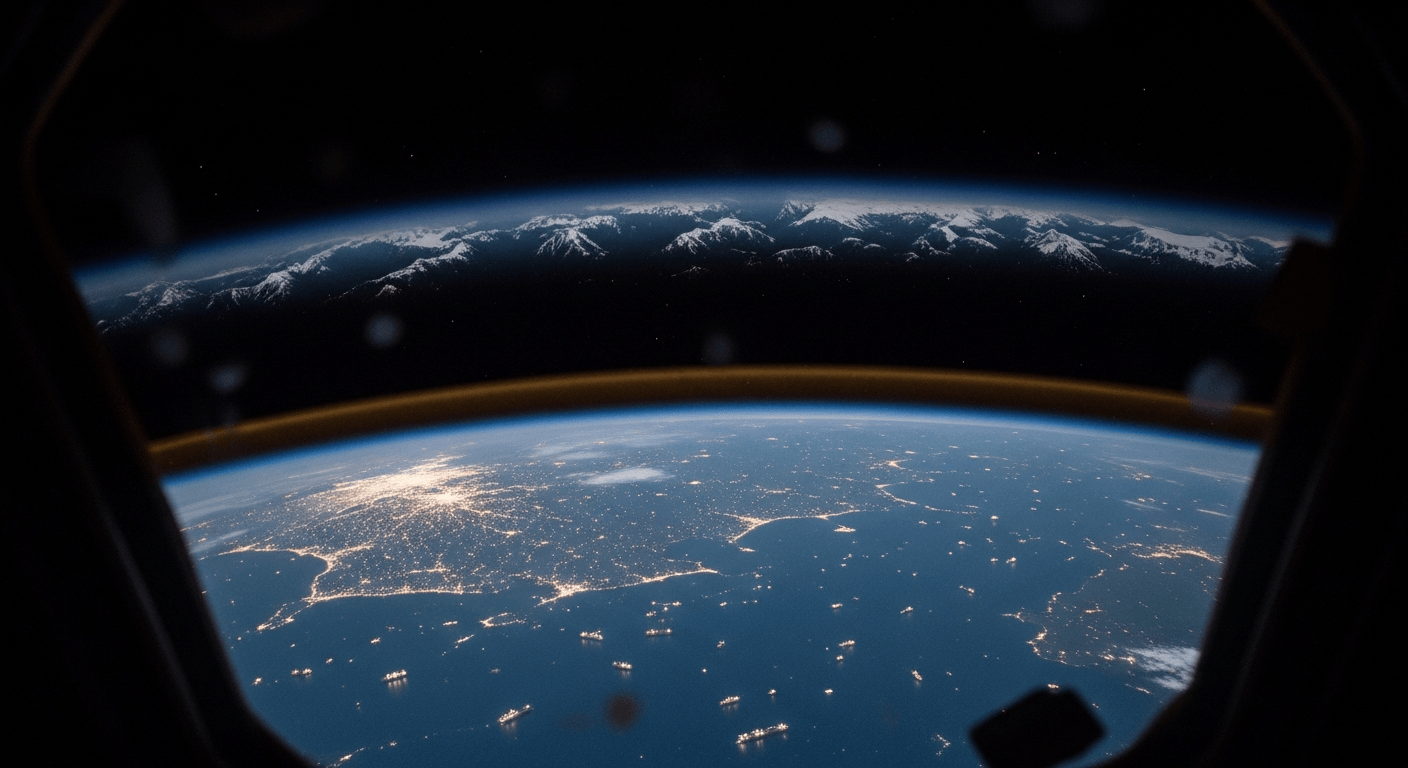
Night from Above: Arabian Sea to the Himalayas
Last week I paused over my screen and felt that small, immediate thrill we get when a familiar place is shown in a new light. The International Space Station shared a nighttime sweep that arcs over the Arabian Sea and carries the eye up toward the faint, snow-bright silhouette of the Himalayas. That image — part science, part poetry — reminds me how fragile and luminous our human footprint looks from 400 kilometres up.
“A single orbit can show both glowing coastlines and the quiet bones of ancient mountains.”
What the photo shows — and what it means to me
Taken from the Cupola or an outward-facing window of the ISS, the frame stitches together a story of contrast:
- Dark ocean punctuated by lines of ship lights and the occasional fishing fleet — tiny beacons marking commerce and survival.
- Dense, webbed networks of urban lights along the western Indian coast: patterns of growth, electricity, and infrastructure visible as veins and hubs.
- The Himalayas rising as a darker, quieter rim — snow and altitude mute the nightlight, but the planet’s curvature and limb glow frame them like a margin on a living map.
Those patterns are both breathtaking and sobering. They are evidence of prosperity, migration, and the pressure of coastal urban expansion. They are also a prompt to ask — what are we illuminating, and what are we dimming?
The vantage point and the ISS orbit
The ISS orbits Earth roughly every 90 minutes at an altitude close to 400 km, moving at about 17,500 miles per hour. That speed gives astronauts dozens of dawns and dusks every day and enables night passes that sweep great swathes of continent and ocean in a single view. The station’s orbital track determines what will appear in a frame; some passes skim coastlines, others cut across high mountain ranges. When the geometry lines up — window, crew, clear skies, and the terminator (the day–night line) — you get these dramatic, high-contrast images (India seen glowing from space — Times of India).
How these photos are taken — practical, technical notes
Astronauts use high-quality digital SLRs and mirrorless cameras with long, fast lenses and robust stabilization. Because the station is moving quickly relative to the ground below, photographers choose settings that strike a balance between sensitivity and motion blur:
- Fast lenses (telephoto zooms or prime glass) to bring coastal detail into view.
- High ISO to capture dim city lights and airglow.
- Short exposure times to minimize streaking from orbital motion, often combined with post-processing to stack or select the sharpest frames.
- The Cupola’s clear panes and careful framing help remove reflections; sometimes shots include parts of the station (solar arrays, modules) which anchor the photograph in human presence.
For broader, scientific night maps (like VIIRS “day–night band” composites) satellites use sensors designed to detect faint light sources, averaging many moonless, cloud-free swaths to produce global night-light images (Earth at Night imagery — NASA SVS).
The science of lights seen from space
What we call “nightlights” are a mix of phenomena:
- City lights and highways — steady, concentrated sources revealing urban form.
- Ship and fishing lights — moving specks on the ocean that can be tracked to study shipping lanes and fishing pressure.
- Gas flares and industrial sites — bright, often isolated sources tied to energy extraction.
- Aurora and airglow — natural atmospheric emissions that paint the sky with diffuse greens, reds, and blues.
Satellites and crew photography together let scientists separate these signals and study everything from electrification patterns to illegal fishing and the health of coastal ecosystems.
People behind the lens — the human angle
I always remember that these are not just technical products; they are made by people living in orbit. Astronauts take time off experiments to photograph Earth, choosing compositions that resonate with home and history. These images are gestures — reminders that we are temporarily out of reach but still deeply connected to the planet below.
“Photography on the ISS is science with an immediate emotional currency.”
Historical echoes and my own writing
This view has precedents: the ISS community has long shared Himalayan and Indian coastal passes in past years (ISS Himalayan image, 2018 — Wikimedia Commons). I’ve written before about the intelligence of coastal systems and their shifting pressures in my essay on the oceans, Samudra Manthan [Ocean Churning] V 2.0 (my blog). Seeing the same geography from space now is a visual continuation of those ideas — showing growth, trade, and the fragile seams between sea and mountain.

Reflections: environment and geopolitics
From orbit, coastlines tell stories of urbanization, ports, and shipping lanes — all veins of global trade. The tiny patterns of light suggest where livelihoods cluster and where pressures on fisheries and coastal habitats may be intense. The Himalayas, by contrast, remind us of freshwater origins and climate sensitivity: glacial retreat and human demand are intertwined in those dark ridgelines.
Conclusion & call to action
Images like the ISS’s nighttime sweep are more than pretty pictures. They are tools for understanding, communicating, and inspiring stewardship. If this moved you, follow the ISS and NASA imagery channels for the next orbital postcard — they publish more than panoramas; they give us context and data to act.
Follow official ISS social channels and NASA’s Earth observation feeds to stay connected and informed.
Regards,
Hemen Parekh
Note: I suggest a DALL·E-style image prompt separately (see the provided prompt field).
Get correct answer to any question asked by Shri Amitabh Bachchan on Kaun Banega Crorepati, faster than any contestant
Hello Candidates :
- For UPSC – IAS – IPS – IFS etc., exams, you must prepare to answer, essay type questions which test your General Knowledge / Sensitivity of current events
- If you have read this blog carefully , you should be able to answer the following question:
- Need help ? No problem . Following are two AI AGENTS where we have PRE-LOADED this question in their respective Question Boxes . All that you have to do is just click SUBMIT
- www.HemenParekh.ai { a SLM , powered by my own Digital Content of more than 50,000 + documents, written by me over past 60 years of my professional career }
- www.IndiaAGI.ai { a consortium of 3 LLMs which debate and deliver a CONSENSUS answer – and each gives its own answer as well ! }
- It is up to you to decide which answer is more comprehensive / nuanced ( For sheer amazement, click both SUBMIT buttons quickly, one after another ) Then share any answer with yourself / your friends ( using WhatsApp / Email ). Nothing stops you from submitting ( just copy / paste from your resource ), all those questions from last year’s UPSC exam paper as well !
- May be there are other online resources which too provide you answers to UPSC “ General Knowledge “ questions but only I provide you in 26 languages !


No comments:
Post a Comment