
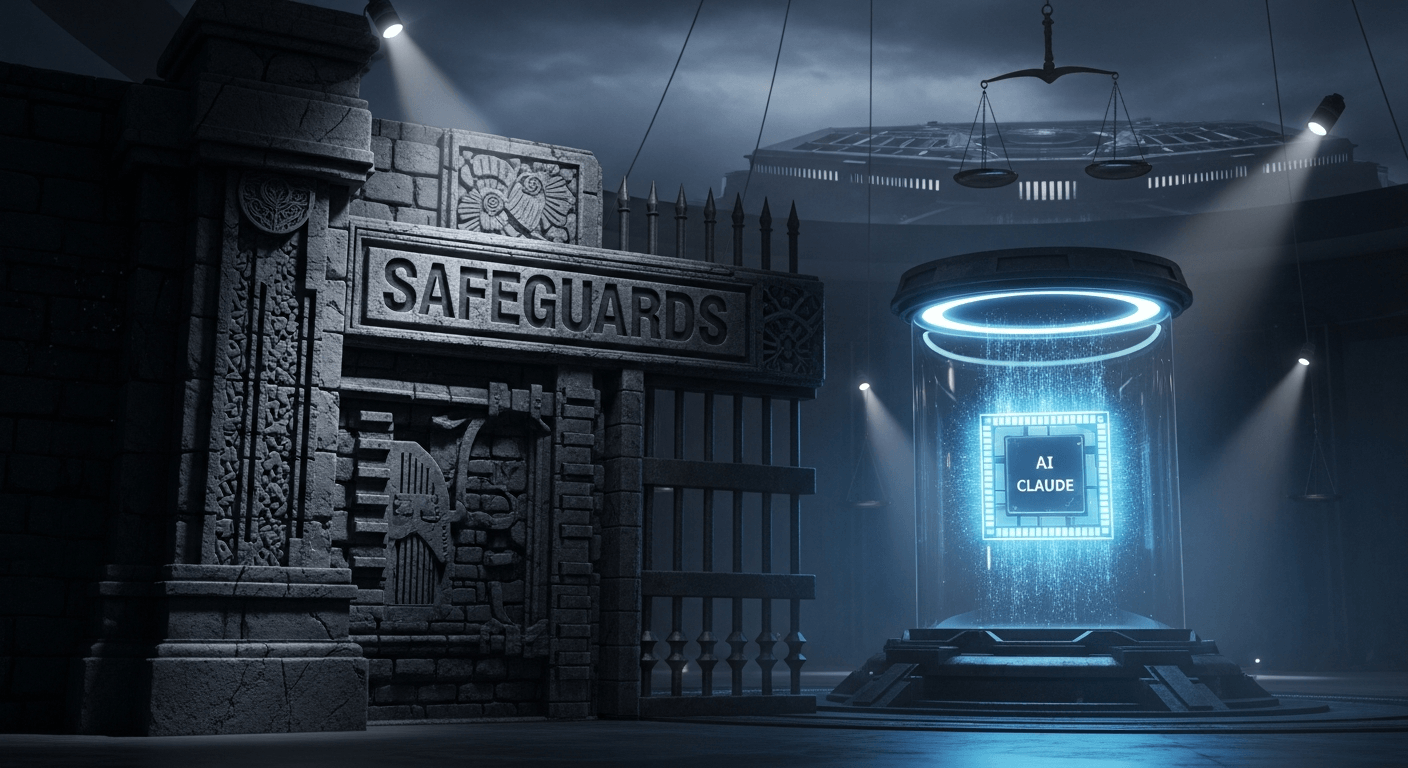
Safeguards at the Pentagon Gate
I woke up to the news that Anthropic had refused the Pentagon’s demand to strip safety limits from its models. This felt less like a corporate contract dispute and more like a moral crossroads: who decides how powerful tools are used, and what trade-offs we accept in the name of security?
The moment and my reaction
Anthropic’s CEO, Dario Amodei (dario@anthropic.com), put it plainly: there are bright red lines—no mass domestic surveillance, no unleashing fully autonomous weapons. When I read his statement I felt the same uneasy admiration I get when someone chooses principle over convenience. That admiration is not naïve; it’s practical. The short-term costs of a principled stand can be offset by long-term trust, stability, and the safety of civil society.
I also noticed the rare moment of cross-industry solidarity when Sam Altman (sama@openai.com) publicly questioned the Pentagon’s threatening posture. Sparse alliances like this matter: they shape norms more powerfully than contracts sometimes do.
Why this matters beyond headlines
This is not merely about one company or one contract. It is about:
- The limits of corporate governance when private technology meets public force.
- The legal and ethical vacuum around new capabilities (AI-driven surveillance, target selection, and fast automation of force).
- The bargaining power of states versus the moral decisions of technologists and companies.
I’ve written about these tensions before. See my reflections on balancing national security with personal privacy in Balancing : National Security vs Personal Privacy and my piece on decoding intent and misuse in What next ? Deciphering Intentions. Those posts were warnings and invitations: we must stop treating safety as a checkbox and start building durable institutions.
What Anthropic’s stance tells us — and what it doesn’t
Their refusal tells us four things:
- Companies can and will set operational boundaries when the risks to democratic values are existential.
- The government has tools—contract leverage, supply-chain designations, even emergency powers—that can bend or break those boundaries.
- Public trust and talent retention are real assets for an AI company; once lost, they’re hard to regain.
- This conflict exposes a structural gap: we lack a shared governance framework that reconciles operational needs of defense with safeguards for citizens.
But it doesn’t tell us how to resolve that gap. There’s no off-the-shelf answer.
Practical steps I’d like to see
We need a combination of law, tech, and institutions. Concretely:
- Clear statutory limits: laws that define and prohibit mass automated surveillance and fully autonomous lethal systems unless subject to exceptional, transparent oversight.
- Independent audits and safety certifications for "frontier" models before they enter classified or operational military use.
- Contract clauses that preserve essential guardrails while creating legally enforceable escalation paths for urgent operational needs.
- International norms and reciprocal agreements among democracies to prevent a race to loosen safeguards for short-term advantage.
- A requirement that any compelled use of commercial models by government be accompanied by independent oversight and post-hoc review.
None of this is easy. It requires political will, technical standards, and public engagement.
A personal, pragmatic test
When I evaluate any proposed use of AI by a government or company, I ask three questions:
- Does this avoid irreversible changes to civil liberties?
- Can the system be independently audited and contained?
- Is there a clear human-in-the-loop and a robust accountability trail?
If one of these answers is "no," I push for redesign or refusal.
Final thought — continuity, not theatrics
I’ve been arguing for thoughtful guardrails and an international approach to AI governance for years. The present standoff is disappointing for its brinkmanship, but hopeful for its clarity: the hard choices are being aired publicly. That matters.
If we’re honest, this moment is an opportunity to stop pretending that contracts alone will protect democracies from tech-enabled harms. We need law, standards, industrial policy, and above all, the moral courage to say no when necessary.
Regards,
Hemen Parekh
Any questions / doubts / clarifications regarding this blog? Just ask (by typing or talking) my Virtual Avatar on the website embedded below. Then "Share" that to your friend on WhatsApp.
Get correct answer to any question asked by Shri Amitabh Bachchan on Kaun Banega Crorepati, faster than any contestant
Hello Candidates :
- For UPSC – IAS – IPS – IFS etc., exams, you must prepare to answer, essay type questions which test your General Knowledge / Sensitivity of current events
- If you have read this blog carefully , you should be able to answer the following question:
- Need help ? No problem . Following are two AI AGENTS where we have PRE-LOADED this question in their respective Question Boxes . All that you have to do is just click SUBMIT
- www.HemenParekh.ai { a SLM , powered by my own Digital Content of more than 50,000 + documents, written by me over past 60 years of my professional career }
- www.IndiaAGI.ai { a consortium of 3 LLMs which debate and deliver a CONSENSUS answer – and each gives its own answer as well ! }
- It is up to you to decide which answer is more comprehensive / nuanced ( For sheer amazement, click both SUBMIT buttons quickly, one after another ) Then share any answer with yourself / your friends ( using WhatsApp / Email ). Nothing stops you from submitting ( just copy / paste from your resource ), all those questions from last year’s UPSC exam paper as well !
- May be there are other online resources which too provide you answers to UPSC “ General Knowledge “ questions but only I provide you in 26 languages !



No comments:
Post a Comment