
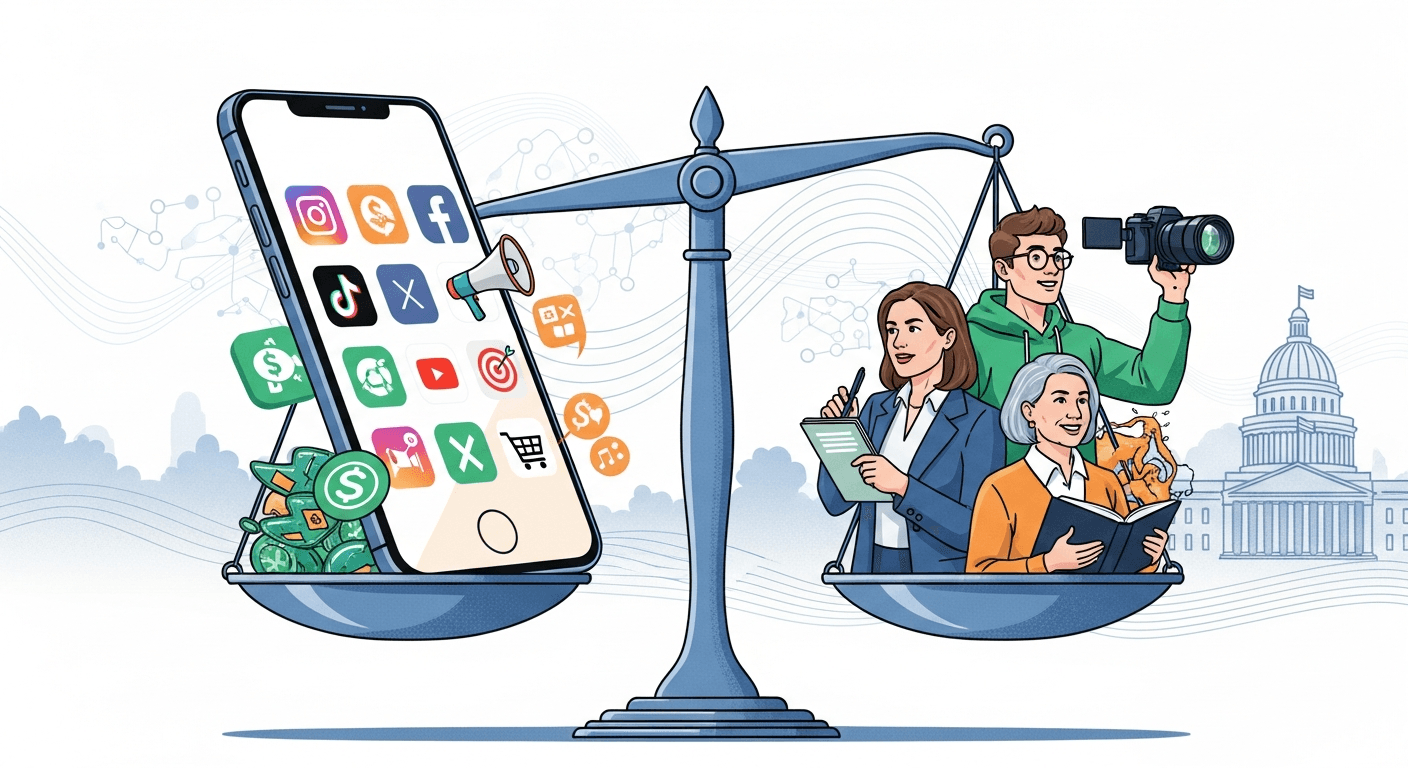
Fair Share for Creators
Introduction — the minister's call and why it matters
Recently a senior Union minister, speaking at the Digital News Publishers Association conclave, made a simple but powerful demand: social media companies must share revenue with the people who create the content that drives their platforms. I agree — and I think this moment is an inflection point for how we value work, truth and trust online.
That statement is not just rhetoric. It names a structural imbalance: platforms extract advertising and attention value from billions of creators and publishers, while keeping the lion’s share of the earnings. If we care about a healthy public sphere, economic justice and high‑quality content, we need to rethink that arrangement.
Background: creator economies and today's revenue models
Over the past decade a new creator economy has emerged. Professionals, hobbyists, journalists, researchers and influencers publish work that generates engagement, feeds recommendation engines and attracts advertisers.
Current dominant monetisation models include:
- Platform ad revenues (platforms sell ads and pay creators a fraction, often via thresholds and opaque rules).
- Direct tipping and donations (small, uneven, and platform-dependent).
- Paid subscriptions or memberships (Substack, Patreon—creator-first but niche).
- Brand deals and sponsorships (lucrative for a few; inaccessible for many).
Platforms capture scale and sell attention. Creators, meanwhile, face volatility, opaque algorithms, and inconsistent compensation.
Why platforms should share revenue: five arguments
- Fairness and economic justice
Creators produce the primary input — original content and attention. Sharing revenue recognizes intellectual labour and redistributes value away from concentrated platform rents.
- Sustainability of the creative ecosystem
Predictable compensation allows creators to invest in higher‑quality reporting, long‑form work, research and niche content that platforms alone won’t fund.
- Reducing misinformation and perverse incentives
When ad dollars reward sensationalism, platforms and creators have incentives that amplify low‑quality or divisive content. Monetisation tied to verified quality metrics and responsible practices can change incentives.
- Incentivising quality over virality
Revenue structures that reward sustained engagement, credibility and original reporting shift creator behaviour away from “click‑to‑outrage” and toward durable value.
- Broader economic inclusion
Revenue sharing can empower creators in tier‑2/3 cities and rural areas, democratising economic opportunity rather than concentrating benefits in a few urban hubs.
Potential objections and my rebuttals
Objection: Free market — platforms built the distribution and should keep profits.
Rebuttal: Platforms provide distribution, but they do not create the content. Markets can be redesigned to internalise creator contributions; regulation has precedent when network effects concentrate market power.
Objection: Implementation complexity — attribution, tracking and fraud are hard.
Rebuttal: Yes, attribution is complex but not insoluble. We have ad measurement, content ID, fingerprinting, and transparent reporting standards. Pilot programs and phased rollout can work.
Objection: Could stifle innovation or raise costs for consumers?
Rebuttal: Thoughtful models balance platform sustainability with creator returns. Many revenue shares simply reallocate existing advertising revenue rather than impose new taxes.
Policy suggestions and practical revenue‑sharing models
I propose a toolbox approach — policymakers and platforms should pick pragmatic, interoperable instruments rather than a one‑size‑fits‑all law.
Ad revenue split: A clear baseline share of platform ad revenue linked to measurable creator engagement (e.g., watch time, verified referral value). Platforms should publish the formula and settle payments monthly.
Subscription rev‑share: When platforms package subscriptions (premium feeds, audio/video), creators whose content drives subscriptions receive a negotiated percentage.
Tipping & micropayments with platform match: Platforms can match small creator revenues for a capped period to bootstrap monetisation for emerging creators.
Transparent creator funds: Platforms that run creator funds should disclose allocation criteria, payout data and appeals mechanisms.
Algorithmic boosts tied to monetisation: Algorithms should preferentially recommend content from creators who agree to transparent revenue terms — aligning discovery with fair pay.
Standardised attribution protocols: An industry standard for tagging, fingerprinting and reporting content provenance to ensure fair payment flows.
Examples and international precedents
YouTube already shares ad revenue with many creators via a partner program, though thresholds and policy changes have often been criticised for opacity.
TikTok and Instagram run creator funds and tipping but payout formulas and scale vary.
Substack demonstrates the subscription model where creators retain significant revenue, showing the viability of creator-first platforms.
Internationally, governments have forced bargaining or rules when platforms capture publisher value (for example, news bargaining codes and rules in some jurisdictions). These precedents show that public policy can rebalance platform‑creator economics.
A workable transition path
Require transparency: platforms must publish anonymised payout data, attribution methods and algorithmic signals that determine monetisation.
Establish baseline minimums: a modest mandatory split or remittance for ad revenues tied to creator‑identified content that generated the ad impression.
Pilot programs: run sectoral pilots (news, education, health) to refine measurement, especially where public interest is high.
Open standards and audits: independent audits and open APIs for creators to verify earnings and claims.
Conclusion — a call to action
I believe this is a pragmatic, urgent reform. Policymakers should set guardrails that protect creators and the public interest; platforms should adopt transparent revenue‑sharing and invest in fair mechanics; creators should organise around standard contracts and insist on visibility into the economics that affect them.
We have the measurement tools, legal precedents and moral case to rebalance a system that currently extracts far more than it returns. If we want a healthier digital commons — one that rewards truth, quality and inclusion — we must ensure creators receive a fair share of the wealth they produce.
Regards,
Hemen Parekh
Any questions / doubts / clarifications regarding this blog? Just ask (by typing or talking) my Virtual Avatar on the website embedded below. Then "Share" that to your friend on WhatsApp.
Get correct answer to any question asked by Shri Amitabh Bachchan on Kaun Banega Crorepati, faster than any contestant
Hello Candidates :
- For UPSC – IAS – IPS – IFS etc., exams, you must prepare to answer, essay type questions which test your General Knowledge / Sensitivity of current events
- If you have read this blog carefully , you should be able to answer the following question:
- Need help ? No problem . Following are two AI AGENTS where we have PRE-LOADED this question in their respective Question Boxes . All that you have to do is just click SUBMIT
- www.HemenParekh.ai { a SLM , powered by my own Digital Content of more than 50,000 + documents, written by me over past 60 years of my professional career }
- www.IndiaAGI.ai { a consortium of 3 LLMs which debate and deliver a CONSENSUS answer – and each gives its own answer as well ! }
- It is up to you to decide which answer is more comprehensive / nuanced ( For sheer amazement, click both SUBMIT buttons quickly, one after another ) Then share any answer with yourself / your friends ( using WhatsApp / Email ). Nothing stops you from submitting ( just copy / paste from your resource ), all those questions from last year’s UPSC exam paper as well !
- May be there are other online resources which too provide you answers to UPSC “ General Knowledge “ questions but only I provide you in 26 languages !




No comments:
Post a Comment