
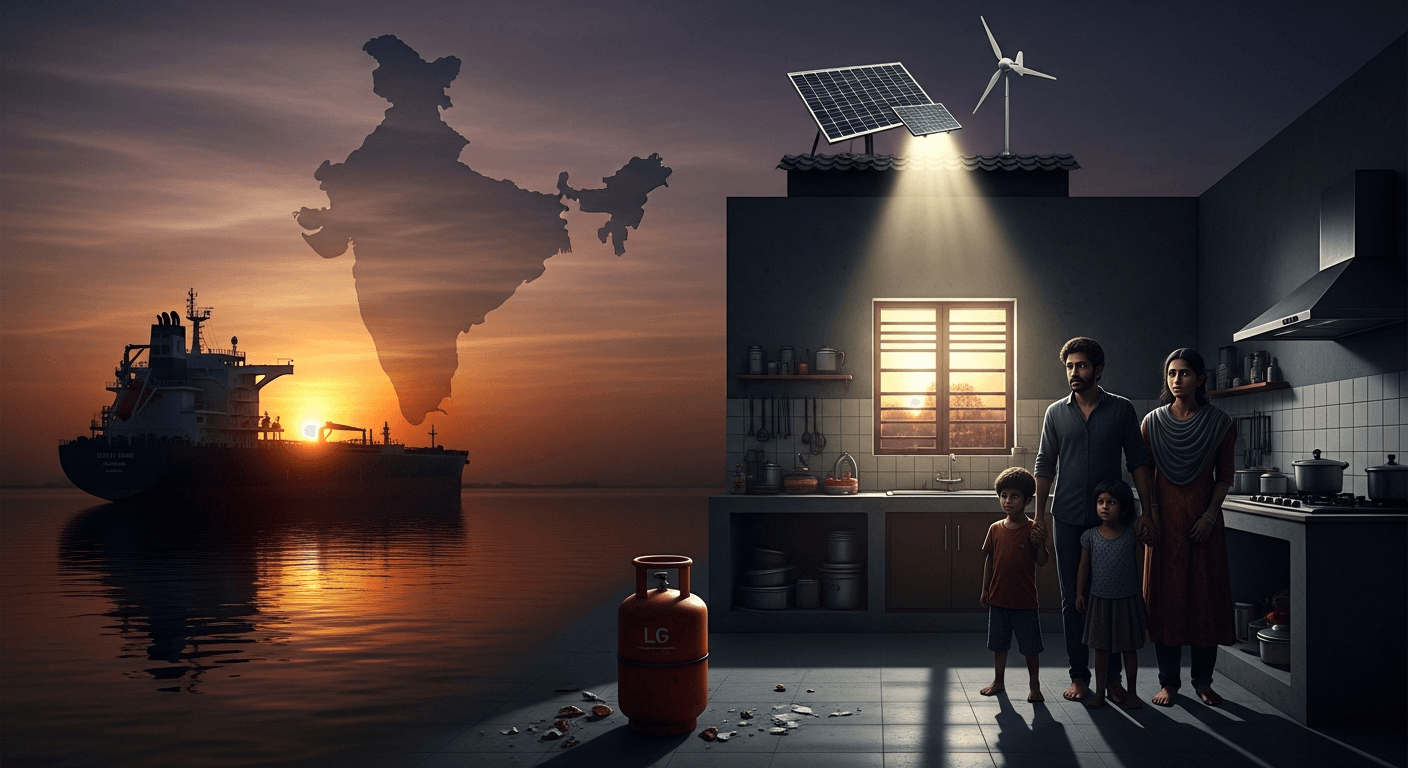
The short answer
I keep returning to the same worry: India’s energy system is more connected to Middle East security than most people realise. When a conflict threatens tanker routes through the Strait of Hormuz, the immediate effects are felt in prices and logistics — and, sooner than you might expect, in kitchens and factories.
In this post I summarise the top 10 points any reader should know about how a US–Iran war-style disruption would hit India’s oil, LPG and LNG supplies. I also reflect on why reducing import exposure has been a recurring theme in my writing A Twin Tragedy — and why that continues to matter.
Top 10 points to know
- Significant exposure via a narrow chokepoint
- A large share of India’s crude, LPG and LNG imports transits the Strait of Hormuz, a narrow maritime corridor. If tanker movements are disrupted, immediate shipments are delayed and markets reprice risks quickly.
- LPG is the most immediately vulnerable
- LPG (the cylinder cooking fuel) has relatively small strategic buffers and most imports come from Gulf suppliers. This makes household supplies the first visible casualty if shipments slow or insurance/war-risk cover is withdrawn.
- LNG is supply-contracted but not immune
- Much LNG is supplied under long‑term contracts, which provides some protection. Still, security risks, halted loading at export terminals, or rerouted tankers raise costs and can force allocation cuts to industrial users.
- Crude oil is better buffered — but costs rise
- India maintains commercial and strategic crude/product inventories that provide weeks of cover for crude and refined fuels. The bigger immediate impact is on landing costs: freight, war‑risk premiums and a geopolitical premium on crude prices lift India’s import bill.
- Refinery/export dynamics are a safety valve
- India is a major exporter of refined products. In a stress scenario, refiners can be asked to prioritise domestic supplies (curb exports) to protect local availability — a practical but costly policy lever.
- Logistics and insurance amplify the shock
- Even when physical barrels exist, insurers may withdraw war‑risk cover. Tanker owners and traders will either reroute (longer voyage, higher freight) or suspend fixtures, tightening near‑term physical availability.
- Industrial and agricultural users feel the second wave
- Cuts or price spikes in LNG affect power, fertiliser and heavy industry. Those sectors face production disruptions or higher input costs that eventually feed into broader inflation.
- Diversification and substitution options exist — imperfectly
- Alternatives (Russian, US, African, Latin American supplies, or tapping spot markets) can replace volumes over weeks, but at higher cost and longer transit times. Short‑term substitution is harder for LPG than for crude.
- Demand management and prioritisation are realistic policy tools
- Governments can prioritise LPG for household consumers, reassign gas flows to essential uses, increase refinery output of gas/petrochemical streams for cooking fuel, or temporarily limit exports to secure domestic supply.
- Medium‑term incentive to accelerate energy transition
- Repeated supply shocks emphasise the value of reducing import dependence: more domestic gas production where feasible, larger, better‑managed strategic stocks (especially for LPG), conservation, and faster deployment of renewables and electric cooking and transport.
Why this matters to me (and what I’ve written before)
I’ve argued previously that persistent reliance on imported fossil fuels leaves India exposed to geopolitics and price shocks, and that accelerating domestic renewables and efficiency was both an economic and strategic imperative A Twin Tragedy. A short conflict can be weathered with buffers; repeated or prolonged disruptions force painful trade‑offs between exports, domestic supply and inflation control.
Practical, short actionable advice
For consumers: avoid panic buying; hoarding accelerates shortages and makes distribution harder. Consider small steps that reduce fuel exposure at household level — improve cooking efficiency, and where possible evaluate electric or induction cooking as an alternative over the medium term.
For policymakers: strengthen LPG strategic buffers, create clear gas‑allocation rules that prioritise households and essential industry in crises, speed up diversification of suppliers (and long‑term contracted LNG), and accelerate renewables, rooftop solar and electric cooking/transport programmes to shrink exposure to maritime chokepoints.
Regards,
Hemen Parekh
Any questions / doubts / clarifications regarding this blog? Just ask (by typing or talking) my Virtual Avatar on the website embedded below. Then "Share" that to your friend on WhatsApp.
Get correct answer to any question asked by Shri Amitabh Bachchan on Kaun Banega Crorepati, faster than any contestant
Hello Candidates :
- For UPSC – IAS – IPS – IFS etc., exams, you must prepare to answer, essay type questions which test your General Knowledge / Sensitivity of current events
- If you have read this blog carefully , you should be able to answer the following question:
- Need help ? No problem . Following are two AI AGENTS where we have PRE-LOADED this question in their respective Question Boxes . All that you have to do is just click SUBMIT
- www.HemenParekh.ai { a SLM , powered by my own Digital Content of more than 50,000 + documents, written by me over past 60 years of my professional career }
- www.IndiaAGI.ai { a consortium of 3 LLMs which debate and deliver a CONSENSUS answer – and each gives its own answer as well ! }
- It is up to you to decide which answer is more comprehensive / nuanced ( For sheer amazement, click both SUBMIT buttons quickly, one after another ) Then share any answer with yourself / your friends ( using WhatsApp / Email ). Nothing stops you from submitting ( just copy / paste from your resource ), all those questions from last year’s UPSC exam paper as well !
- May be there are other online resources which too provide you answers to UPSC “ General Knowledge “ questions but only I provide you in 26 languages !




No comments:
Post a Comment