
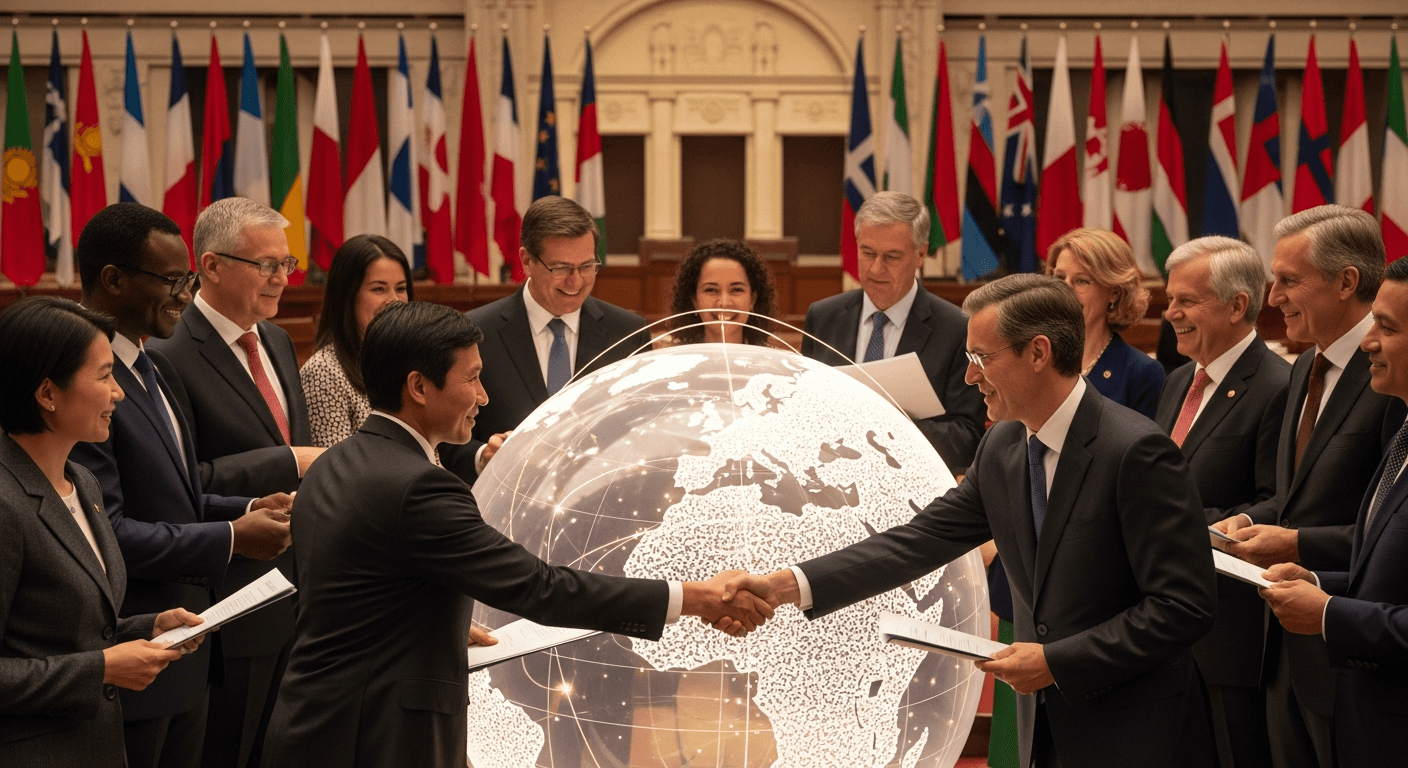
I write this as someone who believes institutions, not just individuals, shape a nation’s long arc. The recent decision by the Lok Sabha to constitute cross-party Parliamentary Friendship Groups with more than 60 nations feels like one of those institutional nudges—small in form, potentially large in consequence. The initiative aims to build sustained Parliament-to-Parliament channels across Asia, Africa, Europe, the Americas and Oceania, complementing traditional diplomacy and widening the circle of democratic conversation.PIB press release Economic Times
Why form cross-party groups?
At its core this move is about institutionalising dialogue. There are three broad reasons the Speaker’s office gave (and I find convincing):
- To create direct, sustained lawmaker-to-lawmaker lines of communication that survive the usual diplomatic churn.
- To allow Legislatures to share procedural and policy know-how: oversight practices, committee models, legislative drafting tips.
- To project a quieter, non-executive strand of India’s foreign policy—one rooted in parliamentary norms and people-to-people ties.
Put simply: governments change, administrations come and go, but parliamentary relationships anchored in regular exchange can provide continuity and trust.
"These groups are not a substitute for our Ministry of External Affairs; they are a complement—an additional voice of our democracy speaking directly to other legislatures," the Speaker said in a statement to the House.
What these groups will do
The plan is deliberately multi-dimensional. I expect the groups to focus on five practical activities:
- Parliamentary diplomacy
- Regular dialogues with counterpart groups, virtual roundtables, and delegation visits to deepen mutual understanding.
- Oversight and institutional learning
- Exchanges on committee structures, anti-corruption frameworks, and legislative scrutiny methods.
- Cultural and educational exchange
- People-to-people programs, academic linkages for parliamentary research, and cultural showcases to build soft trust.
- Trade facilitation and economic conversations
- Legislators can host industry roundtables, cut red-tape discussions, and spotlight subnational partnerships that business delegations can follow up on.
- Legislative coordination on global challenges
- Joint approaches to climate policy, health preparedness, digital governance, and democratic resilience.
These are practical, not merely symbolic. When lawmakers share the nuts and bolts of lawmaking, they can forge quicker, informed responses to shared problems.
Potential benefits
- Continuity: Parliamentary ties can outlast political cycles and preserve institutional memory.
- Trust-building: Regular contact reduces misunderstandings and humanises foreign counterparts.
- Policy diffusion: Good legislative practices—on oversight, transparency, data protection—can spread faster.
- Economic spillovers: Parliamentary introductions can open doors for trade missions and private sector linkages.
- Democratic diplomacy: It projects India as a mature, pluralistic democracy engaging collaboratively.
Anticipated challenges
No initiative of this scale is without obstacles:
- Partisanship risk: Cross-party optics must be managed; if groups become proxies for partisan messaging, credibility will erode.
- Coordination with executive diplomacy: Clear protocols are needed so parliamentary initiatives complement, not contradict, formal foreign policy.
- Resource constraints: Sustained engagement—study visits, research support, translation—requires budgetary commitment.
- Security and sensitivity: Some topics (e.g., defence, intelligence) demand careful handling to avoid diplomatic friction.
- Follow-through: Enthusiasm at launch must translate into measurable outcomes, else the groups risk becoming ceremonial.
A foreign affairs analyst put it crisply: "Parliamentary friendship groups can be a force multiplier for soft power—but they will only matter when they produce policy-relevant, follow-up work that ministries and stakeholders can act on." This pragmatic caution is exactly the kind I would echo: set up for continuity, deliver with discipline.
Context: India’s parliamentary diplomacy
India has been gradually elevating Parliament’s role in foreign engagement. Over recent years there have been multi-party delegations abroad and a clearer push to make legislative ties a routine part of outreach. The Friendship Groups with 60+ nations consolidates that trajectory by creating a structured network spanning continents—from neighbours in South Asia to partners in Europe, North and South America, Africa and Oceania.NewsOnAir
If diplomacy is often framed as executive-to-executive, parliamentary diplomacy is the institutional long game: it builds habits of engagement, mutual respect, and shared problem-solving that can endure political tides.
Conclusion and civic call-to-action
I welcome this initiative as an institutional step toward deeper, more pluralistic global engagement. For it to truly matter, these groups must prioritize practical work—shared research, measurable exchanges, and clear linkages with experts, civil society and the private sector. As citizens, we should watch how our representatives use these channels and ask them for reports and outcomes. Civic engagement—through public hearings, expert briefings, and constituency inputs—can ensure these friendship groups become engines of accountable, people-centered diplomacy.
So ask your MP how their parliamentary friendship group plans to involve local stakeholders. Demand transparency on visits, agendas and outcomes. Democracy strengthens when citizens turn institutional gestures into accountable practice.
Regards,
Hemen Parekh
Any questions / doubts / clarifications regarding this blog? Just ask (by typing or talking) my Virtual Avatar on the website embedded below. Then "Share" that to your friend on WhatsApp.
Get correct answer to any question asked by Shri Amitabh Bachchan on Kaun Banega Crorepati, faster than any contestant
Hello Candidates :
- For UPSC – IAS – IPS – IFS etc., exams, you must prepare to answer, essay type questions which test your General Knowledge / Sensitivity of current events
- If you have read this blog carefully , you should be able to answer the following question:
- Need help ? No problem . Following are two AI AGENTS where we have PRE-LOADED this question in their respective Question Boxes . All that you have to do is just click SUBMIT
- www.HemenParekh.ai { a SLM , powered by my own Digital Content of more than 50,000 + documents, written by me over past 60 years of my professional career }
- www.IndiaAGI.ai { a consortium of 3 LLMs which debate and deliver a CONSENSUS answer – and each gives its own answer as well ! }
- It is up to you to decide which answer is more comprehensive / nuanced ( For sheer amazement, click both SUBMIT buttons quickly, one after another ) Then share any answer with yourself / your friends ( using WhatsApp / Email ). Nothing stops you from submitting ( just copy / paste from your resource ), all those questions from last year’s UPSC exam paper as well !
- May be there are other online resources which too provide you answers to UPSC “ General Knowledge “ questions but only I provide you in 26 languages !





No comments:
Post a Comment