
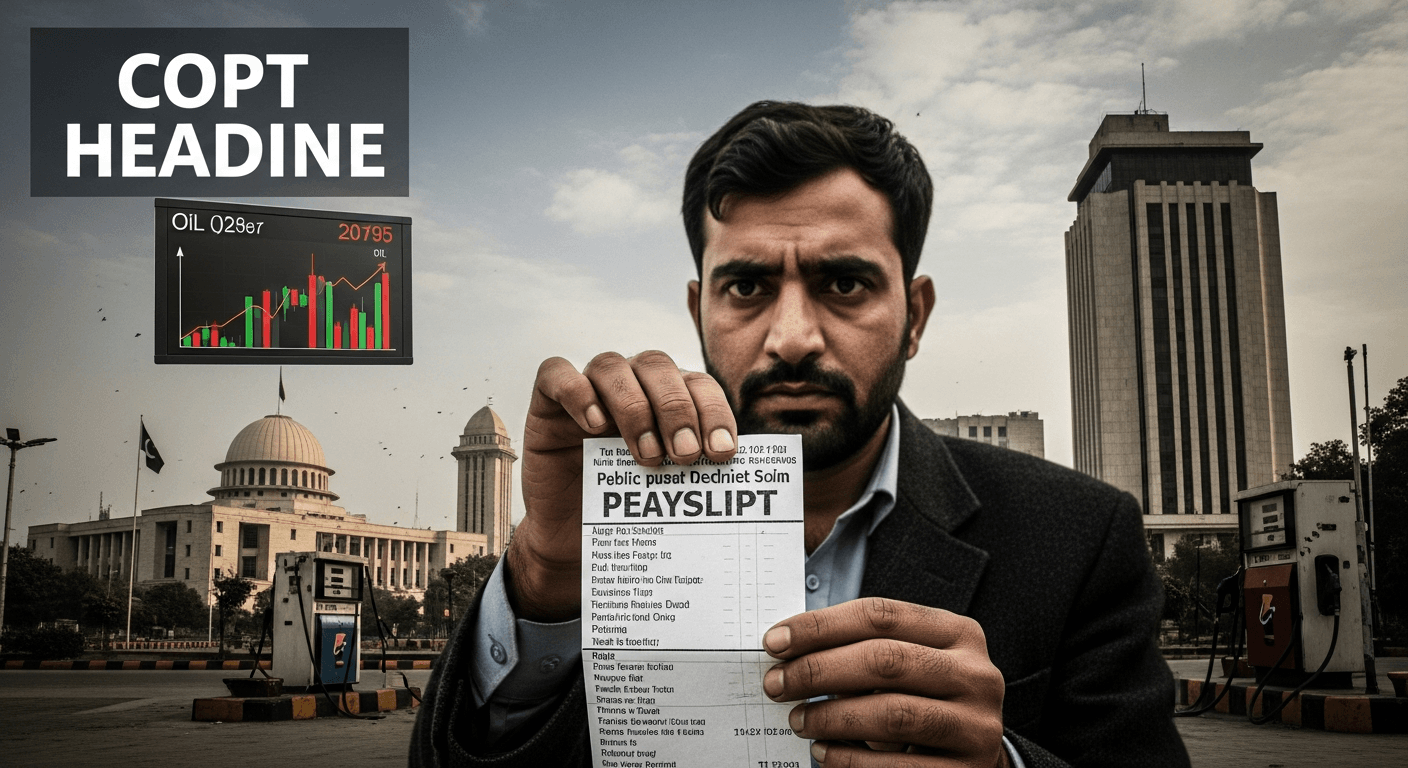
Employees Face the Heat
Austerity in state firms after a sudden fuel shock leaves many workers with pay cuts of up to 30 percent
I write this as someone who has watched economic shocks ripple through livelihoods for years: the latest fuel crisis has forced Pakistan’s government to push austerity into state-owned enterprises, asking some employees to accept salary cuts as high as 30 percent. The move — framed as necessary to preserve fuel stocks and redirect savings to public relief — has left many workers anxious and unions and analysts sounding warnings.
What happened: a quick summary
Over the past weeks global oil disruptions tied to conflict in West Asia pushed international crude prices sharply higher. The government responded with emergency conservation measures: reduced fuel allocations for official vehicles, a four-day workweek for many public offices, and cuts in pay across state-owned enterprises and autonomous institutions. Officials say savings will be used for public relief and to protect essential services while fuel supplies are managed Economic Times.
Background: why Pakistan is vulnerable
Pakistan imports most of its crude and refined fuel products. When global supply tightens and prices spike, domestic pump prices and government fuel bills rise quickly. The country’s limited foreign-exchange reserves and previous cycles of subsidy and fiscal stress mean authorities have fewer buffers. I have written before about austerity pressures and how governments lean on public-sector payrolls when options narrow My earlier note on Pakistan austerity.
Why state firms are cutting pay
State firms (often called public sector enterprises) are large energy consumers and bear part of the government wage bill indirectly through budgetary transfers and board oversight. The government’s calculus is:
- Reduce fuel use in government operations to preserve national stocks.
- Cut immediate recurring expenditures (salaries, allowances, board fees) to free cash for emergency relief and imports.
- Signal fiscal seriousness to international partners and markets.
Officials stress the cuts are temporary and graded — lower-paid staff are meant to be protected in some announcements — but implementation varies across institutions Deccan Herald; Dawn.
Which sectors and firms are affected
The measures apply to a broad set of state firms and autonomous bodies — from energy distribution companies and transport authorities to some industrial public-sector units. Government statements indicate reductions will mirror those for civil servants (roughly 5–30% in different grades) and also include cuts in travel and participation fees for board members. Many agencies providing essential services—health, emergency response, and certain utilities—are reportedly exempted from the strictest reductions.
How many employees are affected?
Precise nationwide numbers are not yet public. Pakistan’s public-sector workforce (including sizable staff in autonomous bodies) runs into the hundreds of thousands. Early estimates in press coverage suggest tens of thousands of employees in state firms will see pay adjustments; the headline cap of 30% has been highlighted for higher grades and managerial pay bands while smaller reductions apply lower down Times of India; Economic Times.
Human costs: voices from the ground
"I can manage a small reduction for a month or two, but my family has rents and school fees," said an employee at one autonomous authority. A government official told me the move was the least-worst option to avoid deeper service disruption. An industry analyst I spoke to warned: "If cuts are prolonged, consumer demand will fall, and fragile firms could face layoffs down the road."
These are not abstract numbers: for many households a 20–30% drop in take-home pay means postponing medical care, cutting food expenses, or taking informal work — all costly in social and economic terms.
Short-term and long-term impacts
Short-term:
- Reduced household spending and immediate hardship for affected employees.
- Lower government fuel consumption and smaller budget outflows.
- Signal to markets and international partners that authorities are acting to conserve resources.
Long-term risks:
- If austerity extends, morale and productivity at state firms could fall, weakening service delivery.
- Prolonged wage cuts without broader reform risk legal and industrial disputes, and could encourage exits from public service.
- Deeper demand contractions could slow an already weak economy, prolonging recovery.
Legal and union responses
Trade unions and worker groups are monitoring the roll-out closely. Legally, the government can impose emergency measures in fiscal crises, but collective agreements and labour laws protect employment terms; challenges or negotiated adjustments are likely. So far, statements from unions range from conditional acceptance to calls for guarantees that lower-paid staff will be spared the steepest cuts.
Government stance and messaging
The official line is austerity is temporary and targeted, meant to conserve fuel and redirect savings to protect the most vulnerable. Authorities have coupled pay measures with fuel-allocation cuts, bans on non-essential travel and new purchases, and calls for remote work to reduce commuting fuel demand. They emphasize third-party audits and transparency in how savings are used for public relief Economic Times.
Possible mitigation and expert recommendations
Analysts suggest a two-track approach:
- Short-term: Protect lowest-paid workers (targeted relief), offer emergency cash or food support, and set firm timelines and review points for pay measures.
- Medium-term: Accelerate fuel diversification (LNG, renewables), improve procurement and reserve management, and pursue structural reforms in loss-making state firms to reduce recurring fiscal pressure.
International financial partners and domestic stakeholders can help by supporting targeted social programs and by pressing for transparent use of savings.
My concluding thought — a practical caution
Austerity can be necessary, but it must be temporary, transparent and equitable. Cutting wages without clear protections for the most vulnerable or credible plans for recovery is a short-term fix that can leave long-term scars. I will be watching how these measures are implemented, whether unions and employees are consulted, and whether the government uses the breathing space to move beyond emergency cuts toward sustainable reform.
Takeaway: salary cuts may conserve fuel and cash now, but protecting lower-paid workers and pairing austerity with reform and social safety nets will determine whether this shock becomes a manageable pause — or a deeper setback for livelihoods.
Regards,
Hemen Parekh
Any questions / doubts / clarifications regarding this blog? Just ask (by typing or talking) my Virtual Avatar on the website embedded below. Then "Share" that to your friend on WhatsApp.
Get correct answer to any question asked by Shri Amitabh Bachchan on Kaun Banega Crorepati, faster than any contestant
Hello Candidates :
- For UPSC – IAS – IPS – IFS etc., exams, you must prepare to answer, essay type questions which test your General Knowledge / Sensitivity of current events
- If you have read this blog carefully , you should be able to answer the following question:
- Need help ? No problem . Following are two AI AGENTS where we have PRE-LOADED this question in their respective Question Boxes . All that you have to do is just click SUBMIT
- www.HemenParekh.ai { a SLM , powered by my own Digital Content of more than 50,000 + documents, written by me over past 60 years of my professional career }
- www.IndiaAGI.ai { a consortium of 3 LLMs which debate and deliver a CONSENSUS answer – and each gives its own answer as well ! }
- It is up to you to decide which answer is more comprehensive / nuanced ( For sheer amazement, click both SUBMIT buttons quickly, one after another ) Then share any answer with yourself / your friends ( using WhatsApp / Email ). Nothing stops you from submitting ( just copy / paste from your resource ), all those questions from last year’s UPSC exam paper as well !
- May be there are other online resources which too provide you answers to UPSC “ General Knowledge “ questions but only I provide you in 26 languages !




No comments:
Post a Comment