
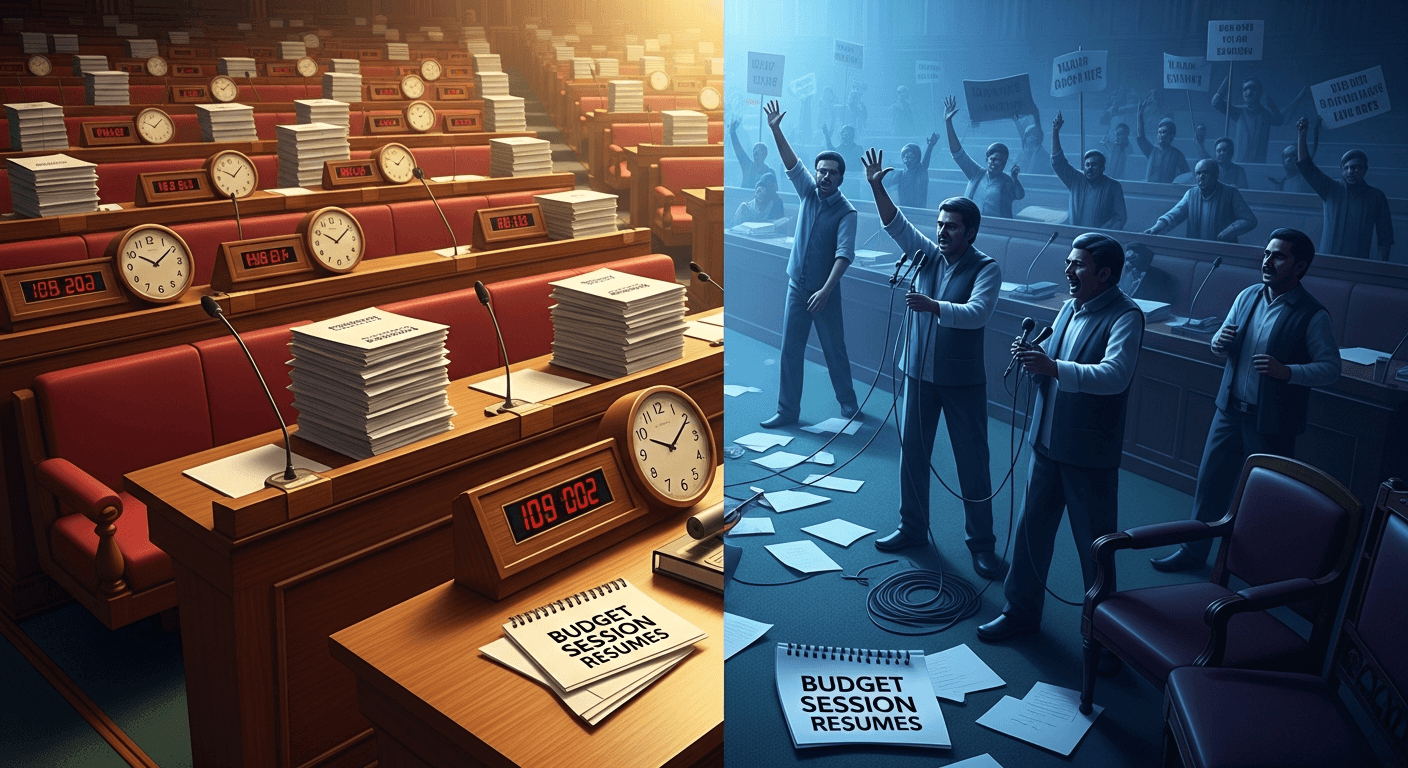
Why the second half feels different
I woke up this morning thinking about the peculiar choreography of our Parliament: two halves of the same institution trying to do opposite things at once. The Budget Session is resuming after the mid-session recess, but the calendar and the mood are not aligned. Legislative timetables, Standing Committees and the need to pass Demands for Grants sit beside a political theatre staged to score points ahead of state elections.
I have watched these patterns repeat often enough to stop being surprised. The coming days will likely be dominated more by spectacle than by statute — motions, symbolic debates, and raw positioning — and less by the hard, often boring work of lawmaking.
What to expect when the session restarts
Here are the concrete dynamics I expect to play out, based on the coverage and the rhythm of recent sessions:
A highly symbolic no-confidence-style debate: the second half will likely open with a motion that is more about demonstrating unity and sending a message than about actually changing power. Expect lots of floor theatre and predictable outcomes.
Broadening of the agenda: even if a motion targets parliamentary procedure or the Chair, the debate will expand to touch on trade deals, tariff decisions, energy imports, and international crises — issues the opposition can use to frame the government’s economic choices as a threat to specific industries and communities.
Repeated disruptions and short sittings: when emotions and electoral calculations matter more than committee work, we lose hours. Time that should be used for scrutinising budgetary allocations instead becomes fuel for headlines.
An attempt to convert debate into campaign theatre: both benches will use the House to rehearse narratives for voters back home — unity on one side, governance and stability on the other.
Little legislative progress in the short term: key bills that need careful scrutiny may be delayed, and several days of sitting time will be consumed by division-lobbies, adjournments and procedural wrangling.
Why this matters beyond politics
The Budget Session is not just a political ritual; it is when the nation’s money is debated and the details that affect schools, hospitals, farms and factories should be examined closely. When parliamentary time is mostly consumed by spectacle:
- Oversight weakens: ministries get less questioning; details in Demands for Grants are glossed over.
- Policy risks increase: hurried approvals and missed scrutiny can leave loopholes and unintended consequences.
- Public trust erodes: when citizens see more shouting than scrutiny, they lose faith in democratic institutions.
Practical fixes I keep returning to
I have argued before that we can preserve the House’s dignity without killing politics. A few practical reforms would blunt the worst effects of these cycles:
- Clear time quotas for budget debates and for each bill, enforced by the Business Advisory Committee.
- A stronger role for Standing Committees during the recess so that Demands for Grants and large policy proposals are pre-scrutinised before plenary debate.
- Limited and enforceable rules on repeated adjournments and frivolous notices that intentionally consume time.
- A credible program for shifting some procedural business to recorded digital formats — not to silence dissent but to make debate more measured and more accessible.
I have proposed versions of these ideas before, particularly the case for using technology to reduce wasted parliamentary hours and to let committees do the heavy lifting outside the glare of the floor debate. See my earlier reflections on making parliamentary proceedings more productive and virtual-friendly Like every work place: Lok Sabha must…. That post explored how online tools and better time allocation could save hours that are now routinely lost to shouting and procedural stalling.
A personal plea to MPs and citizens
To MPs: remember that your primary job is scrutiny. Theatre might win headlines, but careful questioning and disciplined debate change lives.
To citizens: watch closely, ask tougher questions, and nudge representatives to prioritise committee work and careful budget scrutiny. Democracies are resilient, but only if citizens insist on institutions that function.
What I’ll be watching closely
- Whether the House allows focused, clause-by-clause consideration of budgetary allocations.
- If Standing Committees produce timely reports on Demands for Grants during the recess and whether those reports shape debates when the House meets.
- Signs that both sides will prioritize legislative productivity over instant headlines.
If this session becomes a theatre of posturing, the immediate winners will be soundbites and social media moments. But the real cost will be measured later—in delayed reforms, under-scrutinised budgets, and policies that fail to reflect the reality of people on the ground.
Regards,
Hemen Parekh
Any questions / doubts / clarifications regarding this blog? Just ask (by typing or talking) my Virtual Avatar on the website embedded below. Then "Share" that to your friend on WhatsApp.
Get correct answer to any question asked by Shri Amitabh Bachchan on Kaun Banega Crorepati, faster than any contestant
Hello Candidates :
- For UPSC – IAS – IPS – IFS etc., exams, you must prepare to answer, essay type questions which test your General Knowledge / Sensitivity of current events
- If you have read this blog carefully , you should be able to answer the following question:
- Need help ? No problem . Following are two AI AGENTS where we have PRE-LOADED this question in their respective Question Boxes . All that you have to do is just click SUBMIT
- www.HemenParekh.ai { a SLM , powered by my own Digital Content of more than 50,000 + documents, written by me over past 60 years of my professional career }
- www.IndiaAGI.ai { a consortium of 3 LLMs which debate and deliver a CONSENSUS answer – and each gives its own answer as well ! }
- It is up to you to decide which answer is more comprehensive / nuanced ( For sheer amazement, click both SUBMIT buttons quickly, one after another ) Then share any answer with yourself / your friends ( using WhatsApp / Email ). Nothing stops you from submitting ( just copy / paste from your resource ), all those questions from last year’s UPSC exam paper as well !
- May be there are other online resources which too provide you answers to UPSC “ General Knowledge “ questions but only I provide you in 26 languages !




No comments:
Post a Comment