
Summary of the event (with caveats)
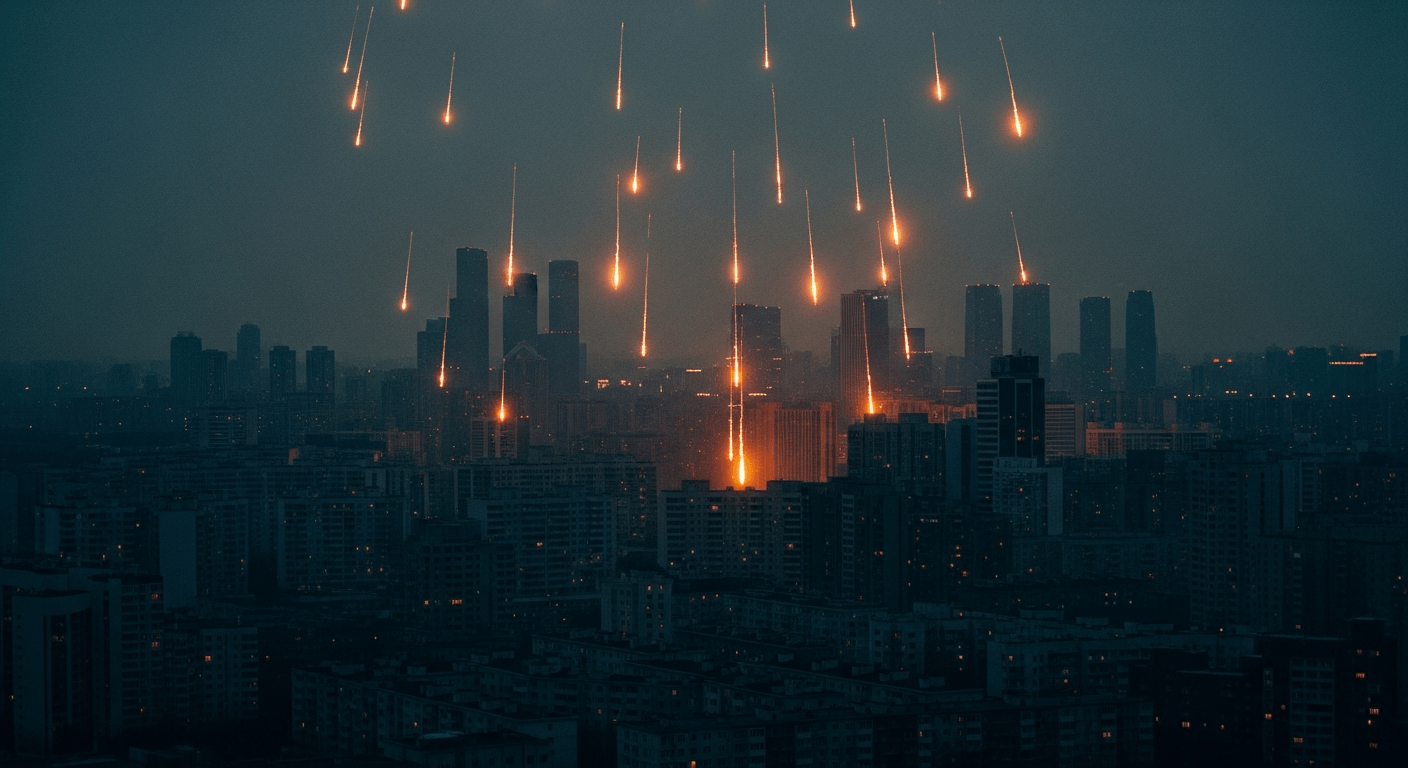
Over the past days I watched and re-watched footage that circulated online showing small, glowing objects descending across the sky over central Israeli cities. Many news outlets and official statements described the images as submunitions released from a ballistic missile carrying a cluster warhead. The broad picture is clear: a missile appeared to open mid‑air, and multiple smaller explosive devices — bomblets — were seen scattering and hitting several locations.
A note of caution: visual material taken in the heat of conflict can be misleading. Debris from intercepted missiles, flare signatures, or separate munitions can look similar on video. I rely on corroborating reporting and statements from authorities and humanitarian organizations to shape the account below rather than any single clip. Still, multiple verified reports and military assessments line up with the conclusion that cluster submunitions were likely involved in recent strikes.
Technical explanation: what cluster munitions are
Cluster munitions are designed to disperse many smaller explosive submunitions from one delivery system — a rocket, missile, artillery shell, or bomb. Instead of one concentrated blast, a single weapon scatters dozens (or in some models, hundreds) of bomblets across a wide area.
Key technical features:
- Delivery and dispersion: the main warhead opens in flight and releases submunitions that fall without guidance.
- Area effect: bomblets are intended to cover a broad zone — useful (from a military perspective) against dispersed manpower, light vehicles, or soft targets.
- Failure rates: a proportion of bomblets often fail to detonate on impact and remain hazardous as unexploded ordnance (UXO).
Different systems vary in submunition count, explosive charge per bomblet, and fuzing mechanisms, but the operational logic is the same: multiple smaller explosions across a wide footprint instead of a single point of destruction.
Legal and humanitarian concerns
Cluster munitions are controversial because their effects are inherently wide-area and indiscriminate in populated settings. The Convention on Cluster Munitions (adopted in 2008) bans their use, production, stockpiling and transfer, and requires clearance and victim assistance for contaminated areas. Many states and humanitarian groups argue the weapons are incompatible with the protections international humanitarian law is meant to guarantee for civilians.
Humanitarian consequences to keep in mind:
- Immediate civilian risk: dispersal across neighborhoods increases the chance of non‑combatant casualties and damage to critical infrastructure.
- Long-term danger from UXO: bomblets that do not explode remain lethal for years, obstructing agriculture, reconstruction and safe movement.
- Clearance burden: locating and neutralizing small bomblets across urban environments is slow, expensive and hazardous for deminers and residents alike.
Why these weapons are tricky for defenses and first responders
From a technical and operational standpoint, cluster warheads complicate both active defenses and post‑strike response.
- Missile defense strain: systems designed to intercept a single incoming warhead can be overwhelmed if that warhead disperses dozens of submunitions. Interceptors that detonate near the main vehicle may still leave bomblets intact or scatter them unpredictably.
- Detection limits: radar and tracking systems have difficulty once a single object becomes many small targets, particularly at lower altitudes and over populated terrain.
- Post‑strike hazard: for emergency services, the pattern of many small impact sites — some with UXO — forces a more cautious and protracted response, delaying rescue and recovery.
Context on Iran and Israel (operational, not historical narrative)
The reported use of cluster payloads in recent missile exchanges reflects an operational choice. For a state using long‑range ballistic systems, adding a cluster warhead changes the tactical effect: it turns a single delivery into a multi‑point threat that can (in theory) increase the likelihood of casualties or infrastructure damage even if some interceptors work.
At the same time, the legal and reputational costs are high. Many international actors treat cluster munitions as a red line because of their long-term humanitarian impact. Whether the perceived military utility outweighs those political and ethical costs is a calculation each user must make — and it is precisely that calculation that escalates tensions and invites international condemnation.
Implications and conclusion
Several implications flow from recent events:
- Defense calculus: defenders must adapt tactics and resources to deal with both the immediate multiplicity of threats and the long tail of UXO clearance.
- Humanitarian footprint: affected areas may face months or years of contamination, with attendant casualties and impediments to recovery.
- Norms and escalation: use of area‑effect weapons in or near population centers risks hardening international positions and could provoke broader responses beyond the immediate battlefield.
I try to hold a few thoughts in balance. Military innovation and adaptation are part of every conflict; yet some innovations carry disproportionate civilian cost. When weapons scatter explosive remnants across towns and fields, the harm can outlive any tactical advantage. If the recent reporting is borne out, what we are seeing is not only a new phase of missile arithmetic — it is also an intensification of the humanitarian problem associated with unexploded submunitions.
We should monitor three practical lines of response: improved detection and clearance capacity where impacts occurred, clearer public guidance to civilians about UXO risks, and renewed diplomatic focus on reinforcing norms that limit weapons with long‑term civilian harm. In the short run the priority is saving lives and securing contaminated areas; in the medium term the priority must be preventing the proliferation of weapons whose effects last long after hostilities pause.
Further reading and resources
- "Video shows Iranian cluster bomb submunitions raining over Israel; why the weapon is tricky" — Times of India: https://timesofindia.indiatimes.com/defence/international/video-shows-iranian-cluster-bomb-submunitions-raining-over-israel-why-the-weapon-is-tricky/articleshow/129304415.cms
- International Committee of the Red Cross — Cluster munitions and international humanitarian law: https://www.icrc.org/en/law-and-policy/cluster-munitions
- Convention on Cluster Munitions (official site): https://www.clusterconvention.org
- Cluster Munition Monitor / ICBL-CMC reporting: https://backend.icblcmc.org/assets/reports/Cluster-Munition-Monitors/CMM2024/Downloads/Cluster-Munition-Monitor-2024-Web.pdf
Regards,
Hemen Parekh
Any questions / doubts / clarifications regarding this blog? Just ask (by typing or talking) my Virtual Avatar on the website embedded below. Then "Share" that to your friend on WhatsApp.
Get correct answer to any question asked by Shri Amitabh Bachchan on Kaun Banega Crorepati, faster than any contestant
Hello Candidates :
- For UPSC – IAS – IPS – IFS etc., exams, you must prepare to answer, essay type questions which test your General Knowledge / Sensitivity of current events
- If you have read this blog carefully , you should be able to answer the following question:
- Need help ? No problem . Following are two AI AGENTS where we have PRE-LOADED this question in their respective Question Boxes . All that you have to do is just click SUBMIT
- www.HemenParekh.ai { a SLM , powered by my own Digital Content of more than 50,000 + documents, written by me over past 60 years of my professional career }
- www.IndiaAGI.ai { a consortium of 3 LLMs which debate and deliver a CONSENSUS answer – and each gives its own answer as well ! }
- It is up to you to decide which answer is more comprehensive / nuanced ( For sheer amazement, click both SUBMIT buttons quickly, one after another ) Then share any answer with yourself / your friends ( using WhatsApp / Email ). Nothing stops you from submitting ( just copy / paste from your resource ), all those questions from last year’s UPSC exam paper as well !
- May be there are other online resources which too provide you answers to UPSC “ General Knowledge “ questions but only I provide you in 26 languages !


No comments:
Post a Comment