
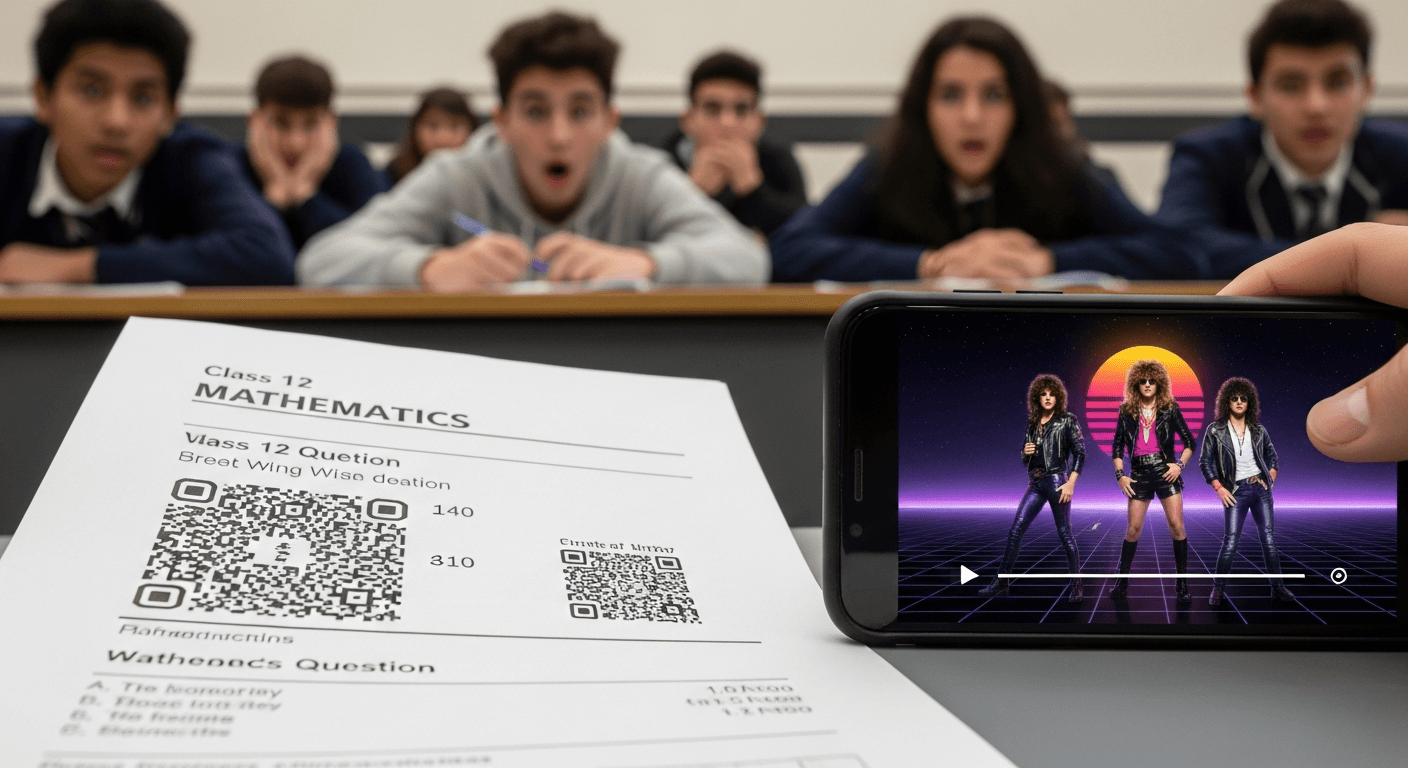
The QR code that became a meme
I woke up to screenshots and messages on March 9 showing that a QR code printed on the CBSE Class 12 maths question paper had, allegedly, redirected students to the old internet prank known as a "Rickroll" — the music video for "Never Gonna Give You Up." The story spread fast across X, Reddit and mainstream outlets: students scanned the QR, expected verification or instructions, and instead got a viral song link. Several outlets covered the episode in real time (India Today, NDTV).
What happened — a short timeline
- March 9: CBSE Class 12 mathematics exam conducted across the country.
- Shortly after the exam: students began posting screenshots and short videos showing a QR code on the question paper. Some scans showed a YouTube link that played the Rickroll song.
- Within hours: the posts went viral; social media users reacted with amusement and concern in near-equal measure.
- Same day: national outlets and fact-checkers reported the viral claims and sought clarification from the Board.
- CBSE responded, saying that QR codes are standard security features and that "in a few question paper sets" scanning one of the QR codes appeared to link to a YouTube video; the Board confirmed the papers were genuine and said steps would be taken to prevent recurrence (News9Live summary of CBSE response).
Reactions: students, parents, media and social platforms
- Students: most posts mixed disbelief with humour — memes and laughing reactions were common. A few expressed worry about whether the paper set they received was authentic.
- Parents: reactions varied from bemused to anxious. For many, the immediate concern was whether the integrity of the exam was compromised.
- Media & social media: the story provided quick viral fodder. Outlets framed it as both a light-hearted internet moment and a potential security head-scratcher for exam authorities.
Possible explanations (balanced view)
- Intentional prank: an unlikely but simple explanation is that someone deliberately generated a QR that points to a public YouTube URL and inserted it into a limited set of printed papers. If true, this points to a failure in printing controls.
- Incorrect QR / human error: QR images are small and can be replaced by similar-looking codes in printing. A substitution at the print shop or packaging stage could explain isolated instances.
- Testing or linking glitch: QR codes can encode short URLs or redirects. If the linked verification service used a misconfigured redirect during a test or migration, a public video link might have been exposed.
At this stage the CBSE has stated that the papers are genuine and that the matter is being investigated. That response is reassuring, but the episode underlines how small technical choices can have outsized reputational impact.
Implications for exam security and trust
QR codes were added to many board papers as an anti-leak, verification and logistics tool. A benign prank — or a printing mistake — still chips away at public confidence. Exam security is not only about preventing leaks; it’s about predictable, auditable operations that maintain trust with millions of students and parents. Even when question integrity is intact, perception matters.
I have written before about the role of technology and surveillance in protecting exam integrity — from CCTV deployment to hybrid digital models for testing (my piece on mandatory CCTV in CBSE exams) and the broader case for secure digital platforms (digital test platforms and exam security). This incident reinforces those themes: tech helps, but processes and audits matter more.
Lessons for exam authorities
- Treat every embedded object (QR, barcode, URL) as a security asset: test, sign and log it.
- Use cryptographic signatures or one-time tokens for QR content so a printed code cannot be repurposed to a public link.
- Enforce strict chain-of-custody at the print and packing stages with random audits.
- Maintain a public verification page that displays the intended QR destination (so students and parents checking later see the expected result).
- Run mock scans and pre-release QA of all paper sets; do not assume a design change is risk-free.
Recommendations — practical steps to prevent repeats
- Replace plain URLs embedded in QR codes with signed, board-controlled redirectors that can be audited and revoked.
- Institute mandatory pre-print verification and random on-site checks at printing facilities.
- Preserve forensic logs: archive every printed sheet’s QR payload and batch identifier.
- Communicate proactively when incidents occur to reduce rumor and panic — transparency builds trust.
Conclusion
This CBSE Class 12 maths QR episode has been an unusual mix of internet culture and exam administration. It’s tempting to laugh at the idea of a Rickroll in a board exam, but the underlying lesson is serious: as boards adopt digital tools for security, they must pair them with rigorous processes and clear communication. Otherwise, a small technical slip can become a headline that undermines confidence in a system serving millions.
Regards,
Hemen Parekh
Any questions / doubts / clarifications regarding this blog? Just ask (by typing or talking) my Virtual Avatar on the website embedded below. Then "Share" that to your friend on WhatsApp.
Get correct answer to any question asked by Shri Amitabh Bachchan on Kaun Banega Crorepati, faster than any contestant
Hello Candidates :
- For UPSC – IAS – IPS – IFS etc., exams, you must prepare to answer, essay type questions which test your General Knowledge / Sensitivity of current events
- If you have read this blog carefully , you should be able to answer the following question:
- Need help ? No problem . Following are two AI AGENTS where we have PRE-LOADED this question in their respective Question Boxes . All that you have to do is just click SUBMIT
- www.HemenParekh.ai { a SLM , powered by my own Digital Content of more than 50,000 + documents, written by me over past 60 years of my professional career }
- www.IndiaAGI.ai { a consortium of 3 LLMs which debate and deliver a CONSENSUS answer – and each gives its own answer as well ! }
- It is up to you to decide which answer is more comprehensive / nuanced ( For sheer amazement, click both SUBMIT buttons quickly, one after another ) Then share any answer with yourself / your friends ( using WhatsApp / Email ). Nothing stops you from submitting ( just copy / paste from your resource ), all those questions from last year’s UPSC exam paper as well !
- May be there are other online resources which too provide you answers to UPSC “ General Knowledge “ questions but only I provide you in 26 languages !



No comments:
Post a Comment