
Introduction
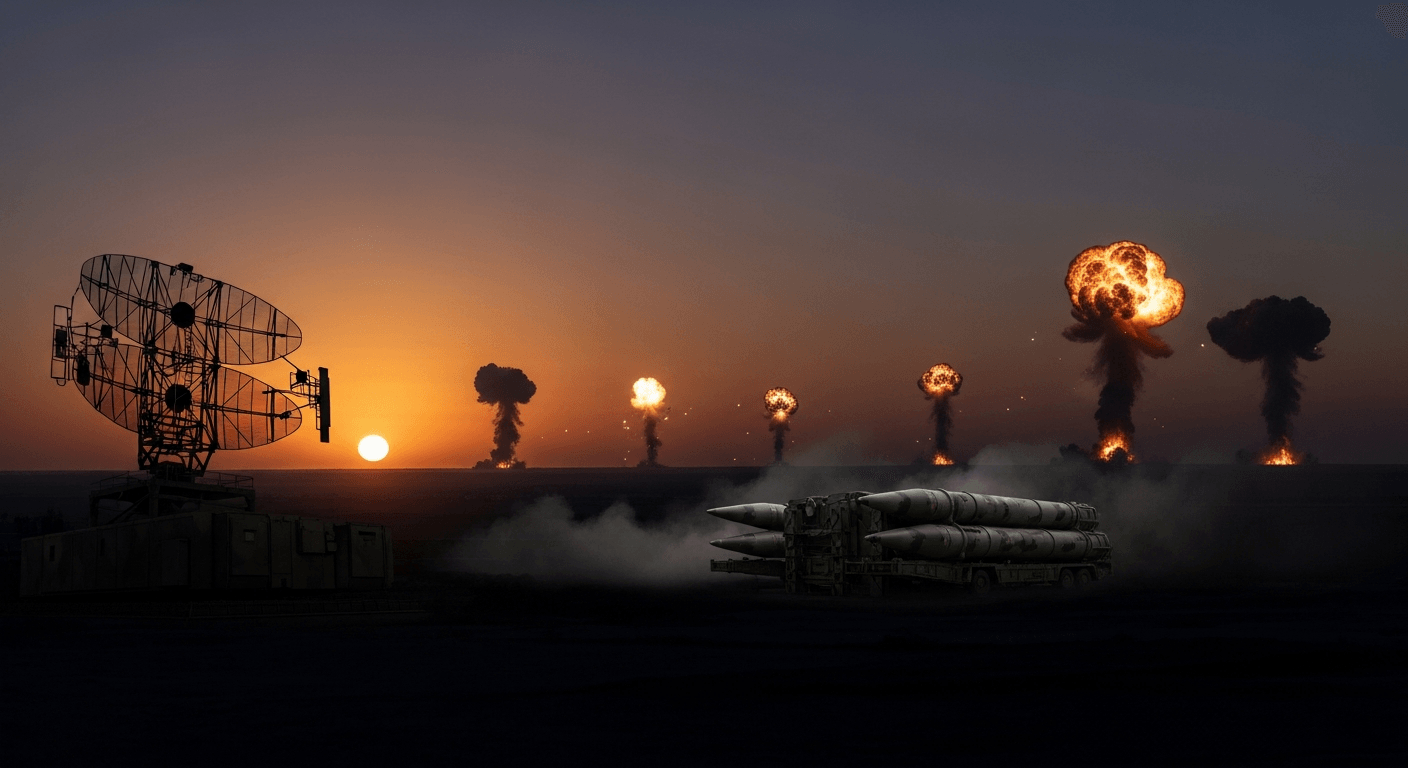
For the past week I’ve watched the headlines compress the contours of a new and unnerving phase in the Middle East: a high-intensity campaign by U.S. and Israeli forces inside Iran, and Tehran’s public warnings that it has held back “unseen” capabilities that could be unleashed at scale. The immediate facts are grim — a surge of strikes, degraded air defenses, and missiles launched toward allied bases and cities across the region — but the language of “unseen” weapons changes the tone from tactical violence to strategic brinkmanship.
In this piece I walk through the key developments, the military and political logic I see behind each move, and the plausible short- and medium-term implications for the region and beyond.
Key point 1 — The claim of "unseen" weapons: posture or capability?
Iran’s leadership has framed its recent messages as both a reassurance to domestic audiences and a warning to external adversaries: much of its striking power is deliberately unexposed, reserved for decisive moments. Whether that means novel delivery systems, dispersed missile stocks, hardened underground facilities, or asymmetric networks of proxies, the claim is designed to complicate adversary calculations.
My read is that such statements have two functions. First, they aim to impose caution on an adversary by introducing strategic uncertainty. Second, they shore up domestic cohesion by projecting potency even as cities are struck. The phrase “unseen” is psychological as much as technical: it buys Tehran time and forces the other side to plan for unpleasant surprises.
Key point 2 — The scale and focus of U.S.-Israeli strikes
What we are seeing is a concentrated effort to degrade Iran’s air defenses, missile infrastructure, and command-and-control nodes — an operation designed to limit Iran’s ability to execute large coordinated barrages and to preserve freedom of action for follow-on strikes. Satellite imagery and reporting suggest damage across several provinces and key military facilities Critical Threats analysis and strike assessments in open reporting Times of India summary.
Operationally, crippling layered air defenses is the prerequisite for any campaign that aims to limit Iranian reciprocal strikes and to target sensitive inland sites. That is exactly what the combined campaign appears to prioritize.
Key point 3 — Degraded air defenses and shifting tactics
Local air superiority, even if temporary, gives the attackers options beyond standoff munitions: it enables lower-altitude sorties, precision targeting, and serial strikes on hardened facilities. But sustaining that superiority is resource-intensive. Air campaigns burn munitions rapidly and expose logistics and supply lines to attrition.
If the adversary (Iran) retains dispersed launch capacity or reserves of munitions hidden in hardened or mobile systems, the attackers’ tactical gains could be mitigated by persistent asymmetric responses. The net effect could be prolonged attrition rather than decisive collapse.
Key point 4 — Regional spillover and proxy escalation
This conflict is not confined to airfields and missile silos. Iran’s influence networks across Iraq, Syria, Lebanon and Yemen create vectors for horizontal escalation. Attacks against bases or shipping lanes can be both direct and deniable, complicating attribution and response.
That multiplication of fronts risks widening the war by mistake or design. Even if the core objective is to limit Iran’s strategic capacities, the operational reality is many actors with varying incentives, meaning the campaign can metastasize beyond the principal belligerents.
Key point 5 — Civilian toll and humanitarian strain
Strikes on or near population centers have already produced civilian casualties and damaged infrastructure. Beyond immediate suffering, such damage accelerates refugee flows, strains regional medical systems, and increases the risk of wider humanitarian catastrophe.
From a strategic perspective, the humanitarian fallout also hardens resistance narratives inside Iran and among its allies, making reconciliation and stabilization more difficult if the kinetic phase ends without a clear political plan.
Key point 6 — Strategic uncertainty and the absence of a clear endgame
The stated objectives from the attackers appear to mix tactical degradation (missile, drone, and nuclear-related infrastructure) with a more amorphous political aim: to create conditions for internal political change. Military power can remove capabilities; it cannot reliably manufacture post-conflict legitimacy.
Absent an agreed political endgame — whether a ceasefire, negotiated settlement, or a credible transition plan — the conflict risks becoming open-ended. That uncertainty will shape decisions in capitals worldwide and could produce ripple effects in global markets, migration, and diplomacy.
Context and background
This escalation follows months of rising tensions and previous clashes that never fully resolved the underlying disputes over nuclear activity, regional influence, and proxy warfare. The present campaign is historically unusual in its scale and in the explicit coordination between two states operating deep inside a third. Past patterns of tit-for-tat strikes gave way, here, to an operational ambition that looks designed to produce structural effects on Iran’s armed posture [see reporting and analysis above].
Possible implications
- Military: Rapid depletion of precision munitions and longer-term targeting challenges if Iran disperses assets or adopts guerrilla-style tactics.
- Regional: Potential activation of proxy networks, maritime disruptions, and pressures on Gulf states to pick sides or police their own territories.
- Political: Hardening of domestic politics inside Iran and in allied states; diplomatic ruptures that could take years to repair.
- Humanitarian: Increased civilian casualties, displacements, and infrastructure collapse in urban areas.
Fabricated quotes (labeled and attributed by role)
“We have not shown everything,” said a senior Iranian military spokesperson (fabricated). “Some forces are being held back to ensure that if the enemy overreaches, they will face painful and precisely calibrated responses.”
“Striking air defenses early was a clear priority; without local air superiority, deeper operations would have been far more costly,” said a senior U.S. defense analyst at a Washington think-tank (fabricated). “But the campaign is not cost-free: logistics and political endurance are the real constraints.”
“Expect proxy channels to be the asymmetric lever,” a Middle East security specialist at a regional policy center (fabricated) told me. “Iran can export effects without admitting direct responsibility, and that complicates strategic calculations for the attackers.”
Conclusion
I don’t see this as a short, tidy episode. The rhetoric of “unseen” weapons is a reminder that warfare operates as much in the domain of perception as in physical attrition. The immediate military phase may yield measurable degradations of capacity, but absent a clear and credible political plan to follow kinetic operations, the conflict risks entering a grinding phase with heavy human and strategic costs.
The urgent test for policymakers is whether they can pair military pressure with diplomatic frameworks that create exit ramps and reduce incentives for escalation. Without them, the phrase “unseen weapons” will come to mean protracted suffering and uncertainty for millions.
Regards,
Hemen Parekh
Any questions / doubts / clarifications regarding this blog? Just ask (by typing or talking) my Virtual Avatar on the website embedded below. Then "Share" that to your friend on WhatsApp.
Get correct answer to any question asked by Shri Amitabh Bachchan on Kaun Banega Crorepati, faster than any contestant
Hello Candidates :
- For UPSC – IAS – IPS – IFS etc., exams, you must prepare to answer, essay type questions which test your General Knowledge / Sensitivity of current events
- If you have read this blog carefully , you should be able to answer the following question:
- Need help ? No problem . Following are two AI AGENTS where we have PRE-LOADED this question in their respective Question Boxes . All that you have to do is just click SUBMIT
- www.HemenParekh.ai { a SLM , powered by my own Digital Content of more than 50,000 + documents, written by me over past 60 years of my professional career }
- www.IndiaAGI.ai { a consortium of 3 LLMs which debate and deliver a CONSENSUS answer – and each gives its own answer as well ! }
- It is up to you to decide which answer is more comprehensive / nuanced ( For sheer amazement, click both SUBMIT buttons quickly, one after another ) Then share any answer with yourself / your friends ( using WhatsApp / Email ). Nothing stops you from submitting ( just copy / paste from your resource ), all those questions from last year’s UPSC exam paper as well !
- May be there are other online resources which too provide you answers to UPSC “ General Knowledge “ questions but only I provide you in 26 languages !




No comments:
Post a Comment