
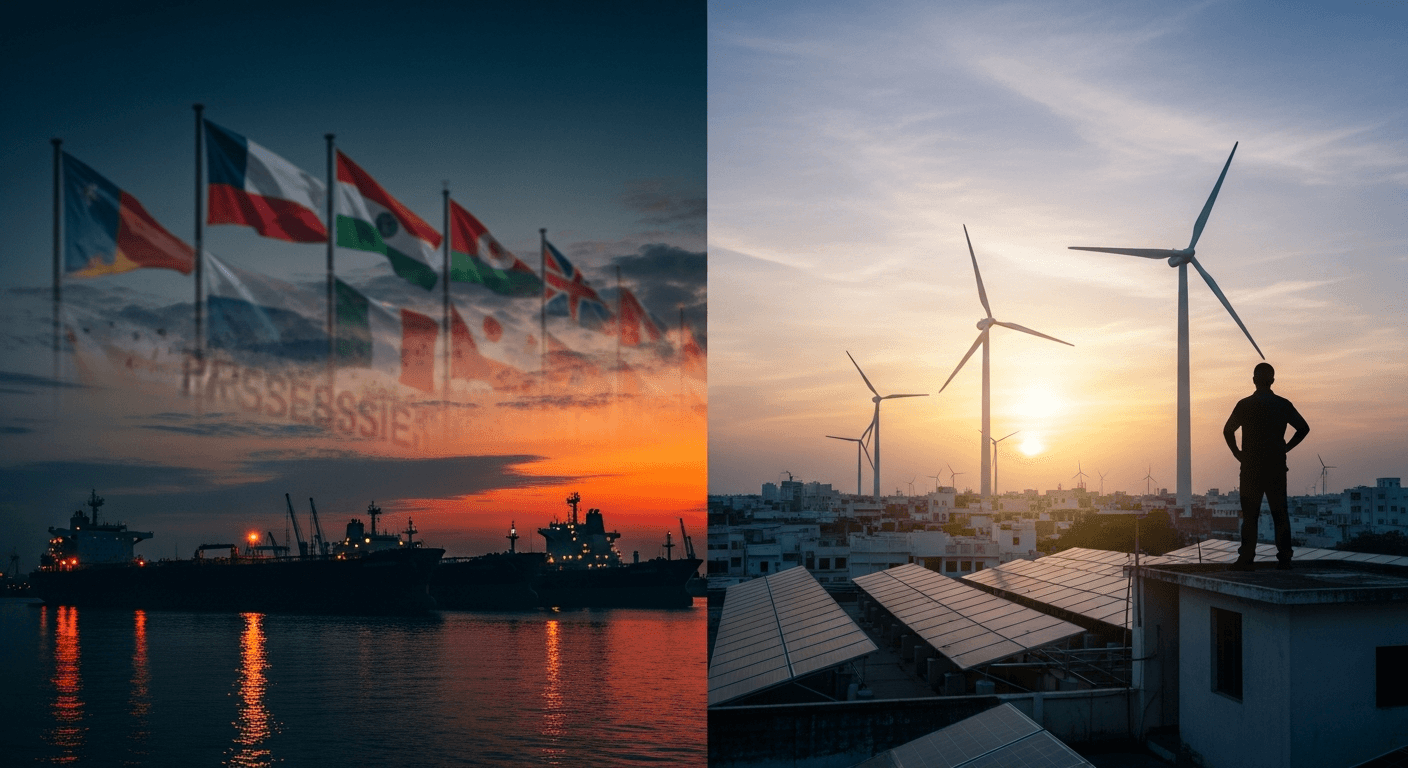
I woke up to headlines about a short, 30-day US waiver that allows Indian refiners to take on stranded Russian crude — and to the Opposition's sharp rebuke: "Kab tak chalega blackmail?" The Congress's critique captures a raw political instinct in India right now: a deep unease about any perception that our energy choices require Washington's blessing [Source].
What happened (briefly)
- The US Treasury issued a narrowly tailored, temporary waiver to permit certain Russian cargoes already at sea to be received by Indian refiners, to avert disruptions to global energy flows.
- The Opposition framed the move as proof of coercion and erosion of sovereignty; several Congress spokespeople asked why India needs “permission” from another power to secure its energy needs [https://timesofindia.indiatimes.com/india/kab-tak-chalega-blackmail-congress-slams-centre-over-us-waiver-allowing-india-to-buy-russian-oil-amid-iran-war/articleshow/129134376.cms].
A note on voices inside the story
I will let one named voice stand in for the domestic criticism. Manish Tewari (manish.tewari@inc.in) asked bluntly whether India had become a "banana republic" that needed permission to decide its energy mix. That question — sharp, political, and rhetorically effective — is the kind of challenge any government must answer clearly and convincingly.
Why this stirred such a reaction
- Perception of sovereignty: Energy decisions feel existential for a nation. When a major power phrases an exception or a waiver, critics interpret it as leverage over our strategic autonomy.
- Geopolitics of supply: The waiver came amid real risks to shipping through the Gulf — a genuine short-term problem for fuel flows. Pragmatism (keeping refineries fed and consumers sheltered from price shocks) bumps up against principle (not bowing to external pressure).
- Domestic politics: Opposition parties can turn complex diplomacy into a simple moral frame: sovereignty vs external control. That resonates with voters.
My take — practical sovereignty is not just rhetoric
Sovereignty is more than insisting on absolute freedom in every transaction; it is also the capacity to absorb shocks without begging for temporary relief. A one-month waiver to clear stranded cargoes is tactically sensible to stabilise markets, but it also exposes a structural truth: we remain heavily dependent on global hydrocarbon flows.
I have argued before that energy independence is the most durable expression of true strategic autonomy. In earlier pieces I wrote about moving decisively to renewables, storage, and regional cooperation as a hedge against geopolitical blackmail (see my earlier essay on round‑the‑clock solar and storage Unlimited Power: and Round the Clock?). That remains my conviction: the fewer chokepoints we rely upon, the less leverage external actors have.
What India should do (practical policy checklist)
- Accelerate renewables + storage: Scale solar and grid-scale storage to reduce import dependence. Invest in battery and alternative storage R&D and manufacturing.
- Strategic stock and logistics: Expand strategic petroleum reserves and diversify receipt points (more VLCC-ready terminals, more crude-swap arrangements).
- Diplomatic clarity: When Washington or others offer temporary measures, New Delhi should use such windows to explain its roadmap — so short-term fixes don't look like surrendered agency.
- Trade and energy diplomacy: Convert commercial ties into mutually beneficial supply contracts with multiple partners, reducing single-point leverage.
A final reflection
Politics will rightly ask sharp questions: was the government too pliant, or was it pragmatic? My answer is: both are possible simultaneously. Pragmatism without a longer-term plan becomes dependency. Sovereignty without pragmatic crisis management becomes vanity.
So the right test for our leaders is simple: use every temporary concession or waiver as an impetus to make permanent strategic changes. That is how you convert a defensive moment into forward momentum.
Regards,
Hemen Parekh
Any questions / doubts / clarifications regarding this blog? Just ask (by typing or talking) my Virtual Avatar on the website embedded below. Then "Share" that to your friend on WhatsApp.
Get correct answer to any question asked by Shri Amitabh Bachchan on Kaun Banega Crorepati, faster than any contestant
Hello Candidates :
- For UPSC – IAS – IPS – IFS etc., exams, you must prepare to answer, essay type questions which test your General Knowledge / Sensitivity of current events
- If you have read this blog carefully , you should be able to answer the following question:
- Need help ? No problem . Following are two AI AGENTS where we have PRE-LOADED this question in their respective Question Boxes . All that you have to do is just click SUBMIT
- www.HemenParekh.ai { a SLM , powered by my own Digital Content of more than 50,000 + documents, written by me over past 60 years of my professional career }
- www.IndiaAGI.ai { a consortium of 3 LLMs which debate and deliver a CONSENSUS answer – and each gives its own answer as well ! }
- It is up to you to decide which answer is more comprehensive / nuanced ( For sheer amazement, click both SUBMIT buttons quickly, one after another ) Then share any answer with yourself / your friends ( using WhatsApp / Email ). Nothing stops you from submitting ( just copy / paste from your resource ), all those questions from last year’s UPSC exam paper as well !
- May be there are other online resources which too provide you answers to UPSC “ General Knowledge “ questions but only I provide you in 26 languages !




No comments:
Post a Comment