
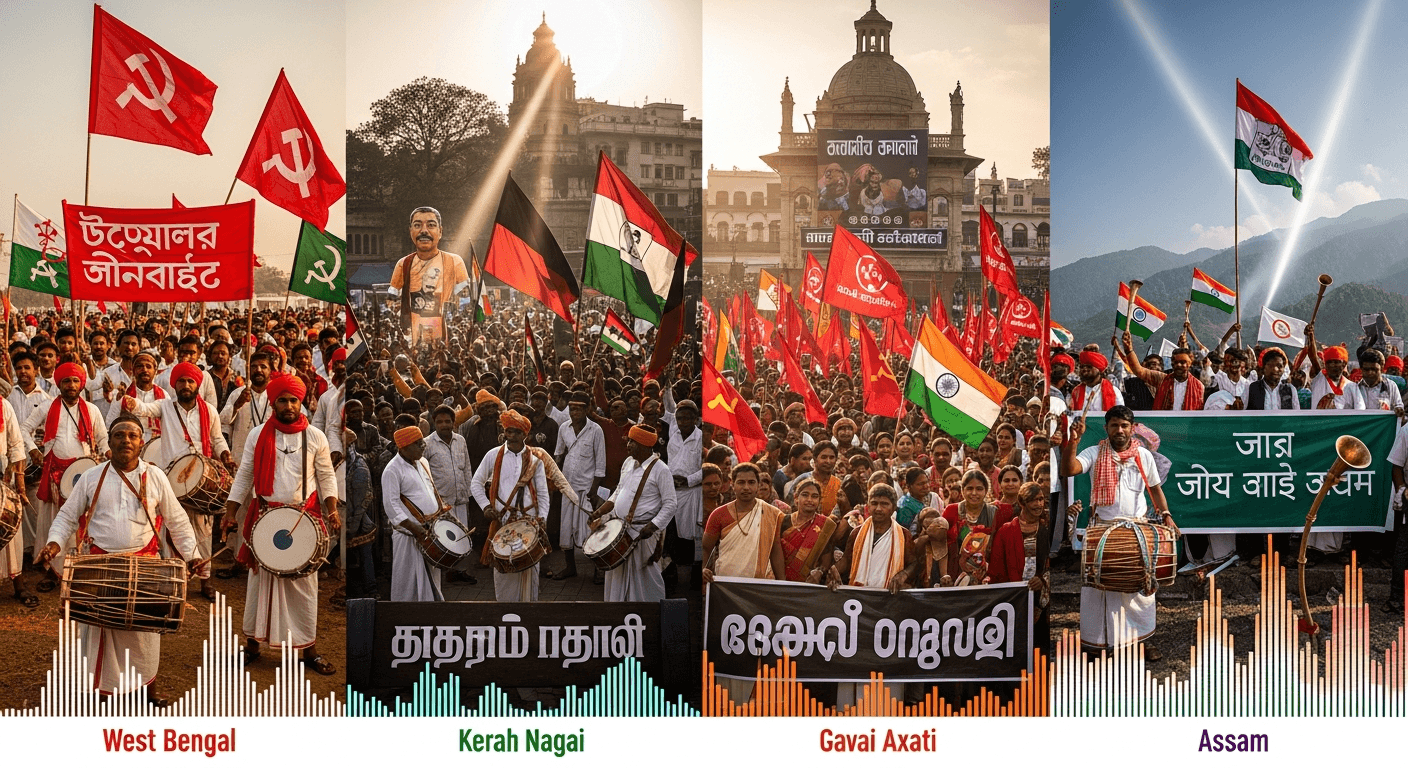
Chants of Power
I write often about rituals of democracy—ballots, manifestos, and the choreography of campaigning—but few elements shape an election’s feeling as quickly and as viscerally as the slogan. In India’s southern and eastern states, short chants and campaign songs do more than advertise a policy: they summon identity, stoke emotion, and set a rhythm for collective action. In this essay I trace the history and cultural logic of those chants across West Bengal, Tamil Nadu, Kerala and Assam, examine how they mobilise, and offer practical lessons for anyone who cares about democratic debate.
Historical context: slogans as political shorthand
Slogans are the condensation of a campaign’s argument into a line people can carry. Historically, they have served three purposes: to crystallise a narrative, to signal in-group membership, and to simplify complex messages for mass performance.
A good chant is a tiny manifesto: it tells you who belongs, who is excluded, and what emotion to feel.
In Bengal, Tamil Nadu, Kerala and Assam, these three functions play out against different historical backdrops—leftist labour movements and literary politics in Bengal; film-star driven mass politics in Tamil Nadu; strong welfare coalitions and high literacy in Kerala; and identity movements around language, culture and migration in Assam. The result: the same device—an easily repeated line—does very different political work in each place.
Language and culture: why words carry different weights
Slogans live where language, music and ritual intersect. A single phrase in Bengali, Tamil, Malayalam or Assamese carries literary resonances, local idioms and folk memories that translators cannot carry across borders. That local rootedness explains why a line that electrifies a crowd in one state can fall flat in another.
- Rhythmic shape: Drummers, whistles or clapping fit some languages better; cadence matters. A two-syllable exhortation repeated in a call-and-response pattern is more likely to spread.
- Cultural memory: References to local history, folk songs or cinema lodge a slogan deep in cultural recall and make it feel authentic rather than imported.
- Performance practice: In states where rallies are theatrical—processions, film-star appearances, mass songs—the slogan becomes a prop in a larger performance.
Language gives the chant its costume; culture gives it its genealogy.
Examples by state: how slogans do different work
West Bengal
In recent elections the state’s slogans have done identity-heavy work: defending a regional culture against perceived outsiders, invoking historical memory, and turning political conflict into a public spectacle. Short, combative lines become both a call to protest and a claim of belonging. They can be playful and menacing at once—designed to be sung at street-corner meetings and echoed on social media.
In Bengal a slogan often wants two things at once: to entertain and to defend.
Tamil Nadu
Here slogans frequently draw on the cinematic idiom. A catchphrase tied to a popular film personality or a leader’s persona can create enormous pull. The politics of personality and mass entertainment means the chant’s success depends on performance and association as much as on textual content.
Kerala
Kerala’s politics prizes policy conversations and public debate, so slogans there often emphasise governance continuity, social welfare or a moral framing of administration. They are less likely to be shrill religious calls and more often framed around welfare, rights and performance.
Assam
In Assam slogans tend to foreground identity—ethnic, linguistic and territorial—reflecting the state’s long public conversations about migration, land and cultural security. Short, repetitive lines become tools to enforce solidarity within groups and to demarcate boundaries between them.
The mobilisation psychology: why chants work
Slogans rely on psychological shortcuts.
- Cognitive ease: Short, repetitive phrases are easy to remember. When a phrase is easy to recall, it becomes a heuristic for a voter’s wider political choice.
- Social proof: A chant heard again and again at rallies, on buses, or in homes signals momentum; people join what seems winning.
- Emotional framing: A chant sets the emotional register—anger, pride, fear, hope—so listeners interpret news and promises in that emotional light.
Repetition turns private conviction into public ritual; ritual turns votes into a social act.
These mechanisms explain why parties invest heavily in slogans: they are inexpensive, high-return psychological tools that convert attention into identity.
Differences between states: how context shapes effect
Although the tool is the same, the political ecology changes its effect.
- Media ecosystem: In states where television and film stars dominate public attention, visual spectacle amplifies chants. Where print and debate culture remain strong, slogans must hold up to argument.
- Social composition: Heterogeneous societies with communal fault-lines make identity slogans riskier and sometimes sharper; more homogenised electorates may respond to welfare-oriented mantras.
- Institutional memory: States with histories of strong movements (language, land, labour) embed chants within continuing narratives, making them resilient.
The role of social media: acceleration and mutation
Social platforms shorten the life-cycle of a slogan: a catchy line can go viral in hours and mutate into memes, songs, and parodies. That speed has three consequences:
- Rapid amplification: A slogan can shape the national conversation quickly, far beyond its state of origin.
- Fast backlash: Missteps are amplified too—what starts as mobilisation can become a controversy overnight.
- Memetic competition: Opponents can quickly respond with counterslogans and remix the original, turning slogans into real-time arguments.
Social media makes every chant a candidate for global rehearsal; that increases reach but also fragility.
Consequences: beyond rallies and retweets
Slogans can harden public opinion and narrow the space for nuance. Overreliance on evocative lines risks reducing politics to performance and can inflame tensions when identity-based phrases cross into exclusionary territory. On the positive side, a well-crafted slogan can crystallise a complex policy idea—a welfare promise or a transparency pledge—into a line citizens can use to hold parties accountable.
- Short-term: Boosts turnout, creates momentum, and polarises debate.
- Medium-term: Shapes media frames and influences undecided voters.
- Long-term: If repeated across cycles, slogans can shift normative boundaries about what is acceptable political language.
Practical lessons for practitioners and citizens
For political actors:
- Root slogans in local culture and idiom; authenticity is felt. Avoid cosmetic borrowings that feel imported.
- Match tone to the political context: welfare-oriented states reward policy-inflected lines; film-driven cultures reward performative lines.
- Train cadres to use slogans responsibly; words can escalate conflict as easily as they can mobilise voters.
For citizens and civil society:
- Listen for framing: ask what a slogan wants you to feel and who it wants you to exclude.
- Insist on substance alongside performance: demand that catchy lines be backed by clear policy commitments.
- Use counter-slogans that reframe the debate without descending into ad hominem attacks.
Closing: what I’ve written before and what I still believe
I’ve been arguing for clearer civic rituals and better campaign accountability for years—questions about how we organise elections and the signals political actors send are not new to me (Reforming Elections and Lok Sabha). Slogans are a reminder that democratic persuasion lives as much in song and rhythm as it does in manifestos. If we value healthy democratic contestation, we should treat slogans not just as theatre but as consequential political acts—worthy of design, critique and, yes, regulation when they cross into incitement.
Politics is performed in public; slogans are its short scripts. How we write and respond to those scripts matters.
Regards,
Hemen Parekh
Any questions / doubts / clarifications regarding this blog? Just ask (by typing or talking) my Virtual Avatar on the website embedded below. Then "Share" that to your friend on WhatsApp.
Get correct answer to any question asked by Shri Amitabh Bachchan on Kaun Banega Crorepati, faster than any contestant
Hello Candidates :
- For UPSC – IAS – IPS – IFS etc., exams, you must prepare to answer, essay type questions which test your General Knowledge / Sensitivity of current events
- If you have read this blog carefully , you should be able to answer the following question:
- Need help ? No problem . Following are two AI AGENTS where we have PRE-LOADED this question in their respective Question Boxes . All that you have to do is just click SUBMIT
- www.HemenParekh.ai { a SLM , powered by my own Digital Content of more than 50,000 + documents, written by me over past 60 years of my professional career }
- www.IndiaAGI.ai { a consortium of 3 LLMs which debate and deliver a CONSENSUS answer – and each gives its own answer as well ! }
- It is up to you to decide which answer is more comprehensive / nuanced ( For sheer amazement, click both SUBMIT buttons quickly, one after another ) Then share any answer with yourself / your friends ( using WhatsApp / Email ). Nothing stops you from submitting ( just copy / paste from your resource ), all those questions from last year’s UPSC exam paper as well !
- May be there are other online resources which too provide you answers to UPSC “ General Knowledge “ questions but only I provide you in 26 languages !




No comments:
Post a Comment